


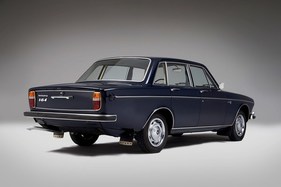
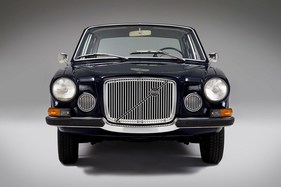

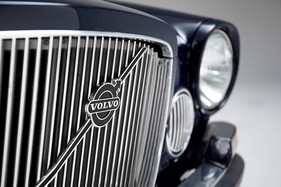


The Swedish premium car manufacturer returned to the luxury class in 1968 with the luxurious Volvo 164 saloon. Based on the Volvo 140, the elegant four-door model met the highest demands in terms of comfort, safety and technology with many exclusive features, the pioneering safety passenger cell with calculated crumple zones and a powerful six-cylinder engine. The most important export market for the prestigious Volvo 164 was the USA, but the Swedish prestige saloon was also successful in Germany.
While the year 1968 was characterized by revolutionary social changes in many countries, Volvo concentrated on the market launch of its new top model, the Volvo 164, in Gothenburg, Sweden.

For some time, Volvo had been pursuing the idea of designing a somewhat larger and more exclusive model. At the end of the 1950s, there were plans for a large, luxurious Volvo with a V8 engine and a powerful, vertically shaped radiator grille. However, when a study revealed that the future would belong to compact vehicles, particularly in the USA, Volvo abandoned this project in 1960. It was not until the Volvo 140 presented in 1966 that a new development project was launched. An in-line six-cylinder engine in the body of the Volvo 140 resulted in the perfect combination of compact forms and great prestige and thus exactly what the market demanded.
Compact prestige saloon with premium engine

Chief designer Jan Wilsgaard used the chassis of the Volvo 140 and combined it with the front design of the prototype P358 from the 1950s. The Volvo brand emblem (Iron Mark) was placed prominently on the radiator grille. It sat on the diagonal typical of the brand, just like on the very first Volvo from 1927 and just as it is used today.
In order for the newly developed B30 in-line six-cylinder engine to fit on the chassis of the Volvo 140, it was extended by ten centimeters from the windscreen. The six-cylinder engine had a displacement of three liters and developed an output of 107 kW (145 hp) thanks to a Zenith-Stromberg twin carburetor.
The press release for the presentation of the Volvo 164 in August 1968 also proudly referred to the German ZF gearbox, whose relatively short gear selector lever was ergonomically positioned in the middle of the cardan tunnel between the front seats.
Luxurious interior with exquisite materials

The interior of the Volvo 164 was of even higher quality than in the Volvo 140 and included seats upholstered in thick wool fabric, textile floor mats and two individual seats in the rear with a folding center armrest. In the second year of production, the Volvo 164 even received leather upholstery, headrests and additional halogen headlights integrated into the front mask as standard. Tinted windows, electric windows, an electric sunroof and air conditioning were also available for the American market.
A Swedish luxury sedan for American individualists

In a test report on the Volvo 164 published in July 1969, the American trade magazine "Car and Driver" also addressed the potential buyers of the Swedish prestige sedan: "Volvo is trying to get its customers out of the showrooms of Buick, Oldsmobile and Mercedes and is succeeding in doing just that. The new Volvo customers are freelancers - doctors, lawyers, dentists ... people who can afford something special." An American advertisement for the Volvo 164 also addressed this theme: "The luxury car that shows you have more than just money."
Over the course of its life, the Volvo 164 was continuously further developed, including the introduction of electronic fuel injection in the 1972 model year. Incidentally, the entire production of the last model year was exported to the USA in 1975. By this time, the successor to the Volvo 164, the Volvo 264 model series, had already gone into production.
Five little-known facts about the Volvo 164:

1. only one Volvo 164 was converted into an ambulance. Volvo Cars Special Vehicles developed this prototype with a high body and extended wheelbase. Although it remained a single vehicle, this Volvo 164 became the forerunner of the ambulances that were later built on the basis of the Volvo 265.
2 Volvo 164 production was relocated to Kalmar in 1974. The production processes at the new Volvo plant were far ahead of their time. For example, the cars were not transported on an assembly line, but on battery-powered trolleys that were guided by guide cables embedded in the floor. The workers built the cars as a team, regularly changing production tasks and responsibilities within the team.
3. the prototype of the luxury Volvo 262C coupé built in Italy was based on a Volvo 164. coachbuilder Coggiola transformed the saloon into a two-door coupé, which was already largely similar to the later production model. One important difference, however, remained the front design of the prototype in the style of the Volvo 164.
4 The B30 six-cylinder engine of the Volvo 164 was also used in various off-road military vehicles. Volvo Penta also produced a marine version of the B30 engine with three carburetors.
5 At the 1970 Geneva Motor Show, the Italian coachbuilder Zagato adorned its stand with the 3000 GTZ prototype. This sports coupé had the B30 engine under the hood and was technically based on the Volvo 164. It is said that the only prototype built still exists today.
