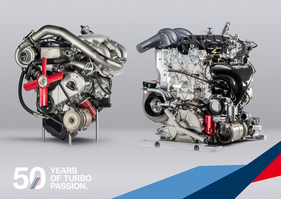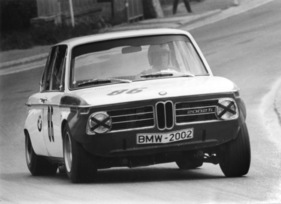
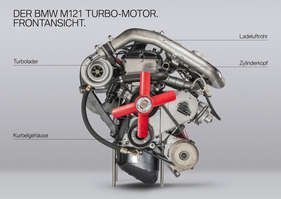
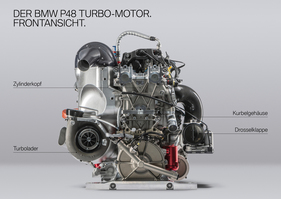
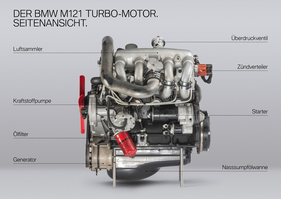
BMW turbo power in motorsport is a success story - and has been for 50 years. In 1969, BMW secured the title in the European Touring Car Championship with Dieter Quester (AUT) in the BMW 2002 TI, doing pioneering work and making history in the process.
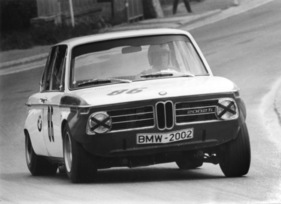
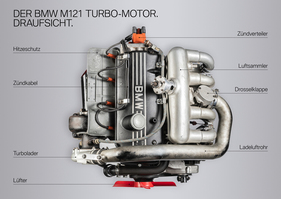
The first BMW turbo in racing with the type designation M121 provided the necessary propulsion.

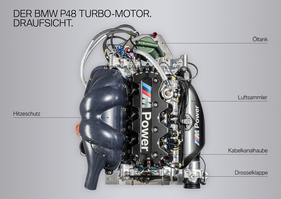
After many other BMW turbo engines, the completely newly developed BMW P48 engine in the BMW M4 DTM according to Class 1 regulations will celebrate its premiere half a century later at the DTM season opener in Hockenheim (GER) at the beginning of May. Times have changed, but the outstanding characteristics of the engine have remained the same.
Then and now - four-cylinder with turbocharger
Despite the 50 years that lie between them, the two high-performance engines have a few things in common: Both are four-cylinder in-line engines with a displacement of two liters and a turbocharger. In both the BMW M121 and the P48, the sensitive engine components have to be protected from the waste heat of the turbocharger by a heat shield. A mechanical injection pump is responsible for supplying the engine with fuel.
Twice as much power with lower consumption
However, the respective values for the pressure at which the combustion air is supplied to the engine are hardly comparable: With 0.98 bar overpressure, the first-generation turbo racing engines achieved around 280 hp at 6,500 rpm. Although the exhaust blower was theoretically capable of developing a boost pressure of 1.76 bar, the pressure in the cylinder would have been so enormous that the cylinder head would have lifted. Today, boost pressures of up to 2.5 bar are possible with more than 600 hp. The crankcase and cylinder head were manufactured in a special sand casting process at the BMW foundry in Landshut.
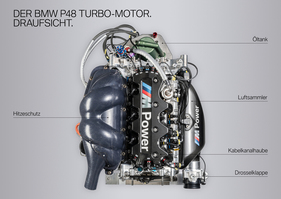
Components such as the ignition distributor, fan, wet sump oil pan and a pressure relief valve have now disappeared from the engine. There is no longer a direct charge air pipe that feeds the compressed air to the engine without cooling. Instead, the P48 has a sophisticated dry sump system. The oil required for lubrication in the engine is immediately extracted again without oil pan losses. The oil tank, which is attached directly to the engine, is also part of this system. An efficient charge air cooling system also increases performance and efficiency.
Auxiliary units such as the starter and generator are no longer mounted on the engine, but on the rear-mounted transaxle gearbox. Carbon fiber-reinforced plastic has replaced the old welded cast aluminum construction on the air manifold. In addition, the throttle valve is moved electrically and no longer via a mechanical throttle linkage. Instead of open ignition cables, the electrical cables in the P48 are protected in a cable duct cover also made of carbon.
One of the most efficient BMW racing engines of all time
One of the key issues surrounding the P48 is its extremely good fuel consumption. As the permitted fuel flow is limited by the regulations, every fuel saving means an increase in performance and was tracked in detail.
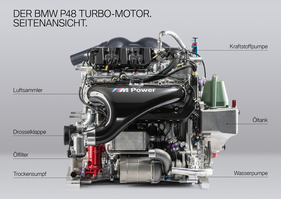
Compared to its already very efficient predecessor, the engine was almost 10 percent more efficient, and even more than 50 percent compared to the M121 from 1969. The high-pressure direct injection known from the BMW series engines contributed to this, as did a mixture preparation and combustion process tested in many simulations and trials, which allows operation in so-called "lean operation".
Consistent minimization of friction losses, e.g. through the aforementioned oil system, and the use of highly heat-resistant components that do not require cooling by fuel, make the P48 one of the most efficient BMW racing engines of all time.
BMW turbo engines guarantee maximum sportiness
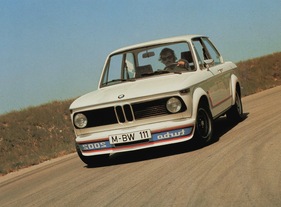
Nevertheless, even the original turbo from 1969 has nothing to hide when it comes to performance: As the developers were not allowed to increase the displacement of the BMW 2002 TI, the power had to be increased in a different way. The engine no longer sucked in its mixture itself, but it was blown into it. The exhaust gas turbocharger was used for this purpose. This turned the BMW 2002 TI into a genuine sports car with a top speed of 240 km/h.
This was followed in 1973 by the BMW 2002 turbo, the first series-produced German car with an exhaust gas turbocharger.
The next chapter in BMW's turbo history in motorsport is now being opened in the DTM. The Class 1 regulations mark the beginning of a new era, particularly in technical terms.
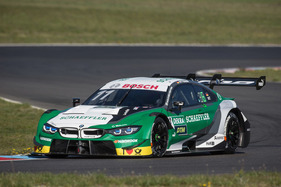
The previous V8 engines are being replaced by more powerful four-cylinder turbo engines. The sound of the new turbos is great, the performance impressive. But its most brilliant feature is its efficiency. At 85 kilograms, the fuselage engine of the new turbo units weighs almost half as much as its predecessor. The lightweight engine impresses with impressive figures compared to the DTM engines used to date: Half the displacement, higher performance, lower fuel consumption.
Figures, data and facts about the new BMW P48 engine
- Type: P48, R4 turbo engine with direct injection
- Displacement: 1999 cc
- Weight: 85 kg (basic weight according to regulations)
- Bore: between 86 and 90 mm
- Speed: max. 9500 rpm
- Power: over 600 hp
- Running time: over 6000 km (per season)
- Fuel quantity limiter: 95 kg/h due to regulations, 100 kg/h during push-to-pass function
- Further specifications: Cylinder block and cylinder head in cast aluminum from the BMW foundry in Landshut, crankshaft in steel, four valves per cylinder, actuated via finger followers, camshafts in steel, driven via gear wheels, high-pressure direct injection, as with BMW series engines at 350 bar, dry sump system
Despite the significant increase in performance of approx. 100 hp, the engine is designed for reliability and durability and lasts around 6000 kilometers. 1.5 engines may be used per vehicle during the season. With the "Push-to-Pass" system, an additional 5 kg/h of fuel can be provided for a period of five seconds in 2019, resulting in a power increase of around 30 hp.
The P48's turbocharger pushes 400 liters of air per second into the engine - 3500 times as much as a person breathes. The pistons accelerate from zero to 100 km/h in less than a thousandth of a second - 1200 times faster than a moon rocket. The water pump converts around 18,000 liters in one hour. This would fill a bathtub in around 20 seconds. 1,005 drawings were made for the final assembly of the motor, which consists of around 2,000 individual parts. Lined up, they cover the floor of a 250 square meter apartment.
The BMW P48 and the Class 1 regulations marked the dawn of a new era in touring car racing. Just like its ancestor from 1969, the turbo ignites - today as it did 50 years ago.