


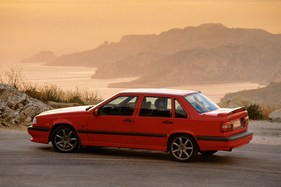


This Volvo changed the brand: the Volvo 850 was the first model of the Swedish premium brand to combine a dynamic front-wheel drive layout with transverse-mounted five-cylinder engines with up to 250 hp. A revolutionary drive combination for Volvo, which had been developed in the Galaxy research program. The declared aim of Galaxy was to reach for the stars and the Volvo 850 did indeed enter new technical galaxies. This included several safety innovations, sensational motorsport successes and, in the Volvo 850 AWD, a variable four-wheel drive with viscous coupling as the forerunner of today's electronically controlled all-wheel drive system Instant Traction®. With the Volvo 850, Volvo took a great leap forward and transformed its image into a premium manufacturer of desirable cars that transported far more than family and leisure.

"A dynamic vehicle with four world firsts"
The Volvo 850 GLT celebrated its spectacular world premiere on June 11, 1991 in Stockholm's Globe Arena. A fitting premiere platform for the completely new Volvo mid-range model from the Galaxy development program. After all, Galaxy stood for one of the largest development investments in Swedish industrial history.

In fact, Volvo had never before introduced so many technical innovations as in the Volvo 850, which was decisive for the future of the brand. Although the angular design of the Volvo 850 conveyed a recognizable relationship to the successful Volvo 740 and Volvo 940 model series, it was completely new and significantly more dynamic. Unlike these traditional model series with rear-wheel drive, the Volvo 850 offered a driving pleasure never before experienced in this form. The slogan "A dynamic vehicle with four world firsts" already proclaimed this at the market launch.
Efficient five-cylinder engines for the "safest car in the world"
These four world firsts among the technical highlights of the Volvo 850 were transversely mounted, powerful yet efficient Volvo five-cylinder engines driving the front wheels and a newly developed Deltalink rear axle, which combined the dynamic qualities and ride comfort of independent suspension with the exceptional robustness of a rigid axle. Added to this were the innovative SIPS (Side Impact Protection System) side impact protection and the ARH (Automatic Retractor Height Adjustment) seat belt height adjustment for the front passengers. Important new safety features that contributed to the press calling the Volvo 850 "the safest car in the world" right from the start. Volvo extended this lead once again in 1995 with a further safety development: From this point onwards, the Volvo 850 became the first mass-produced car in the world to be fitted with side airbags.

Only rarely do new cars set so many milestones, but the Volvo 850's journey from the first concepts to market launch was correspondingly long. Development work on the Volvo 850 began back in 1978, when Volvo decided at one of its very first meetings to think along completely new lines and completely detached from previous specifications in order to reach for the stars. This resulted in the project name Galaxy.
Two new model series
Galaxy led to two new Volvo model series, one Swedish and one Dutch. Initially, the technology on which both model series were based was developed jointly in the Galaxy program, after which the Galaxy teams split up. The Dutch Volvo Car B.V. now developed the Volvo 400 models to series maturity, while Volvo Cars in Sweden finalized the Volvo 850.

The Volvo 850 GLT was the first model to be presented with a 170 hp five-cylinder naturally aspirated engine with innovative four-valve technology. Even at an early stage of development, Volvo placed particular emphasis on making the Volvo 850 GLT a dynamic vehicle for exceptional driving pleasure. This even included details such as the characteristic intake noises of a naturally aspirated engine and an appropriate exhaust sound. An effort that paid off, as the Volvo 850 immediately earned enthusiastic test reports in the trade press and a flood of media awards.
Perfectly shaped station wagons with room for racing success and powerful turbos
The next important version of the Volvo 850 to make its debut in February 1993 was the estate, which shone with typical Volvo features such as a vertically sloping rear end for maximum load volume. A unique and completely new design feature in this form, on the other hand, were the huge vertical rear lights that covered the entire D-pillar. The decision for these striking light units was made during development work, when chief designer Jan Wilsgaard set up an estate model on which lights of different sizes could be fitted for comparison purposes. An effort that paid off. The large, vertical rear lights turned the five-door Volvo 850 into a perfectly shaped estate car that was awarded design prizes. First and foremost the coveted Japanese "1994 Good Design Grand Prize" and the Italian "Most Beautiful Estate Car" award.

The engine range for the Volvo 850 was quickly expanded, from the Volvo 850 GLT, which was initially only available with a five-cylinder petrol engine, to a broad product portfolio with an innovative direct-injection diesel engine and the most powerful Scandinavian turbo of all time. This exceptional performer made its debut at the 1994 Geneva Motor Show. With its unmistakably eye-catching yellow paintwork, the Volvo 850 T 5R looked like an exclamation mark on wheels. Under the hood was a 240 hp turbocharged five-cylinder engine with intercooling, which provided an impressive torque of 330 Nm. The standard equipment of these performance sports cars included special spoilers, a square exhaust tailpipe and 17-inch Titanium series aluminum wheels.
One of the fastest estate cars ever
The Volvo 850 T 5R was originally intended to be built in a special series limited to 2,500 units, but the yellow saloons and estates sold out within a few weeks. This was followed by the same number of black vehicles and finally a final series of 2,500 Volvo 850 T 5Rs painted dark green. Only the Volvo 850 R with 250 hp, which was launched in 1996 as a saloon and estate, was even more powerful. In test reports, the German press celebrated the five-door model, which could reach speeds of up to 250 km/h, as one of the fastest estate cars ever.

1994 was also the year in which Volvo returned to the racetracks with a unique eye-catcher. When two Volvo 850s rolled onto the starting line at the season opener of the British Touring Car Championship BTTC in Thruxton in the south of England, the spectators could not believe their eyes: instead of the expected Volvo 850 saloons, the Swedes were competing with the world's first racing touring cars with estate bodywork. With the sensational Volvo 850 station wagons, the BTTC became one of the most popular racing series in Europe in 1994. In cooperation with Tom Walkinshaw Racing, Volvo invested heavily in this motorsport commitment and signed up the Swede Rickard Rydell and the Dutchman Jan Lammers to drive the two cars. Unfortunately, a change in the racing regulations in the 1995 season prevented the Volvo 850 station wagon from competing again, so Volvo switched to the sedan. Rickard Rydell took third place in the championship that season.

After more than five years of production, the successful Volvo 850 was further developed into the Volvo S70 saloon and the Volvo V70 estate for the 1997 model year. A total of 1,360,522 vehicles of all model versions based on the Volvo 850 were built.
