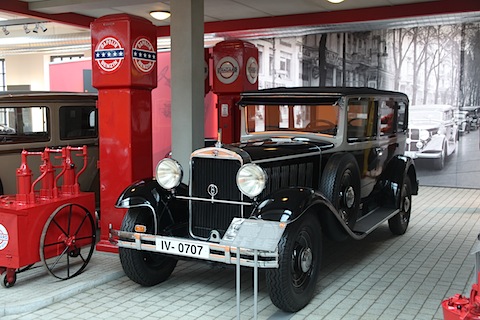
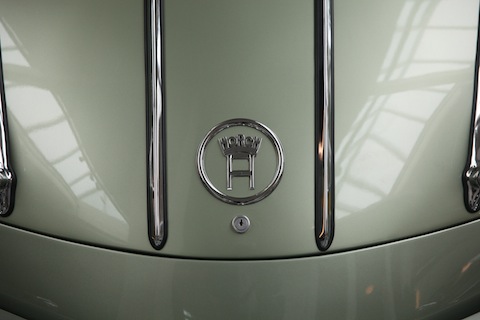
The August Horch Museum in Zwickau was mentioned in an Zwischengas report back in 2012. Even then, it was noted that you can learn a lot there on an entertaining tour. A lot has changed since that first visit and the museum has become even more attractive.

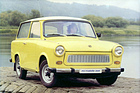
Visitors are now greeted by the Tabant monument in the parking lot, which reminds them that this car was built here in Zwickau from 1958 to 1991. And there are other significant changes: The exhibition space has been doubled, so that 6500 square meters are now available.
Significant growth
The fact that this has not detracted from the clarity is due to the fact that the museum area is now divided into two complexes (with tours A and B), in the middle of which there is a restaurant with a terrace.

Assuming that you need around 2 hours for each tour, you can take a relaxing break at "half-time". As our museum report from 2012 largely corresponds to the first part of the museum (now Tour A), the new part of the museum, i.e. Tour B, will be described here.
More motor racing and post-war automobile construction
On this tour, the topics of Auto Union racing (1927 to 1939), Zwickau automobile construction in the post-war period and the GDR (1945 to 1990) and automobile construction in Zwickau today (1990 to 2017) are now presented in detail and permanently. A further area is available for conferences and special exhibitions. At the time of the author's visit, the special exhibition "Brands of the VW Group" was running there (until November 3, 2019).

Our tour starts with the racing history of Auto Union, beginning with the replica of the DKW sports car PS 600 (1930/31) alongside the DKW ARe motorcycle from 1927.

Undoubtedly impressive is the silver Wanderer W 25 Stromlinie Spezial (1938), a recreation from 2003. Cars of this type were successfully used on the long-distance Liège-Rome-Liège race.

Passing various DKW sports cars and an ancestral gallery of famous Auto Union racing drivers, you reach a small racing grandstand in front of which two racing cars from the short but extremely successful era of the Auto Union Silver Arrows are placed.

First of all, there is the replica of an Auto Union Type C from 1936. The original had a mid-engine with 16 cylinders and an output of 520 hp. After a change in the regulations, the Type D (1938), which was also presented, was used with a 3 L V12 with a Roots supercharger.

Visitors should spend some time in the grandstand and watch the impressive film documents from this period, which was significantly influenced by racing drivers Bernd Rosemeyer and Hans Stuck. The presentation of contemporary references, which illustrate the synchronization of racing during the Nazi era for the purpose of propaganda, is particularly noteworthy here.
Diverse presentation of car production in Zwickau
The next section in the tour shows car production in Zwickau. Even though some of the exhibits had already been on display before, the presentation is now even more varied and informative.

Visitors are greeted by the twin IFA F9 (East) / DKW F 89 (West) as a kind of introduction, before moving on to the P50 "workers' car", the P70, the Wartburg and the large Sachsenring P240, and finally to the Trabant in its various forms.

But first things first: Post-war production initially began quite modestly. The exhibition shows a Horch stove and children's toys with the Horch logo. Commercial vehicles were also produced at first. But now to the Trabant, which is naturally given appropriate space in Zwickau. This car, which was intended for mass motorization, is rightly placed in direct relation to its contemporary western competitors of the late 1950s - the NSU Prinz, VW Beetle and Goggomobil.

This makes it clear that today's cult car was definitely at the height of its time when it first appeared. A unique feature of the Zwickau museum fits into this context: the production process of the bodywork is shown using a production line for thermoset production.
However, it also becomes clear why the Trabant ultimately seemed to have fallen out of time as the production period progressed.
Further developments and remarkable new designs are shown, all of which could not be realized due to a lack of approval from the party leadership, which inevitably meant that the connection was lost at some point.

Against this background, there was nothing left to do but to modify the Trabant in every respect - for example as a rally car or for military purposes as a Kübelwagen or even as a three-axle armored personnel carrier for the pre-military training of young people.
Past and present
The new part of the Horch Museum also shows the leisure time of GDR citizens and their vehicles. A ramp-like road presents cars and their caravans on their way to vacation. This often took place in the "Datsche" - a vacation scene with great attention to detail shows how you can imagine this.

Tour B ends in the present day. Today's automobile construction in Zwickau is shown. The special exhibition of VW Group brands mentioned at the beginning of the tour fits in with this theme.

A visit to the August Horch Museum is even more worthwhile after its expansion, not least because the (automotive) historical references are presented in an exemplary manner.
Further information about the August Horch Museum in Zwickau can be found on the museum website .