



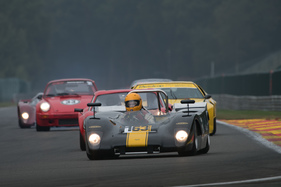
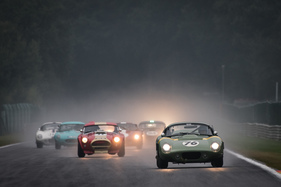
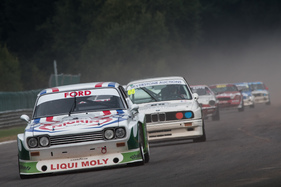

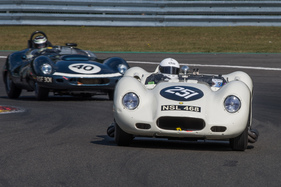
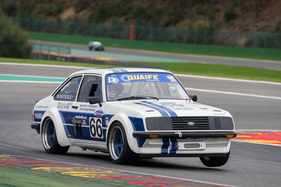
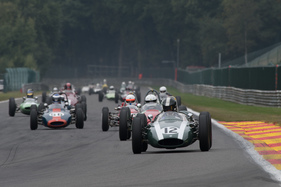
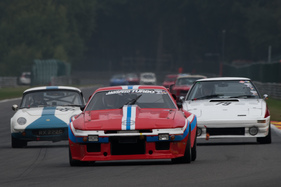
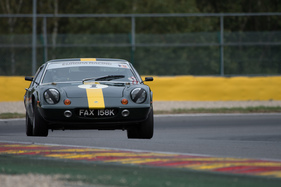
Spa Francorchamps is one of the most beautiful racetracks in the world and has one of the most exciting and difficult passages of all circuits, the Eau Rouge. No wonder drivers from the historic camp look forward to competing there every year. One of the opportunities to do so is called the "Spa Six Hours" and this event offered "racing" at its best with around 650 old racing cars and 16 races.

No rain!
The weather on September 16-18, 2016 seemed almost unbelievable: it didn't rain for a minute, even though Spa is considered almost rainproof. At least there was dense fog in the early morning, so the Spa fans didn't have to do without moisture completely, but otherwise the sun shone and bands of clouds passed by. On Sunday, it was mostly completely overcast, cool, but without rain.

Into the night
The highlight of the Spa Six Hours in 2016 was, of course, the six-hour endurance race of the same name.

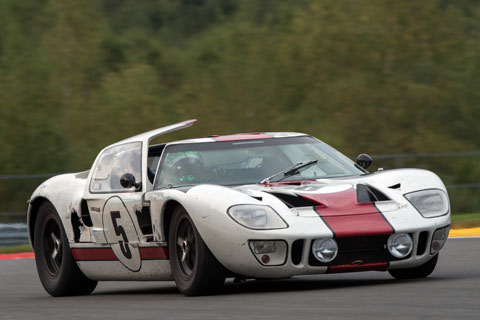
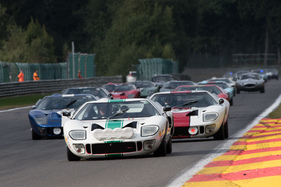
Touring and racing cars built up to 1965 were allowed to compete, and the field of over 100 vehicles included a whole pack of Ford GT40s, which also set the tone in the race. Only the TVR Griffith of Whitaker/Reuben/O'Brien was able to break into the GT40 phalanx and secure 4th place after 95 laps.

The other top four places went to the British-American mid-engined Ford racing car, with the winners Wright/Gans/Wolfe completing 98 laps, followed by Wood/Stretton with a gap of 1:36.057.

The overall GT40 result might have looked even better, but the leading Meaden/Berger/Barilla put their Ford GT40 into the barriers after just 11 laps.

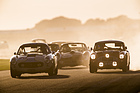
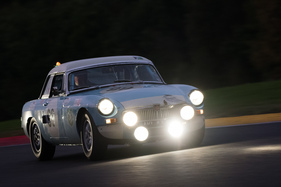
The last two hours of the six-hour race took place almost completely in the dark, which allowed spectators to observe how the various lamp constructions worked. Unfortunately, more and more historic racers are using LED and xenon lights to improve visibility, something that is understandable from a safety point of view, but no longer looks truly historic.

Touring cars at their finest
Certainly particularly impressive for many spectators was the race of the historic touring cars, which were sent into the race in two groups at distant ends of the track behind the safety car. After a few laps, the two-liter touring cars up to 1966 naturally mingled with the faster Group 1/2/5 and A cars and there were plenty of overtaking maneuvers to watch.

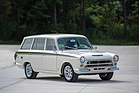
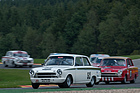
Of course, the two classes were judged separately. The newer cars were won by Tromans/Meaden in a Ford Capri, while the class up to 1966 was dominated by Wolfe/Hall in a Ford Lotus Cortina, closely followed by former professional racing driver Steve Soper in another Cortina.

While the field of older cars was very much dominated by the Ford Lotus Cortina, the HTTC cars showed a colourful variety, from the BMW M3 (E30) to the AMC Javelin, the Rover SD1, the Chevrolet Camaro and the Datsun 240 Z or MG Metro Turbo.

Fans of the Spa 24-hour race who wanted to watch the Schnitzer-BMW 3.0 CSL, which had already competed at Spa in 1972, were disappointed. Like 44 years earlier, the BMW unfortunately retired, but this time without even having completed a lap of the race.

The beautiful sports cars of the fifties
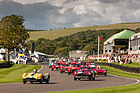
Anyone interested in the 24 Hours of Le Mans of the 1950s and who admired the sports cars of the time will certainly have enjoyed the Woodcote and Stirling Moss Trophy race at Spa. Jaguar D-Type, C-Type, Lister Knobbly, Cooper Monaco, Lotus 15, Elva Mk V or Lola Mk1.

Exotic cars such as the Jowett Jupiter, the Connaught ALSR and the Willment Climax were also at the start and showed just how beautiful racing cars can be.

The one-hour race was dominated by two Lister Kobbly, Wood/Nuthall had the longer end on their side in the end and won with 21 laps and a lead of almost 20 seconds.
Unfortunately, some of the particularly rare cars, such as an RGS Atalanta or an Allard J2, were unable to start.
The sports cars of the sixties and seventies
Cars such as the Lola T70, the Chevron B8/B16 and Porsche were also on the grid in the FIA Masters Historic Sports Car Series race at Spa. Unfortunately, the Porsche 917 of Monteverde/Pearson did not make it into the race; the red mid-engined twelve-cylinder car did not complete more than a few practice laps.

As a result, the race was primarily dominated by the Lola T70, which took home a well-deserved victory with Oli Bryant. It is always interesting to see in this series how the most diverse sports car concepts - open versus closed, big-stroke versus narrow-chested - can still lead to similarly fast lap times in the end.

Free-standing wheels
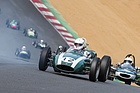
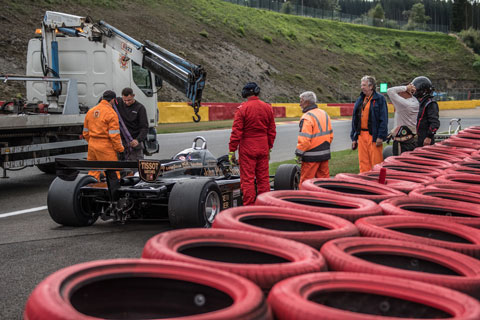
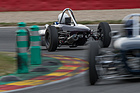
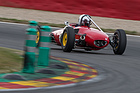
Of course, there were also monoposti on show at Spa, with historic single-seaters from the 1920s to 1960s taking part in two 30-minute races as part of the Historic Grand Prix Association, while the newer Formula 1 cars from 1966 to 1985 took part in two 30-minute races as part of the FIA Masters Formula One. The latter was won by Padmore in his Williams FW07C, while the older cars were won once by Horsman in the Lotus 18/21 and in the second race by Jolley in the Cooper T45/51, who had lost three seconds to the leader in the first race.

The two Formula Junior Historic Racing Association races were won by Wilson in the Lotus 20/22 and Jackson in the Brabham BT2. The first race in particular remained exciting right to the end, which was impressively demonstrated by the gaps of tenths between the top three drivers.

Group of the exotics
Even connoisseurs are puzzled here: have you ever heard of Martin? Or Rawlson, Clan Crusader, Coldwell, Davrian or Willment? You rarely see vehicles of these brands, but it's up to you to decide whether you find them visually appealing. In any case, it is very much appreciated to see such exotic cars at motorsport events, and the organizers of the Spa Six Hours also do this very well. More exotic cars can be found in the "Historic Sports Car Club" picture gallery.

Enthusiastic spectators
The Spa-Francorchamps circuit is attractive for spectators as there are many interesting places to watch the races. Accordingly, the crowds are well distributed. And when it doesn't rain, as was the case in 2016, it is even more interesting to linger on the track.
Popular positions were found on the long straight between Eau Rouge and Les Combes, but also at the 180-degree Bruxelles corner.
The pit lane was also very busy, sometimes it was almost impossible to get through.

Overall, the 2016 edition was also a strongly British-influenced racing event, where you can also meet Central Europeans, but they are in the minority compared to the AVD Oldtimer Grand Prix. On the other hand, spectators can also see cars that usually only appear at British racing events. This positions the Spa Six Hours as an exciting alternative to the OGP.