


The Spa Francorchamps circuit has existed since 1921, when the first race was due to take place on the triangle of country roads between Spa, Malmedy and Stavelot. It had to be canceled because only one car had been entered.
This problem did not exist in 2013 at the "Spa Six Hours", because with around 600 racing cars in 12 races, the event was well equipped and the numerous spectators, who were well spread out along the extensive route, could not complain about a lack of variety.
Shorter and shorter
The circuit has changed a few times since 1921, becoming shorter in particular; today the course is still seven kilometers long, whereas it started out at 15 kilometers.
But it is still one of the fastest racetracks in the world. Motorsport fans know the track from the Formula 1 television broadcasts or the legendary 24 Hours of Francorchamps races, but only a personal visit to the circuit reveals its special charms.
Super steep!
From the center of the village of Francorchamps, you drive towards Malmedy and descend to the main entrance, where the paddocks, i.e. the pits, are located. You then pass under the track via a tunnel and reach the inner area with the paddock, where there are also chip and sausage stands as well as drinks stalls. The entrances to the old grandstands are also here and there is always something going on at a major event.

However, this does not distinguish Spa from other racetracks, the big difference only becomes apparent when you take a look at the famous "Eau Rouge" passage. You would hardly have imagined this stretch of road to be so steep, it's as if the road surface had been folded up at the Eau Rouge bend. From some parts of the paddocks, you can no longer see the lowest point, but only the steep uphill section ... Really impressive!
Multi-level
But there are other special features. The paddock is located on the fourth basement level relative to the start/finish area. A lift takes you up about 20 meters to the newer pits. From there, however, it is another three floors up to the viewing terrace. Here you can enjoy a phenomenal view over the sea of conifers, with the typical Spa orange and red track boundaries (curbs) flashing in many places. You can always see individual parts of the track and even the cars can be seen from this terrace. A stunning view and probably quite unique as far as racetracks go.
From here, you can also appreciate the huge differences in altitude that exist on this natural race track: After the Eau Rouge depression, the cars thunder up the hill, with the track climbing up to "Les Combes", from where it then descends via a 180-degree bend ("Bruxelles") and a double-left bend to "Courbe", the lowest point of the track. From there, a mountain-like course begins again towards the finish...

Six-hour race as namesake and main attraction
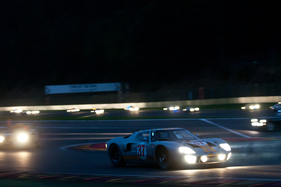
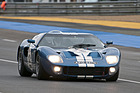
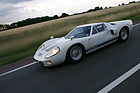
The "Spa Six Hours" was designed as a historic endurance race and thus also gave its name to the entire race weekend. The six-hour race started at 15:55 and lasted into the night. At 21:55, the Ford GT 40 of Voyazides/Hatfield was waved off as the winner.
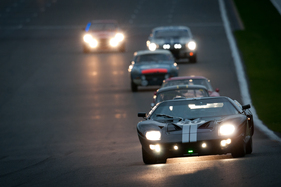
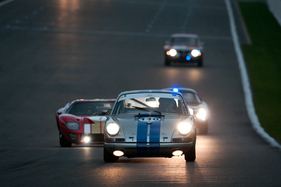
When the sun had set after a few hours of racing, the sky had turned into a cloudy, crimson sea and the GT cars drove around the circuit like little lights on the water.

All kinds of unusual light installations could be discovered on the vehicles, such as illuminated aerials, blue illuminated underbodies, flashing lights around headlights and many other things that were probably not part of the standard equipment of racing cars 50 years ago. However, these lights created a special atmosphere and made it easier for drivers and spectators to distinguish the individual vehicles.

There was also plenty of action in the pits, as there was a lot to do on the cars over six hours, be it refueling, driver changes, wheel changes or minor and major repairs.

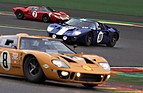
Behind the victorious Ford GT 40 came the brute Chevrolet Corvette Grand Sport, driven in turn by Michel Campagne, A. Kalff and the well-known F1 racing driver Jan Lammers. They were the only ones to break through the Ford GT 40 phalanx.

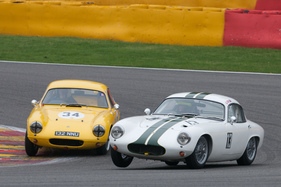
Among the fastest were also the GTS10 class winners Wilson/Wolfe/Stirling in a Lotus Elan 26R, the GTS11 class leaders Smits/Kuipert/Jon in a Ford Shelby Mustang 350 GT and the fastest in the GTS11 group, the Brits Tice/Conoley in a Marcos 1800 GT.
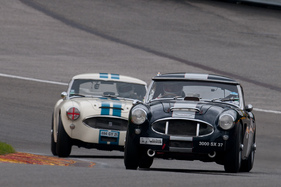
In addition to the cars already mentioned, Jaguar E Type, TVR Griffith, Porsche 911, Triumph TR4, MG B, Ginetta G4, Ford Falcon Sprint, Austin Healey, Lotus Elite, Morgan Plus 8, Datsun 240 Z, Porsche 356, Austin Mini Cooper S, TVR Grantura, Aston Martin DB4 and Ferrari 250 GT SWB were among the 109 racing cars entered.

Gran Turismo in the fog
Practice for the Granturismo racing cars up to 1963 took place on Friday morning in slightly damp conditions and fog. Visibility was not ideal and many a driver would have preferred to get into the car a little later. But the race on Saturday also started in the early hours and again fog impaired visibility, especially at "Les Combes", the highest point of the course.

After practice, it was easy to predict that one of the Ferrari 250 GTs would be the winner of the race, but there were a few surprises early on in the race. The yellow SWB of Oliver/Pearson retired after just one lap and the lead was passed to Gaye/Reid in the silver SWB. However, they were only able to enjoy two laps before Hart/Van der Lof took the lead.
Things got exciting again at the pit stop. Both Ferraris pitted at the same time and the second-placed driver came within a whisker of winning the race in the pits. In the end, however, Hart/Van der Lof won ahead of Gaye/Reid. The AC Cobra of Hunt/Blakeney-Edwards came third, but in the "D" class. Monteverde/Pearson in an Aston Martin DB 4 came in fourth, also winning their "INV" class.
Further results
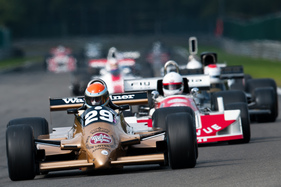
In the two rounds of the FIA Masters Historic Formula One Championship, Lyons won both times in the magnificent Hesketh 308E, once followed by Fish in the Ensign N180, once with Hartley in the Arrows A4 in second place. Third in both races was D'Ansembourg in the Williams FW07/C.
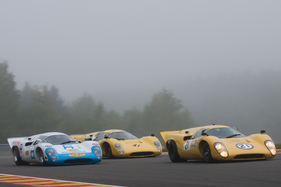
The FIA Masters Sports Cars race was won by the pairing of Voyazides/Hadfield in a Lola T70 Mk3B, followed by Tandy in another T70. Third place went to Wills in a McLaren M1C. Unfortunately, the announced Porsche 917 and Ferrari 512 did not make it to the start.

In the race for the Masters Gentlemen Drivers, Caron in a Cobra Daytona Coupé took the top spot, Graf von Oeynhausen in a Jaguar E Type came in second and Voyazides in his AC Cobra was third.
In the Touring Car Masters, Bates was first in a Porsche 911 RSR, second was Brown in a Ford Escort RS and third was Wyndham in a Jaguar E-Type. What was interesting about this race were the very different vehicles, with Mini Coopers battling against Ferrari 308 GTS, Lotus Cortina against Porsche 914/6 or Jaguar XK 150 against Aston Martin DBS V8.
In the CanAm Interserie Challenge Race, Liguori successfully held off the big bangers Lola T70 of Stretton and Tandy in the Lola T292.

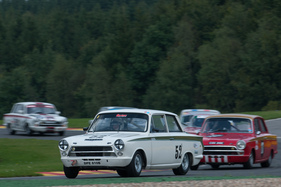
In the touring cars competing for the U2TC Historic Motro Racing News Trophy, Shaw/JackieOliver in the BMW 1800 TiSA came out on top, followed by Bryant/Wolfe in the Ford Lotus Cortina and Tromans/Meaden in another Lotus Cortina. Furiani/Glasel came fourth in an Alfa Romeo Giulia Sprint GTA.
There were beautiful sports cars to admire in the Woodcote Trophy Stirling Moss, which was won by C. Ward in a Lister Costin. S. Lynn was second on the podium in a Lister Knobbly and O. Bryant third in a Lotus 15. Unfortunately, some of the announced cars were also missing here, for example the Aston Martin DB 4 Zagato or a Ferrari 246S.

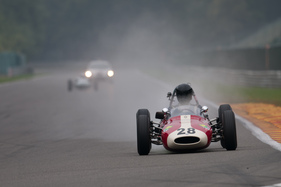
In the historic Grand Prix single-seaters, J. Minshaw won on Saturday in a Brabham BT4 ahead of Horsman in a Lotus 18/21 and M. Griffiths in a Cooper T51. On Sunday, M. Griffiths came out on top in the Cooper, followed by M. Blees in a Brabham BT7A and C. Locke in a Lotus 32B.

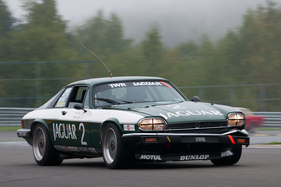
Diversity was also the motto of the British Sports GT & Saloon Challenge. The winner was S. McCarthy in an MG B GT V8, followed in second place by G. Miller in a Triumph TR7 V8, followed by T. Gilmartin in a Morgan Plus 8, followed by an Aston Martin DB6, a Ferrari 308 GTB, a Rover SD1, a Chevrolet Camaro and a Jaguar XJS.
M. Dwyer finished the two races as part of the "Historic Sports Car Club Open Wheel Race" as the overall winner in a March 742. Tromans/Stretton in a Chevron B42 finished a close second, with W. Tomkins in a March 732 and A. Taylor on a March 78B.
Photos
Are you missing photos of a particular vehicle and have not found any in the gallery? Please also note the separate picture galleries for each race field under "Recommended articles". If necessary, please contact us via the contact form.