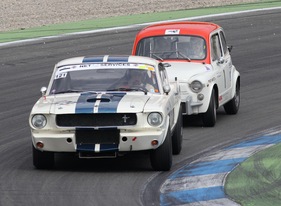
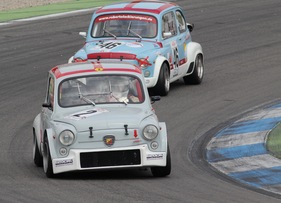

The "dwarves" were almost the biggest! In any case, the field of "little ones" was the largest at this year's Hockenheim Historic - in Memorial of Jim Clark. Over 60 Mini, Fiat Abarth, Steyr-Puch and NSU TT cars took to the track in the two regularity tests, joined by Austin-Healey Sprite, Triumph Spitfire and Leo Aumüller's Abarth 850 TC, among others. And the little ones provided the best entertainment, as if the aim was not to be the most even, but the fastest. Experienced racers know, however, that you are at your best when you drive at the limit. However, overtaking maneuvers and the occasional slip-up are naturally detrimental.
Ford GT 40 unchallenged at the top
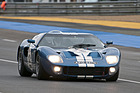
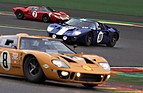
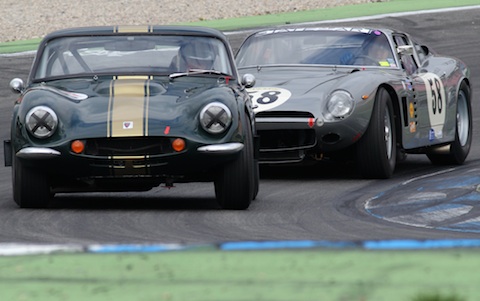
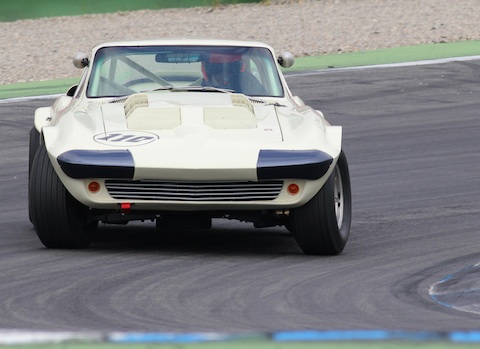
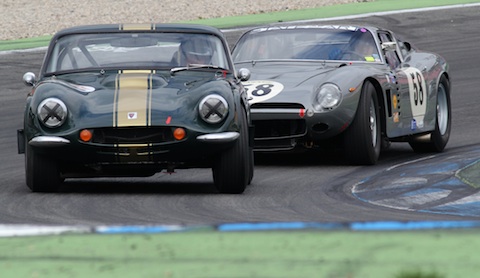
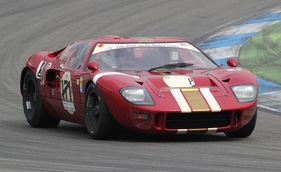
The NK HTGT, the Dutch championship for historic touring cars and Gran Turismo, visited the Hockenheimring from Holland and offered a lot for the car and the ear. Georg Stummeyer left nothing to be desired in his superior Ford GT 40 in both races and lapped a considerable proportion of the field, which was not slow either. He also benefited from the bad luck of Corvette driver Michiel Campagne, who had to start from the back of the field in the first race and fought his way up to third place. He owed this fabulous result not least to the 1963 Chevrolet Corvette Grand Sport, a so-called "continuation car" of the legendary five-car series that Duntov initiated in 1962. Michiel Campagne had the Corvette drifting so that it was a joy to drive, true to the motto: what do I need a steering wheel when I have an accelerator pedal? However, the Lotus Elan pack kept up surprisingly well with this hustle and bustle and finished the first race in 2nd, 4th and 5th place, the second in 3rd, 4th and 5th place, because Michiel was able to drive the Grand Sport to second place. The NK HTGT field included a number of goodies, such as the 1965 Iso A3C, the TVR Griffith 200, which unfortunately only took part in the first race, and the 1965 Alpine A 110. Beautiful cars with good sound qualities.
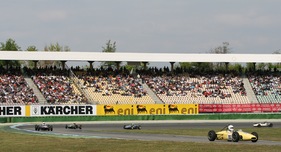
Wheel-to-wheel battles in the Formula Junior
As always, the Formula Junior races were exciting, even if we have seen closer finishes and Pierre Tonetti won both races. Behind them, however, there was a lot of swapping of places and the occasional trip into the gravel.
The large field, which was divided into different vehicle concepts (front engine, mid-engine with drum brakes, mid-engine with disc brakes) was, as always, a colorful mix and also featured rare vehicle types such as the Jolus, the Lightning Envoyette and the Dagrada. The finish was identical in first and second place in both races, with Pierre Tonetti winning the race in his 1963 Brabham BT6 ahead of John Fryda in a Lotus 22. They were followed in the first race by Urs Eberhardt in a Lotus 27 and in the second race by Jens Rauschen in a Lotus 22. Incidentally, the lap times of the best Formula Junior drivers were faster than Georg Stummeyer in a Ford GT 40.
Battle between power and lightness
In the Super Sports Cup, as always, the large-volume CAN-AM cars such as the Lola T222 and McLaren M8F with engines of over eight liters displacement competed against the 2-liter lightweights such as the Chevron B19 or Mach 76S .
However, both races were won by a compromise of the two concepts, so to speak, namely the Lola T292 DFV with a three-liter engine, driven by Michele Liguori. He took three or more seconds per lap from the runner-up, Timo Scheibner, in the large-volume Lola T222 . Silvio Kalb came third in both races in the March 76S from 1976 with a two-liter engine. The big CAN-AM sports cars were once again a pleasure for the ears with their clear intonation and also for the eyes with their large intake manifolds.
McLaren victory in Formula 1
A McLaren won the Formula 1 race not only in Shanghai, but also at the Hockenheimring. In the historic Formula 1, however, it was an MP4/1B-6 driven by Bobby Verdon-Roe that took the win, followed by the Arrows A4 of Steve Hartley and the Wolf WR 1-2, piloted by Peter Wünsch.
Catching up in the historic Formula 2
Martin Stretton clearly won the first race, but in the second race he did not get off to the best possible start in his March 742 and then had to fight his way up from sixth to second place. Matthew Watts gratefully took the podium in the second race. Hans Peter from Switzerland, who finished fourth in the first race with his Ralt RT1, improved to third place in the second race.
David against Goliath and the audience
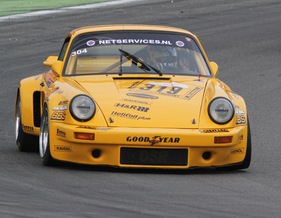
Another highlight was the Youngtimer Touring Car Challenge, which was visiting the Hockenheimring from the Netherlands. Pole position holder Daniel Schrey was unable to exploit his advantage at both starts and had to make up the lost places, which he managed to do thanks to the generous power on offer, meaning that he finished at the top of the podium in his Porsche 911.
The YTCC field is extremely diverse and there is a broad spectrum of vehicles from the expected BMW M3 (E30), Ford Escort RS 2000 to Porsche 944, Renault-Alpine A310, VW Golf GTI, Toyota Celica, Rover Vitesse SD1, Opel Ascona B, Ferrari Mondial or Fiat 128 Coupé to the Trabant 601, which together offer entertaining racing. And when the Trabant braked into the Sachskurve a few meters later and caught up with a BMW or a VW Golf GTI, the audience cheered enthusiastically.
The many duels that raged across the most diverse vehicle concepts and eras were exciting. The Ford Escort RS 1600 in third place in the first race is proof of the balanced field, as is the BMW 635 CSI, which successfully fought its way through a pack of Porsches. The audience applauded the spirited battles, not least because vehicles were also racing against each other that they themselves knew or had even driven.
Historic racing transporters are reminiscent of old times
Between the races of the not overloaded program, there was enough time to take a look at the paddock and in particular the exhibition of historic racing transporters. The Fiat 642 RN 2 Bartoletti transporter with the Ferrari 250 Testarossa was certainly the main attraction of the exhibition, but the Opel Blitz, which was in Porsche service, was also widely admired. As always, the entire paddock was accessible and drivers and mechanics were always ready for a chat.
Weather luck and racing history on the race track
The event benefited from the dry April weather, even if the wind and passing cloud fields did not allow the thermometer to climb too high.
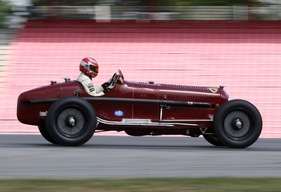
However, this was ideal for the racing cars. A number of gems from racing history, from the Alfa Romeo P3 or ERA B Type Voiturette to the Ferrari 312B3, along with many other historically interesting formula and racing cars, completed their laps after midday.
The Hockenheim Historic program was supplemented by other series that were less committed to historic than to current racing and in turn brought the public closer to a wide variety of vehicle concepts.
The Pforzheim Design University awarded prizes to the most beautiful vehicles in various categories. The winners were the Ferrari transporter, the Chevron B16 by Leo Schiewek, the Ferrari 312B3 by Leopold Hrobsky and the Iso A3C by Pieter Boel. You can live with this selection.
In memory of Jim Clark
Of course, the namesake of the event should not be forgotten amidst all the racing action: Jim Clark, who died on April 7, 1971 in Hockenheim. An exhibition with many memorabilia, collected by Jürg Mallepell, was held in his honor on the roof of the pit building.