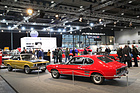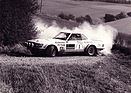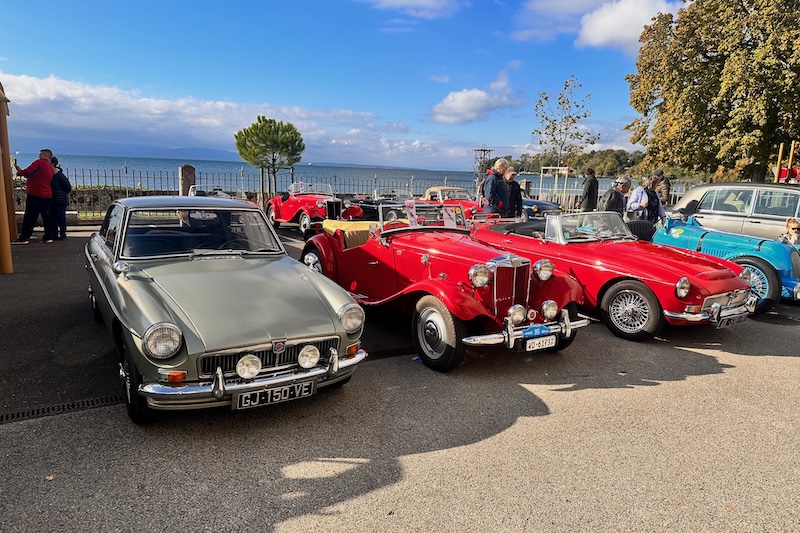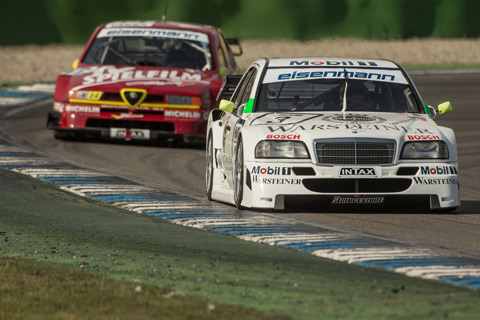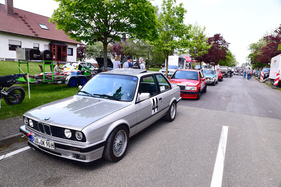


Traditionally, the Ransel Classics began on the Wednesday before Ascension Day with the arrival of the first participants in the otherwise tranquil Taunus village of Ransel. After initial minor problems with the registration software, the starter list filled up quickly and to the limit. In the end - including the double starters - there were just over 180 cars at the start. As usual, they were spread over the main road in Ransel and two larger meadows and celebrated a four-day motorsport festival together with local clubs, the fire department and many fans. The latter were once again able to travel to the spectator points in comfort by bus.

Looking back, the RAC had truly had "sunshine" with the weather. The extended Ascension weekend actually consisted of the only four days in a row in May 2024 on which it did not rain at some point. Nevertheless, some people's spirits were a little clouded, as Lorch motorsport veteran Stefan Wacket, a founding member of the Rheingau Automobile Club (RAC) and a frequent starter on the Ranseler Berg, unfortunately lost his battle against the insidious disease ALS in March.
Regulations and route
The key data of the "Green Hell on the Mountain" from Lorch am Rhein up to the district of Ransel have remained the same: 4.425 km with over 50 bends. Of these, several 100 m sections with a sloping road surface. As in the previous year, these sections were secured with beacons and were therefore not repeated.

In terms of sport and organization, everything has also remained the same: There are two modes of driving. In mode 1, a minimum time of 3:20 minutes and a maximum of 6:30 minutes must be adhered to. In mode 2, you only have to stay under 6:00 minutes. The more than 180 cars were divided into three starting groups. These are shifted by one group each day, i.e. the 1st starter group opens on Friday, the 2nd group on Saturday and the 3rd group on Sunday.

To avoid running into slower vehicles, the fastest vehicles always start first and the slowest at the end. This will be adjusted for each race. Friday (only one free practice session) and Saturday went relatively smoothly. On Sunday, in the first compulsory training run, there were many minor accidents or interruptions due to technical defects. The race lasted well into the afternoon. The actual two scoring runs could only be completed shortly after 19:00.
Winner not eligible to win
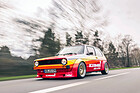
The absolute crowd favorite was Christoph Nemec with his "Race Bus", a heavily tuned VW T2 from 1972. In the rear of the red and white racing bus is a VW type 4 engine with 139 hp, enlarged to 2.4 liters.

As younger vehicles built in 1994 and later were eligible to compete in a guest class (starting numbers 900 and higher) but were not counted towards the overall victory, it was a curious fact that multiple Ransel winner Maik Ellebrecht had driven the most consistently with a time difference of 0.34 seconds, but was not declared the winner in the end. Instead, the overall victory went to Sebastian Kollmann in a 1985 VW Polo with a difference of 0.55 seconds.

He was followed by Günter Valtinke in a 1991 Mercedes-Benz 190 E 2.0 with a difference of just one hundredth of a second. Sven Schneider in a 1985 VW Scirocco completed the podium. He was followed by Hans Schrumpf in a 1977 Porsche 911 SC and finally Dieter Specht in a 1983 VW Golf.
Future uncertain
How the Ransel Classics will continue next year depends on the further course of events or the completion of the renovation work on the track, which is due to start in the summer. However, anyone familiar with German construction sites knows how long these can take. Let's hope for the best. The RAC and everyone in Ransel deserve it after the successful twelfth edition in 2024.