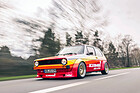
When the successor was already in the starting blocks, Volkswagen helped sales of the Golf GTI with a special model that is known today as the "Pirelli Golf". In fact, this variant is one of the most sought-after specimens of the Golf 1 GTI, which is still popular today.
Successful GTI model
The history of the GTI is well known and has already been told elsewhere, so here it is in brief: The VW Golf GTI was unveiled at the IAA in September 1975 and it differed from the normal Golfs with its 1.6-liter injection engine from the Audi 80 GT/E as well as its sporty looks and equipment, Recaro sports seats, a golf ball as a gear knob, a sporty chassis, matt black accents and, of course, the GTI lettering on the red-framed radiator grille.

The recipe was a hit, and instead of the planned 5000 units, 450,000 were sold. The Golf GTI became the father of an entire vehicle segment.
Continuous evolution
Volkswagen did not rest on its initial laurels, but continued to improve the Golf and the GTI variant. In 1978, all models were fitted with plastic bumpers and, above all, better rust protection and more effective noise insulation. From 1979, the GTI was available with a five-speed gearbox.

In 1980, the Golf received wide tail lights and a new dashboard, which also replaced the previously round displays in the GTI. The "spittoon" steering wheel also disappeared and gave way to a version with a baffle.

Finally, in 1982, the Golf GTI, which was now also available in a five-door version, received a 1.8-liter engine with 112 instead of 110 hp.
The GTI now cost CHF 18,130 or DM 20,285, but it remained the car testers' favorite. They liked the new engine. The Automobil Revue commented:
"The 1.8-liter injection engine is convincing in every respect. The main difference compared to the previous power unit is the increase in power in the lower rev range: the maximum torque, which has climbed from 140 to 153 Nm, is already available at 3500 rpm and not just at 5000 rpm, and 5800 rpm is also sufficient for the maximum output of 112 hp (1.6-liter: 110 hp at 6100 rpm). ... In the discipline "acceleration in the gears", which is a measure of elasticity, the 895 kg GTI not only leaves its predecessor behind, but also most of its competitors."
In fact, with a test consumption of 9.6 liters per 100 km, the GTI 1800 was even more economical than its predecessor (10.2 liters). And it also beat it in terms of driving performance, e.g. accelerating from 0 to 100 km/h in 8.9 instead of 9.2 seconds. With a top speed of 187 km/h in fifth gear, there was also no criticism of the top speed.
"With the 1.8-liter injection engine, VW has largely restored the performance advantage that the first GTI initially had over its competitors. The GTI is still the uncrowned leader in its class - and this is particularly remarkable in view of its no longer quite dewy bodywork," summarized Automobil Revue in a test in the late summer of 1982.
Competition catches up
In fact, the Golf GTI was joined by another strong competitor in the new Opel Kadett GTE from March 1983. With a displacement of 1.8 liters and 115 hp, sporty styling and a slightly higher utility value overall, the Opel was able to score points, especially as it was even a little cheaper at DM 20,255.
In the comparison test by "auto motor und sport", however, the Golf GTI performed well, accelerating better (8.6 instead of 9.7 seconds from 0 to 100 km/h) and even running faster (192 instead of 190 km/h) than the actually more aerodynamic Opel, which, however, also had a higher weight than the VW. The Golf also beat the Opel in terms of ride comfort, so Thomas Fischer declared a clear winner:
"However, that doesn't change the fundamental outcome of this duel. All things considered, even the best Opel Kadett is nowhere near good enough to beat the VW Golf GTI."
However, the Golf GTI also had to contend with other rivals, in particular the Ford Escort XR3i and the Fiat Ritmo Abarth 125 TC. The latter was cheaper and significantly more powerful, while the Ford Escort benefited above all from better aerodynamics.
The Golf GTI clearly beat its "GTI" competitors in the German registration figures in 1982.
Successor on the horizon
It was clear early on in 1983 that the Golf 1 was to have a successor that could do everything better. The Golf II was finally announced at the IAA in September 1983, but prototype photos of the "new one" made the rounds much earlier.

So there were good reasons to organize some sales promotion even for the top-of-the-range GTI model beyond the stronger competition. In spring 1983, a "special model" was announced, "auto motor und sport" characterized the offer as follows:
"In addition to the unchanged VW Golf GTI, the Wolfsburg-based company is now offering a special version of the high-performance sports sedan. 6J X 14 alloy wheels with 185/60 HR 14 Pirelli P6 tires, a leather steering wheel and twin headlights document the sporty character of the bestseller. A second exterior mirror and green tinted windows round off the optional extras, for which there is no extra charge. The two-door GTI costs 20,285 marks, the four-door 20,980 marks."
Inexpensive additional equipment
The "Pirelli Golf" was also available in three exclusive color schemes, namely Alpine White, Helios Blue Metallic, Mars Red and Lhasa Metallic, combined with matching interior appointments.

The interior-adjustable rear-view mirrors and the bumpers were painted in the same color as the fender flares, while the twin headlight grille was standard.
The digital multifunction display (MFA) was also part of the equipment and allowed the oil temperature, outside temperature, distance traveled, driving time and average fuel consumption to be checked.

The most important distinguishing features were, of course, the 14-inch rims with the "P" pattern and the Pirelli P6 wide tires, which, however, prevented snow chains from being fitted.
Around 10,500 units
The "Pirelli Golf" was a sales success, with around 10,500 units being built between May and October 1983. It was a worthy farewell performance and offered a lot of equipment for the money, as it cost no more than the normal model. Pirelli Golfs were probably also delivered without painted plastic parts and in other colors; people were very flexible back then.

The Pirelli wheels were also used on other GTI models to upgrade the cars, so that today it is not so easy to distinguish original "special models" from retrofitted normal GTIs.
At the steering wheel
It is a pleasure to sit down in the well-equipped "Pirelli Golf"; the painted mirrors and widening are immediately noticeable, as is the steering wheel, which is less attractive than the earlier sports steering wheel but has a leather cover.

Functionally, there is little to criticize about the dashboard with its rectangular instruments, which has been fitted since 1980; a fuel consumption display seems rather out of place in the GTI.

Of course, the engine starts straight away and driving the compact Golf is no problem at all. Shifting gears with the golf ball is a pleasure, and thanks to good all-round visibility, low vehicle weight and compact dimensions, country road raiding is a lot of fun. You don't even have to let it get to the point of load change-induced oversteer.

The wide wheels provide additional grip, even if you miss the visually attractive P6 tires of the time (a kind of narrowed P7). Today, P6 tires unfortunately look like other rubber, the characteristic pattern has been lost.

The GTI has never lacked forward dynamics anyway; after all, 112 hp with just under 900 kg can do a lot. The fact that the VW Golf GTI will be 50 years old in 2026 is certainly not noticeable in the sprightly Pirelli Golf.
The 1983 VW Golf GTI Pirelli photographed for this article will be auctioned off by the Oldtimer Galerie on May 30, 2026 as part of the Swiss Classic World . Thank you for the opportunity to take a photo.