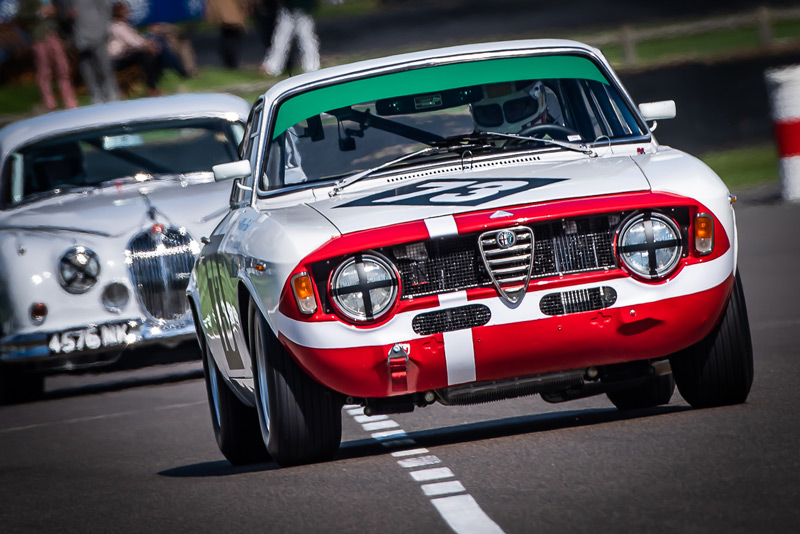
The first motor race was held in Rouen, France, in 1894. The English have long since conquered the attribute "Heart of motor racing", and apparently only they can really celebrate it: The Goodwood Revival, which takes place every September, is the absolute highlight of classic car racing worldwide.

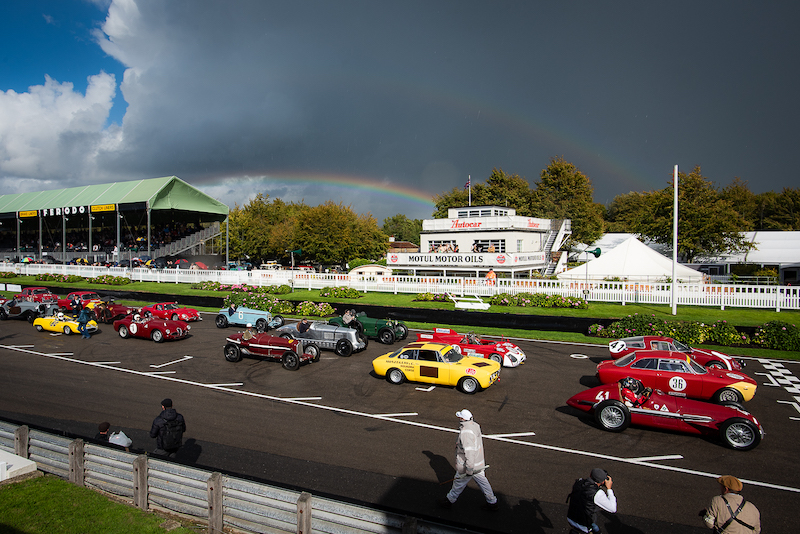
"Give me Goodwood on a summer's day and you can forget the rest of the world." This slogan by Roy Salvadori greeted the tens of thousands of spectators in the entrance area; large banners with this statement had been stretched across the streets. For three days, there were no "track limits", no grid penalties or time penalties from any stewards - all of these things from today's Formula 1 were banned from Goodwood. From Friday to Sunday, racing was celebrated in its original form and the starting grid was lined up in a 3-2-3 system as it used to be. The good old grid girls (not related to their year!) also experienced a renaissance; not in ultra-short mini skirts or hot pants, but demurely covered up in skirts that reached above the knee. Over 150,000 spectators enjoyed this racing festival to the full.

Over 40 drivers of international renown, from Formula 1 world champions and Grand Prix winners to Le Mans winners and winners in endurance and touring car racing, graced the various racing fields alongside the "normal" drivers. The start lists were a "who's who" of racing: from A for Richard Attwood (Le Mans winner in 1970) to W for Andy Wallace (Le Mans winner in 1988) or Marco Werner (three-time Le Mans winner). The (racing) celebrities were also represented in the paddock. Nick Mason, Pink Floyd drummer and great classic car enthusiast, was there, as were Rowan Atkinson, alias Mr. Bean - who also took the wheel of his Jaguar Mk VII himself -, Jacky Ickx and Mario Illien.
Anniversaries to celebrate
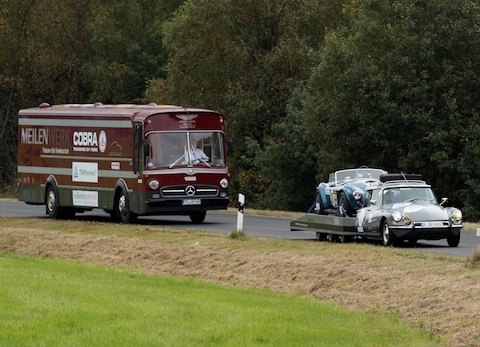
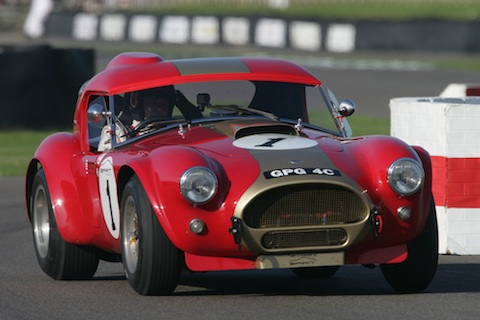
And anniversaries were celebrated - no, downright celebrated. The program included 100 years of Caroll Shelby, 75 years of Lotus and 75 years of Porsche. Demo laps were on the program for the "Shelbians" and Lotus enthusiasts. The Porsche anniversary was celebrated with a race for early 911s. On Saturday and Sunday, three-time Formula 1 world champion Jackie Stewart had the race track to himself: the 84-year-old drove his 1973 world champion Tyrrell around the circuit to frenetic cheers and a standing ovation from the spectators.

Even the weather gods supported the weekend procession. On Friday and Saturday the sun blazed down from the sky, on Sunday it was a little more pleasant thanks to the clouds. A brief rain shower poured down on Sunday afternoon and provided some cooling. It was a completely different story for the races, which were held on a damp or wet track. Within minutes, top-class racing machines were transformed into veritable heaps of scrap metal. Bizzarini drivers Adrian Willmott / Andrew Jordan lacked the necessary caution (or routine?) and turned a particularly rare Bizzarrini 5300 GT into an expensive total loss after a tête-à-queue and the subsequent crash into the embankment.

Spread over Saturday and Sunday, the spectators were treated to thirteen car races, a motorcycle race and, for everyone's amusement, a pedal car race with the next generation of automobiles. In the infield, every morning started with a procession on the airfield: sirens sounded before 8:00 a.m.; soldiers and pilots in full war gear rushed onto the waiting Spitfire fighter planes, took off and then made their rounds in the sky. On Sunday morning, a Mass was said in the presence of Charles Gordon-Lennox, 11th Duke of Richmond, the former Earl of March.

Commenting on 13 races is a bit difficult and probably no fun. So here are some of the highlights:
St Mary's Trophy Part 1 and Part 2
The two races for the St Mary's Trophy, in which two drivers shared the car, probably offered the best entertainment value. Part 1 was held on Saturday and Part 2 on Sunday. The "guest drivers" took to the wheel on Saturday, and the result reads like the result of an endurance race: Romain Dumas (two-time Le Mans winner, winner and record holder at the Pikes Peak hill climb) ahead of Rob Huff (four touring car titles), Tom Kristensen (seven-time Le Mans winner), Jenson Button (2009 Formula 1 world champion), Jimmie Johnson (seven-time Nascar champion), Benoit Treluyer (three-time Le Mans winner).

Even if the result sounds somewhat logical, a look at the different drivable undercarriages reveals astonishing things. There was a battle between a Ford Thunderbird and a Jaguar Mk I, an Austin A90 Westminster, an Alfa Romeo Giulietta, an Austin A 40 and another Austin A 90. The driving and battling was fierce. On the bends, the cars were often door handle to door handle and bumper to bumper. To the cheers of the crowd, the cars were lined up in front of the bends and or skidded through in full drift. Jenson Button, who "only" finished fourth, enthused after the race: "It was a dream to change gears in the Giulietta, always drive flat out and push the car to its limits when drifting."

The second race on Sunday was no less spectacular. Now the somewhat lesser-known names were at the wheel. But that didn't mean it was any less spectacular. Chris Ward (Jaguar Mk I) was able to keep Fred Sheperd (Ford Thunderbird) at bay until lap ten. Then the order changed until three laps before the finish. In a dramatic braking maneuver in the Woodcote bend, Ward snatched the lead back, defended it until after the chicane before the home straight, only to have to make do with second place 200 meters before the checkered flag with a veritable gearbox failure and thus a lack of propulsion.


Lavant Cup
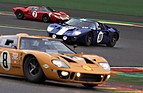
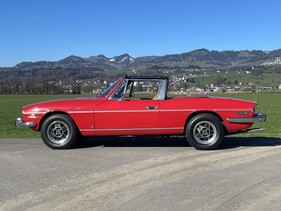
The race for the Lavant Cup was probably one of the highlights of the weekend. Two Ferrari 250 LMs, no fewer than nine Ferrari 250 SWBs, the famous Ferrari 250 SWB "Breadvan", a Ferrari 250 GT Drogo, two Ferrari 250 GTOs, a Ferrari 250 GT Lusso and a Ferrari 250 GT Tour de France battled it out for the winner's laurels. After practice, the two LMs driven by Rob Hall and Gary Pearson were naturally the fastest. Emanuele Pirro dominated the "SWB" field and also put his car on the front row of the grid in third place.

The LM with starting number 26 was then missing at the start: thermal problems prevented Gary Pearson from taking up the race. But the Edi-Wyss-Engineering team was delighted in the pits: Emanuele Pirro took a brilliant lead. Pole setter Rob Hall only came back from the first lap in sixth place after his false start. On lap five, however, he restored order in the hierarchy: the 250 LM moved ahead of the 250 SWB. The finish line was also crossed in this order. Thomas Schnitzler, Edi Wyss' successor, was beaming about second place (and the "victory" in the SWB class): "We feared thermal problems. But the car held out perfectly. And with Pirro, we naturally had a very, very fast driver." This was also proven by the Italian's gap - he was just 1.5 seconds behind the LM.
Fordwater Trophy
30 early Porsche 911s (1964 and 1965 models, all running on synthetic fuel) battled for victory and honor. Well-known professional drivers took to the wheel: Tom Kristensen sat in the cockpit, as did Jenson Button, Mark Webber, Peter Dumbreck and Michael and Jeroen Bleekemolen. Gaby von Oppenheim was the only woman on the grid. The pairing of James Thorpe / Chris Ward got off to the best start - but then caused a minor sensation when braking for the Woodcote bend shortly before the home straight: number 777 with Guy Ziser / Oliver Webb braked unusually late, overtook four or five rivals from the outside to the inside of the bend, flicked the 911 into a perfect, long drift and took the top position. But the big show didn't help: the pit stops and driver changes reshuffled the cards. At the finish, no team with professionals behind the wheel was able to take a place on the podium. Jordan / Holme won ahead of Quaife / Thorpe and Butcher / Paul.

Goodwood Trophy
For Grand Prix and Voiturette racing cars 1930 to 1951: The wide range of eligible years naturally did not exactly ensure equal opportunities. The best Swiss driver in this category was Urs Müller with his Maserati 6CM in ninth place. The car is an ex-Gigi Villoresi racing car and belonged to Peter Heuberger in earlier years. "The Maserati is a mechanically challenging task. My goal in the race is to arrive accident-free and finish in a better position than in practice," Müller said before the race.

Heinz Bachmann was another Swiss driver at the start. He drove an ERA B-Type R9B and started the race from eleventh place. "This is my first race appearance after four years," he commented on his involvement, adding: "It's a special honor to be allowed to start at Goodwood." However, a water channel in the cylinder head was leaking after practice: "We tried to fix this defect with a Sunoco miracle cure and make it to the finish in one piece." The result was eleventh place.

Fritz Burkard drove a true gem. His Alfa Romeo 8C 2300 is an ex-factory car and was driven in the 1930s by none other than Tazio Nuvolari. Burkard came to Goodwood with the "Monza" on the road: "After the last race in Hampton, I attended an Alfa Romeo meeting with Jeremy Clarkson and then drove on to Goodwood. Here we removed the mudguards - and the racing car was ready!" Burkard, who competes in four to five races a year, finished in 14th place.

Ian Baxter (Alta 61 IS) was the winner, catching Mark Gilles (ERA A-Type R3A) virtually at the finish line after 13 laps and beating him by a tenth of a second. Third place went to David Morris (ERA B-Type R11B).
Chichester Cup / Glover Trophy
Philipp Buhofer competed in two series. He drove his Lotus 23 in the Formula Junior: "It's an extremely competitive field. I'll be happy if I finish in a better position than on the grid," he said before the race. The engine change following damage in the previous race at Silverstone should improve his chances. He crossed the finish line in eighth place, two places better than on the grid. The race was a blast. In the style of the "young guns", as the Formula Junior and Formula 3 drivers used to be called, there was a fight for every place. Second-placed Sam Wilson was also annoyed at the finish: "I didn't always take the best line and therefore had no chance against the winner Horatio Fitz-Simon."

Things went better for Philipp Buhofer in the second series of Formula 1 racing cars from 1961 to 1965. Although he lost his fifth place at the start, he was able to move up to sixth place again by the finish. With the BRM P261, he fulfilled a long-cherished dream. "The racing car used to hang on the wall of a bar. We brought it back to the racetrack." Andrew Willis (BRM 261) and Ben Mitchell (LDS-Climax) battled for the lead over the entire race distance. They alternated at the front no fewer than five times. In the photo finish, Willis came out on top by half a second.
Sussex Trophy
Sports cars from 1955 to 1960 competed in the Sussex Trophy. Conrad Ulrich and his Maserati 300 S competed against the likes of the Jaguar C-Type and D-Type: "I take part here more for the fun of it. It's an incredible atmosphere here in Goodwood, comparable at best to the Historic race in Monaco." He started the race from 26th place and finished in 21st place. "I'm satisfied. I was more interested in really enjoying the race. The ranking doesn't really matter," he said after crossing the finish line.
Oliver Bryant fought for victory in his Lotus 15 Climax right from the start. He fought his way forward from third place. He took the lead on the sixth lap and never relinquished it until the end. At the finish line, lighting a big cigar, he was beaming: "Super duels throughout the race and great joy to be the happy winner." Sam Hancock (Ferrari Dino 246 F1) came second. Miles Griffith (Lotus-Climax) crossed the finish line in third place.