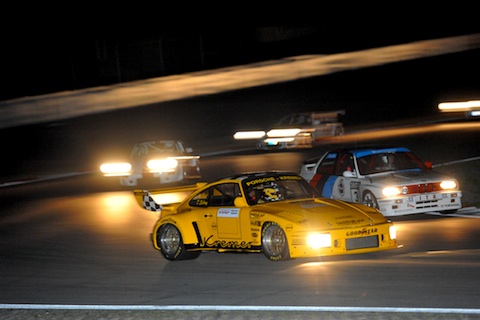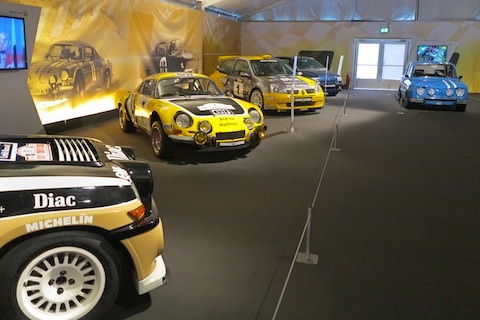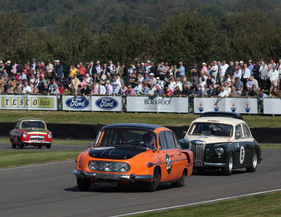


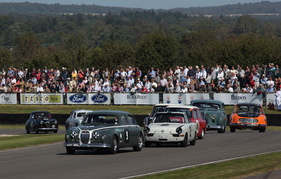
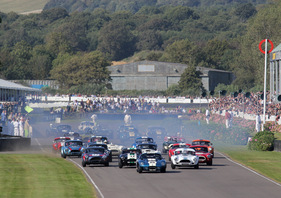
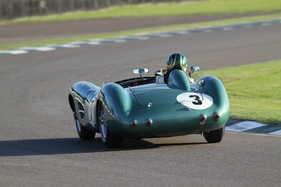
Every year in late summer, the Earl of March invites people to the Goodwood Revival. And they come in droves. Not only the spectators, who arrive in historic outfits, but also the racing legends of the past (and present) and the vehicle owners, including the manufacturers/works museums with their valuable racing cars. The 2012 Revival was no exception and once again lived up to its reputation of being a true revival, i.e. bringing the old days back to life.
"Dan Gurney for President"
Every year, the Goodwood Revival honors a luminary from the rich history of motoring. In 2012, it was Dan Gurney 's turn.
In 1964, the editor-in-chief of Car and Driver launched the (not entirely serious) "Dan Gurney for President" campaign to propose an alternative to the Democrats and Republicans in the American presidential election campaign. Of course, Gurney did not become president, but this campaign alone shows how popular Dan was and still is in America.
Stirling Moss put it in a nutshell: "Dan Gurney is perhaps the best American racing driver ever". Dan Gurney was not only a gifted racing driver but also an enterprising and creative spirit who defied the big racing teams of the world with his Eagle racing cars. His racing car even won an F1 Grand Prix.
So this man was honored at Goodwood. A whole caravan of racing cars that Dan Gurney once drove rolled around the circuit, Dan himself was chauffeured in a Ferrari Testarossa and visibly enjoyed being in the crowd. In an emotional speech, he thanked his fans and praised the unique Goodwood event.
Triumphal procession of the pre-war Silver Arrows
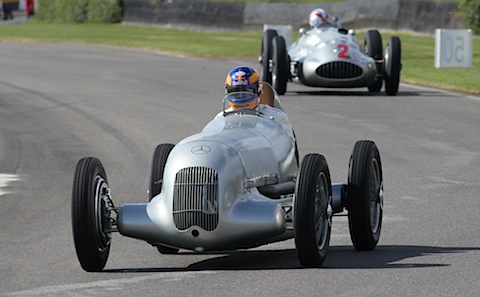
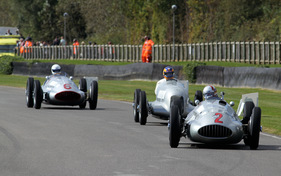
One item on the program of the 2012 Revival had already caused quite a stir in the run-up to the event: the "Silver Arrow Demonstration". A unique collection of Silver Arrows from Auto Union and Mercedes-Benz had been put together, including the Mercedes-Benz W25, W125, W154 and W165 monoposti, as well as the Auto Union Type A, Type C and Type D racing cars in various versions. Drivers such as Jochen Mass, Roland Asch and Harald Demuth drove the unique racing cars around the circuit and, despite admonitions from the factory officials, left them smoking.
The technology did not always stand up to this hustle and bustle, but the audience was thrilled by the shiny silver racing cars and their sounds and smells.
The starting procedure alone was probably worth a trip to Goodwood. Pre-flushing, warming up, changing the plugs, etc. Harald Demuth commented on his drive that the cars were actually quite pleasant, albeit strenuous, to drive. Unfortunately, they shouldn't let the wheels spin ...
50 years of the Ferrari GTO
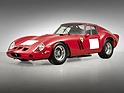
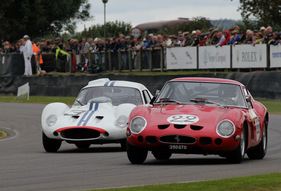
After the Ferrari 250 GTOs had already attracted a great deal of attention at the Le Mans Classic, Goodwood did not want to be left behind. Fifteen GTOs, including some particularly unique examples, were registered. The fact that several of these valuable vehicles not only took part in the demo train, but also in the RAC TT Celebration, and were not spared in the least, was certainly one of the highlights of the event.
Shelby Cup - come hell or high water
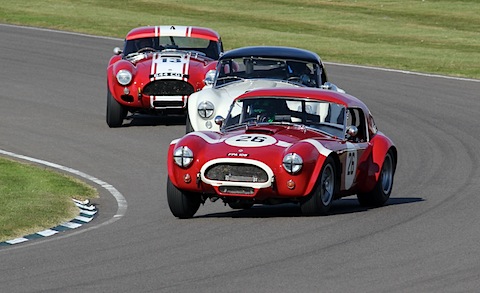
A race featuring only Shelby AC Cobra 4.7-litre sports cars was one of the main attractions of the 2012 Goodwood Revival. Two of these rare vehicles had to call it a day in practice and the fast American racers were not spared in the race either.
Qualifying was dominated by the sensational Shelby American Cobra Daytona Coupé (Brack/Hill). Many racing greats, including Henri Pescarolo, Jochen Mass, Jürgen Barth, Vern Schuppan, Brian Redman, etc. took to the wheel, each sharing a car with a partner.
The 45-minute race itself was initially led by the Daytona Coupé. After their retirement, the "normal" Cobras were among themselves, but the race remained exciting until the end, when the leader was forced to retire with the black flag. In the end, Hall/Wolfe emerged as the winners, followed by Coronel/Hart and Caron/Reid. The fastest lap was set by Caron/Reid in 1:25.853, which corresponds to an average of almost 170 km/h, an indication that this was not just a coffee run.
David against Goliath at the St. Mary's Trophy
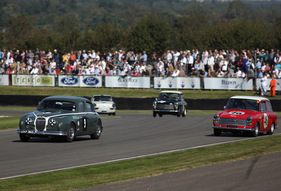
Touring cars from the years 1950 to 1959, which were already racing at the time, were admitted to the two-part St. Marty's Trophy. A professional racing driver or other racing celebrity invited by the Earl of March shared the cockpit of his limousine with the owner of the car. Rob Huff, known from current touring car racing, put "his" Austin A40 on pole position, followed by Anthony Reid in a Jaguar Mk1 and Jackie Oliver in a BMW 700, followed by Martin Brundle in an Austin A35 and Mat Jackson in a Ford Prefect 107E.
This order had to be surprising! The Goodwood Circuit is a circuit with many full-throttle sections, interspersed with a few slow sections (including the tight chicane before the start and finish) and some high-speed corners. So how could it be that narrow-bodied vehicles such as an Austin A40 or, even more so, a BMW 700 could compete against displacement giants such as the Jaguar Mk1 or the Tatra T603?
Well, as Rob Huff revealed, his carefully prepared Austin had an easy 130 to 140 hp instead of the perhaps 60 hp of the time, and he had nothing else to criticize about the easy-to-drive car. Only the tires would degrade massively over the distance of a race, in the end it would feel like driving on a wet track.
The BMW 700 was even more powerful under the hood: the 700 cm3 engine had grown to almost 900 cm3 and the power of the air-cooled two-cylinder engine had been increased to around 90 hp. Minimal weight, carefully tuned chassis and small engines trimmed for maximum power were the recipe for literally driving at the potentially overpowering Jaguar saloons.
And the cars were not spared, as shown by various paint samples on the BMW 700 of Jackie Oliver, who finished third in the first race, seven seconds behind Anthony Reid in the Jaguar Mk1 and 10 seconds behind Rob Huff in the A40.
The second part of the race was really tough. Robert Shaw spun the BMW 700 taken over by Oliver into the infield early on and had to make up a lot of ground, while the two Austin A40s kept up with each other until Mark Daniell spun just before the chicane. Various dents and hanging bumpers proved that the race cars had been given nothing. Reid/Law came through the turmoil with relative ease, taking victory in the end in their Jaguar Mk1, followed by Huff/Smail and Brack/Daniell, both in Austin A40s. They were followed by the BMW 700 of Oliver/Sahw and the Tatra T603 of Haugland/Berg.
It wasn't just the racing action that was worth seeing, but also the vehicles that some of the spectators had probably never seen before. In addition to those already mentioned, a Standard Vanguard, a Gaz Volga M21, a Ford Zodiac and a Borgward Isabella also appeared on the grid. Together with several Austin A35s, Renault 4CVs, MG Magnette and Sunbeam Rapier, among other makes, these cars offered a real throwback to touring car racing in the fifties, even if it was modern material technology that made the performances on show possible.
High tension among the sports cars in the Whitsun Trophy
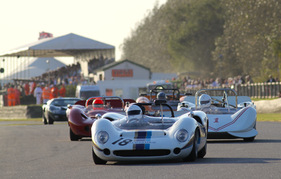
The Whitsun Trophy, which had been set up for racing prototypes from 1963 and 1966, had already seen some trouble in practice when Chris Chiles threw his Hamill-Chevrolet SR3 out of Woodcote. The race was to be one of the most exciting of the entire event. At times, five cars were battling for victory, separated by mere centimeters.
The Chinook-Chevrolet Mk2, the McLaren-Chevrolet M1A/B and the Lola Chevrolet T70 Spyder were really fighting on equal terms and the lap times were more than sensational, as they were driven under 1:20, which corresponds to an average speed of around 183 km/h.
At the end of the race, Gary Pearson in the Lola-Chevrolet T70 Spyder came out on top, with Jay Esterer in the Chinook-Chevrolet Mk2 in second and Roger Wills in the McLaren-Chevrolet M1B in third, followed by two other cars of the same type. The top four were within 3.4 seconds of each other at the end of the race!
A winner in the Fordwater Trophy only at the end
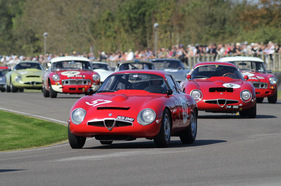
This year's Fordwater Trophy was open to race-oriented production sports cars and GT vehicles from 1964 and 1966. Alfa Romeo Giulia TZ1, MG B, Ferrari 275 GTB/C, Ford Shelby Mustang GT350, Ginetta G10, Porsche 904 GTS, Marcos 1800 GT, Lotus (Elan) 26R, Triumph TR4 SLR, Morgan Plus 4 SLR in various guises dominated the action.
Martin Stretton had already shown in practice with his unconventional Lotus 26R (with 1.6-liter engine) that he was a force to be reckoned with. But in the race, the action was dominated for a long time by Andrew Newall in the Ginetta G10 (with a 4.7-liter Ford engine). Stretton even got into trouble at Woodcote and had to pull away with just a few laps to go, but then Newall was struck down by the devil and had to retire his car. This cleared the way for Stretton and he won by a clear margin ahead of Jackie Oliver in another Lotus 25R. Third place went to John Hugenholtz in a Ford Shelby Mustang GT350.
Starting turmoil in the Richmond & Gordon Trophy
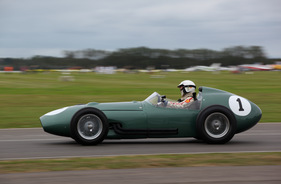
The Formula 1 cars from 1954 to 1961 were supposed to battle it out for 25 minutes with other monoposti from the period, but the safety car had to be deployed after the start as several cars were involved in accidents. Andrew Garner in a BRM Type 23, Paul Smooth in a Lotus 18, Willi Balz in a Maserati 250F and Michael Hinderer in another Maserati 250F were unable to continue their race. After a few laps the race continued, but the material battle was not over yet. Eberhard Thiesen undulated the nose of his beautiful Lancia D50.
In the end, pole-setter Alasdair McCaig took the win in his Cooper-Climax T53 "Lowline", followed by Rod Jolley in another Cooper-Climax, which had followed McCaig like a shadow for most of the race. Third place went to Gary Pearson in a BRM Type 25 and fourth to Richard Attwood in an Aston Martin DBR4.
Most expensive sports cars at the limit at the RAC TT Celebration
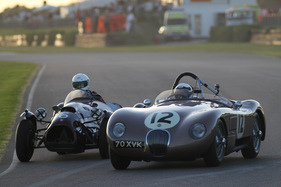
When three Ferrari 250 GTOs, six Ferrari 250 GT SWBs, an Aston Martin DB4 Zagato, several DB4 GTs, two Aston Project cars, a Sunbeam Lister Tiger, a Chevrolet Corvette Sting Ray and two Maserati Tipo 151s compete against a horde of Jaguar E Types, it seems as if time has been turned back 50 years at Goodwood.
In fact, similar starting fields were already common at the Tourist Trophy in the early sixties, although in those days SWBs, GTOs and DB4 GTSs were just as normal racing cars as E-Types, which were not cheap but affordable, whereas today some of the vehicles entered are worth in the two-digit million range.
The drivers didn't seem to have noticed any of this, however, as they drove their sports cars around the bends of the Goodwood Circuit on the last groove. Some even excelled themselves, such as Adrian Newey, who started the race from pole position in his perfectly prepared E-Type Lightweight. He spun on the very first lap and had to continue the race at the back of the field, fighting his way forward position by position. Jean Alesi got off to the best start in the Ferrari 250 GTO, but subsequently lost position after position, while his engine gave off clear blue smoke signals. The Maserati Tipo 151, driven by Derek Hill and Joe Colasacco, made an impressive advance, but on lap 11 the car flew into the barriers in the middle section of the track, whereupon the safety car had to take control.
During this phase, most of the drivers went into the pits and handed the race cars over to their cockpit partners. On lap 14, Martin Brundle took over the E-Type from Newey and it only took two laps before he was already at the head of the field and could no longer be displaced. In the end, Brundle/Newey won by around 30 seconds ahead of Young/Verdon-Roe and Needell/Folch. The top five all drove E-Types, sixth place went to a Lister-Jaguar Coupé, followed by the first Ferrari 250 GTO in seventh place.
A total of 16 races
In addition to the seven races already mentioned, a further 11 were on the program, covering a wide range of vehicle categories, from the two-seater sports cars of the period 1952-1955, to the Formula Junior cars of the years 1958 to 1960, to the sports cars of the pre-war years, the sports cars of the years 1955-1960 and the Formula cars with 1.5 liter displacement of the period 1961 to 1965. And those who were also interested in motorcycles were able to follow racing machines of the years 1951 to 1954 in two rounds.
On the ground and in the air
If the 16 races on the ground were enough entertainment for a whole week or more, the Goodwood program was also supplemented by presentations in the air. Spitfire, Lancaster, Hunter, Hurricane, Mustnng and other aircraft made their rounds over the race site, taking off and landing partly on the grass runways within the infield and inviting spectators to discover them.
There was also plenty to see away from the race track, such as the Earls Court Motor Show with an exhibition of great British sports cars.
A three-day garden party
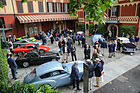
For many visitors, however, Goodwood was above all a huge "garden party", an opportunity to meet up with friends, have a picnic and take a stroll. It was a matter of course that people dressed appropriately for the period, in keeping with the Earl of March's call. And also necessary. For example, it was not permitted to enter the pits without a tie. From military uniforms to spotted skirts, hats in all variations to racing overalls, anything was possible as long as it looked old and stood out. Whole families strolled around the grounds in their sixties look with matching baby carriages, making observers feel like they had stepped back decades if it weren't for the omnipresent cell phones and digital cameras.
Around 150,000 tickets are said to have been sold, where else but in England would such an event be conceivable - 150,000 people dressing up like they did 50 or 60 years ago and reliving the past for three days?
Commerce and bottlenecks
Such market potential was naturally exploited accordingly. Market stalls, sales displays, catering opportunities, champagne bars and illustrious sponsors not only provided entertainment and food for the participants, but also kept the tills of the organizers and their partners ringing.
It is understandable that such a major event poses enormous challenges for traffic management around and within the event site. However, the traffic jams on the roads, just like the slow-moving traffic through the underpasses between the infield and the outside area of the race track, reached a level that could probably make some visitors reluctant to return.
Please also note the picture galleries with hundreds of photos offered under "recommended articles". The detailed results of the individual races are available online.