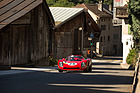
It was almost spooky when the silence of the fogged-in mountains was broken by the pounding of an eight-cylinder engine and the screeching of a compressor. Nothing could be seen until a magnificent Alfa Romeo 8C 2300 Zagato emerged from the fog and soon disappeared again into the white of the cold, damp clouds. It could be heard for much longer than it could be seen.

And it was the same with the other cars that made the journey from La Rösa to the Bernina Pass hospice in poor visibility.
There are only a few historic mountain races that stipulate the fight for the best time and at the same time can look back on a great tradition, Bernina Gran Turismo is one of the exceptions in the annual calendar.

On October 1 and 2, 2016, the time had come for the second time: not quite four dozen racing and sports cars set off on the almost six-kilometre-long hill climb course to battle against the clock, but even more so against the weather. And with virtually no spectators.
Almost like back then
There was already a race on the Bernina Pass in 1929 . It was held as part of the St. Moritz Automobile Week, which was launched around three years after the canton of Graubünden opened its doors to automobiles. The original Bernina mountain race led from Poschiavo (1011 m) to the top of the pass. The racers therefore conquered a distance of around 16.5 km and an altitude difference of 1216 meters.

Hans Stuck spun his Austo-Daimler over the unpaved track to the top of the pass in 14 minutes and 58.4 seconds, allowing him to call himself "King of the Bernina". Incidentally, an Amilcar also appeared on the start list in 1929, and one of these ventured up the hill climb again in 2016.
Fast hill climb course
The mountain road winds its way from La Rösa to the Hospitz on the Bernina Pass over around 5.9 km. A few hairpin bends put pressure on the speed, but in principle the well-maintained route is quite fast. The fastest riders averaged just over 100 km/h, despite poor visibility. They covered 452 meters in altitude and the engine had to be supplied with the right mixture up to the top of the pass at 2328 meters.
Two participation modes
The race was either for best time or for consistency. Just under a dozen participants chose the racing mode, while the rest of the field tried to set identical times and not exceed the target speed of 80 km/h for vehicles built after 1947 and 49.9 km/h for cars built before 1946. However, the resulting target times of around 4:45 and 7:56 minutes respectively still allowed for sporty driving, with penalty points being awarded for underruns.

The entry fee per participant was CHF 1850, which also included some food and of course the prizes. Not a cheap pleasure, but when do you ever get one of the most beautiful mountain passes in the world (almost) to yourself?
Bad luck with the weather
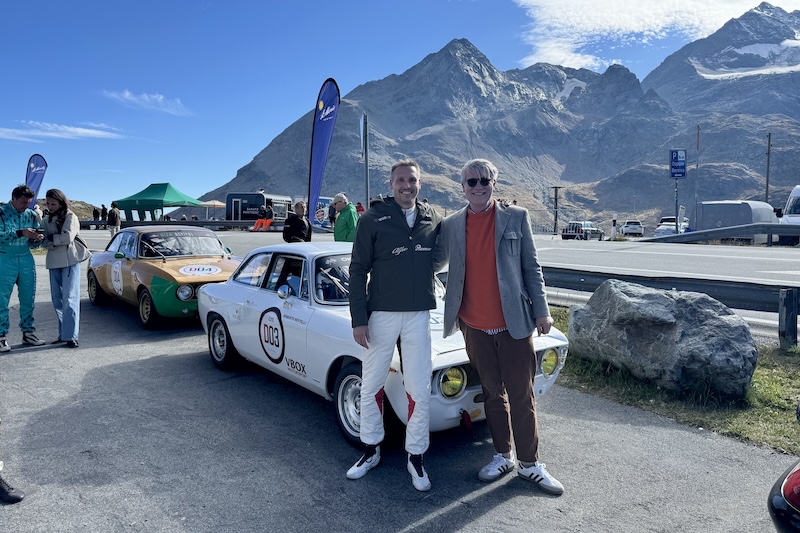
Unfortunately, the second edition of Bernina Gran Turismo was also under a bad star as far as the weather was concerned. On Saturday, visibility was often less than 20 meters due to fog and clouds, and the route remained predominantly wet and slippery. On Sunday, the conditions were no better and the participants were only able to enjoy the impressive mountain panorama for brief moments when the clouds broke up. And this after a beautiful week with lots of sunshine.

The cold and damp weather also prevented a large number of spectators from attending. The planned free shuttles from the official parking lots did not even need to run, as they would have been poorly staffed. There were a few visitors at the track, however, despite minimal propaganda, they knew about the time and place and arrived at the track in good time between the two races.
Racing rarities on the mountain
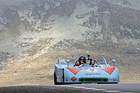
And they, the visitors, got to see something that you don't get to see every day, even at major international historic racing events. Two Porsche 908s in spider configuration raced up the hill, a 908/2 from 1969 and a 908/3 from 1970, although the eight-cylinder cars were only able to show off their talent in one race due to the bad weather.

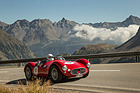
Other drivers of open-top racing cars also suffered from the damp and cold weather conditions and were happy to find refuge in the mountain restaurant between races. A Maserati A6CGS from 1953, a Lister Costin from 1959, a Cooper T33 from 1954 or a Ferrari 500 TRC from 1957 would certainly have been more pleasant racing cars in the sunshine.

The drivers of the coupés and touring cars, including three of the rare Porsche 356 Carrera with the Fuhrmann engine, certainly had it a little better, but they struggled with clogged windshields and suboptimal windshield wipers.
Manageable field of vehicles
45 vehicles were planned according to the announcement, but the number was already reduced after the training runs and on Sunday, after a few technical failures, there were just 38 timed vehicles. However, this was no reason for boredom, as there was plenty on offer in terms of variety and quality.

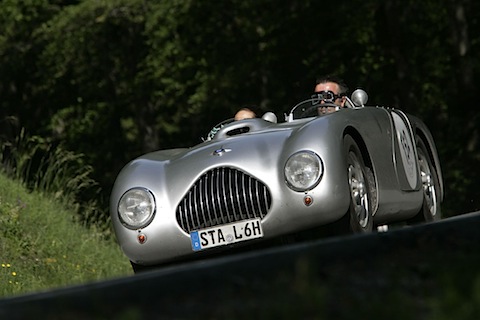
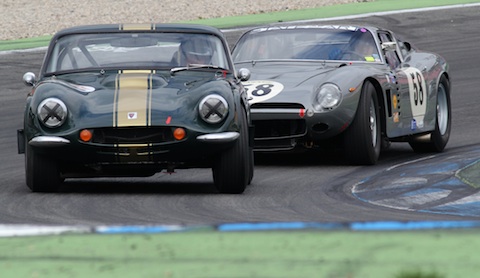
For example, the Austin A35, which had recently competed for top places at the Goodwood Revival, was at the start, as was the Jaguar C Type, which had been seen winning at Monaco and Le Mans. From the Brabham BT-30 Formula 2 to the former works touring car Ford Lotus Cortina, the entire spectrum that historic racing has to offer was on display.
The fast and the steady
Only one race could be driven really fast, so it was the times of the second race on Saturday that decided the racing class.

The overall winner was Christopher Rendlen in a 1970 Porsche 908/3, followed by Christian Kleinguti in a 1970 Brabham BT30 and Daniele Perfette in a 1971 Porsche 911 T.

Chris Ward finished fourth in the 1952 Jaguar C-Type, followed by Reto Gansser in the 1975 Porsche 911 Carrera and Derek Hood in the 1965 Ford GT40. As there were almost as many classes as participants in the 11-car racing category, almost every driver was able to celebrate a class win.

In the uniformity classification, the winners were W. Nützi / M. Forrer in a 1928 Amlcar CGSS, Marc Glänzer in a Lotus Elite, Ruedi Stoop in a 1965 Ford Falcon, Johannes Jäger in a 1971 Huron FF71 Formula F, Diego Schwarzenbach in a 1968 Volvo 123 GT and Philip Mouser in a 1974 Ford Escort RS 1800.

Enthusiastic participants
Regardless of the prizes won, the drivers were positively impressed by the successful event. Of course, (almost) everyone would have wished for better weather conditions, but this could not be blamed on the organization.
The weekend was accident-free, with only minor incidents in the demo classes, so the Swiss Auto Sport racing authorities were also very satisfied and complimented the organization.

"The event has potential, great things can happen here," said a visibly upbeat participant and it will be interesting to see what the Bernina mountain race will look like in 2017, when up to 80 or 85 vehicles will once again race up the mountain in hopefully better weather conditions.