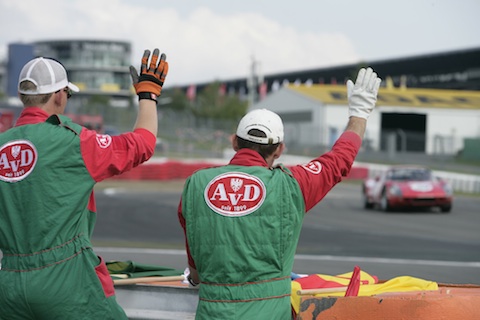
It was in 1973 when fans of old racing cars first met at the Nürburgring to prove at a "racing and industrial show" that their cars were still good for fast laps. The small-scale event developed into the AvD Oldtimer Grand Prix, which attracts tens of thousands every year and has become the largest event of its kind in Germany.

Large crowd
They flocked to Nürburg once again on 11 to 13 August 2017, with the organizer counting 45,000 spectators. And they came to see exciting races and beautiful cars in motion.
Over 500 cars on the race track
16 races, several regularity tests, plus parades and high-speed presentations were offered to the loyal OGP visitors over three days. Whether you were interested in small, lively single-seaters, elegant and beautifully shaped sports cars from the late fifties or powerful Group 6 prototypes from the seventies, there was something for everyone.

And as always at such events, spectators (at least in the paddock) were able to get up close to the cars, much closer than the sterile motorsport series of the modern era would ever allow.
Capricious weather and its consequences
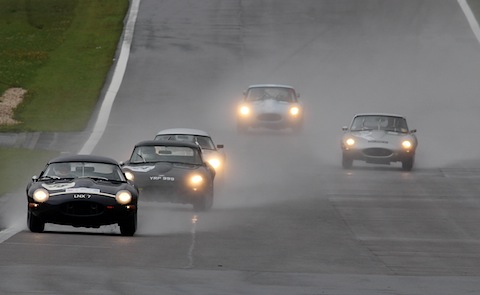
The Eifel once again did itself credit and presented a weather that not only called for well-insulated clothing with cold temperatures, but also for rubber boots and umbrellas with rainfall from all directions. It was only on Sunday after lunch that the sun really came out and it was a little warmer at the end with temperatures of around 22 degrees.

The wet and cold conditions also made the track slippery, many vehicles had hardly any traction and the wheels were constantly spinning. It almost goes without saying that there were also the odd spin and skid in such conditions.
Lotus against Maserati
The race for two-seater racing cars and GT vehicles up to 1960/1961, which starts at dusk on Saturday evening and continues into the night, has been a highlight for many years. Somewhat surprisingly for many observers, a battle developed between the powerful Maserati sports cars and the lightweight but clearly inferior Lotus two-seaters.

In the end, there were two cars from each of the two brands in 1st to 4th place. The one-hour race was ultimately won by Ulrich Schumacher in the Maserati Tip 63, with Michael Gans in the Lotus 15 in second place, Hart Seven/Fierro Guillermo in the Maserati Tipo 61 in third and Jörg Markus in the Lotus Eleven in fourth.
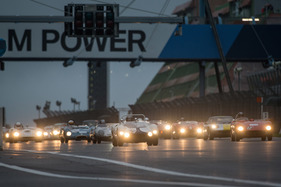
Their rivals all had to settle for at least one lap less, with the seventh-placed driver being particularly surprising. It was Rainer Bastuck who drove his Marcos 1800 GT right between the thoroughbred sports cars.

The result of the half-hour race on Sunday looked almost the same, except that the Tipo 61 was able to finish ahead of the Lotus 15. For the public, however, the results probably mattered less than the Le Mans start, which was celebrated as a show at the beginning of Saturday evening's race.

Almost complete Grand Prix field
The Formula 1 cars with Cosworth engines, which took part in one race each on Saturday and Sunday, were certainly also among the highlights in terms of sound. With 18 cars, the starting field was almost Grand Prix-sized, but the three-liter formula cars covered over a decade of Formula 1 history.

It is therefore not surprising that it is usually an unequal battle when a Tyrrell-Ford 001 from 1970 competes against a wing car like the Williams-Ford FW07B from 1980. The difference in lap times was already 18 seconds in practice.

As a result, Michael Lyons took the top step of the podium in the first race with a 30-second lead in the Williams FW07B, while the second was won by Martin Stretton in the Tyrrell 012. Unfortunately, the second race didn't end without a fender bender, as the Fittipaldi F5A (Copersucar) flew over Lotus 77, which had locked its brakes.
Marathon driver
Marco Werner is known to be one of the crowned Le Mans winners. On the AvD OGP weekend, however, he covered almost as many kilometers as in the Sarthe, as he was seen competing in a wide variety of classes.
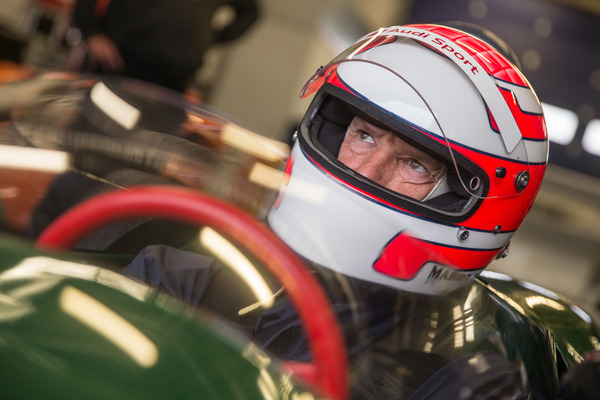
For example, he drove a Lotus 22 in the FIA Lurani Trophy for Formula Junior cars and finished 4th in the first race with the small monoposto. However, Jackson Cameron won both races in the Brabham BT2, while Bruno Weibel came out on top in the D2 class.

Touring car festival
Touring cars from the sixties to eighties competed in several fields and races. The new Touring Car Classics naturally also attracted a lot of attention at the Nürburgring. For once, it was not the fast Mercedes-Benz C-Class cars that were victorious, but Stefan Rupp in the 1996 Alfa Romeo 155 V6 TI. The fastest Ford Sierra RS Cosworth finished fourth overall.

Touring cars also competed in the evenly matched field of former DTM and STW vehicles and, of course, there were also many a revved-up saloon, but also thoroughbred racing cars in the style of a Porsche 935 or a BMW M1 Procar to be seen at the two rounds of the revival of the German Racing Championship.

In the end, Wolgang Kaufmann in a Porsche 935 in the first race and Afschin Fatemi in a Porsche 934/5 in the second were awarded the winner's trophy, while the BMW M1s either decimated themselves or took their opponents, such as Stephan Mücke's Ford Capri, out of the race. In any case, there was plenty of action on the track, as well as acoustic entertainment and flames.

The AvD Touring Car and GT Trophy was won by Sebastian Glaser and Patrick Simon in the Ford Escort RS 1600 with a narrow margin ahead of another Escort.
A Porsche 917 in the sports car field
Certainly one of the most attractive cars in the entire fleet was the Porsche 917, which Claudio Roddaro brought to the Eifel from France. It started with its five-liter twelve-cylinder engine in the middle of open-top Lola sports cars, lightweight Chevron prototypes and powerful 1960s Lola T70s.

In the end, he finished sixth, but he had no chance against the leading Diogo Ferrao and Martin Stretton in the Lola T292.

Andy Willis in the Ferrari 246 Dino beat the Maserati 250 F twice in the Grand Prix cars up to 1960, while the winner of the Formula 3 cars from 1964 to 1984 was Christian Olsen twice in the Martini MK39 with an Alfa Romeo engine.
Vehicle diversity was once again the order of the day for the Gentlemen Drivers, who held a race lasting a good hour in GT cars up to 1965, which ended with victory for Michael Gans and Andrew Wolfe in the AC Cobra.
Anniversary after anniversary
A number of anniversaries were celebrated at the Nürburgring.

In addition to the 45th anniversary of the Oldtimer Grand Prix itself, the event also looked back on 90 years of the Nürburgring, lit 25 candles on the Jaguar XJ-220 cake and celebrated 40 years of the Porsche 928 and 50 years of the Ford Cosworth V8.
The manufacturer show
When the classic car Grand Prix was held for the first time in 1973, it was still called the "Racing and Industry Show". Actually, the name would still fit today, because if you look at how the manufacturers dress up, so to speak, then you can certainly still speak of an "industrial show" in 2017. In fact, the incoming Porsche sports cars filled huge parking areas, where they could be beautifully presented according to model series.

Like Porsche, Jaguar and Volvo also had large show areas and displayed their new vehicles and what else they have to offer. Impressive!

Automotive tradition could also be followed on the track, for example in the run of vehicles from Skoda's motorsport history or in the parade run for Ferrari's 70th birthday.
Everything all right?
So there were many happy faces in the grandstands and in the paddock of the Nürburgring. But perhaps the organizers, who did an excellent job, are not quite sure what the right concept is for the future. In any case, they are looking for ideas and suggestions on how to make things even better.

From a sober point of view, the spectators would of course like to see more exciting races with more battles for position, something that the British simply do better. Unfortunately, there is probably little that can be done to change the fact that the safety-oriented Grand Prix circuit with its huge distances between the spectators and the racing action does not necessarily create a great atmosphere.