Anyone who used to go to the movies in Germany will remember the refrain "like ice in the sunshine", which was a rather clichéd way of encouraging people to buy ice cream confectionery. And suddenly this catchy tune is back in my head; as ice cream for adults is served early in the morning under a steel-blue sky and minus 14 degrees Celsius: Very expensive, particularly beautiful, (automotive) culturally and historically significant, exotic or even all four selection criteria fulfilling automotive creations, which shine for the favor of the audience and the thousands of cameras of the Instagram "grip wearers" or "car spotters". The winning vehicle in the "Best of Show" category is a good example of "It has everything a jury is looking for" and certainly deserves this award; but more on that later.
This time there is no fine crunching of tires from a Rolls-Royce Phantom whose chauffeur is delivering a sable cap forgotten in the hotel to some champagne event with shivering horses on the ice surface of Lake St. Moritz, which is covered in fresh snow, champagne and oyster bars and fortunately stable. Today it's all about "rock'n'roll"; about driving machines from a better time and the roar and vibration of sports and racing engines that seem to cut the thin mountain air razor-sharp, including echoes from the village of St. Moritz. At least when the engines start; after listless carburetors or other components have had to be prepared for use early in the morning with starting aid spray or a hot air dryer.
Let's move on to the starting grid; here are some highlights in the categories:
Legendary Liveries:
The winner here was the Lancia Stratos (1976) in full Alitalia livery, certainly one of the crowd favorites:

Also noteworthy here are:


And the winner of the special prize as "Hero below Zero"

Open Wheels (pre-war or monoposti)
The winner here is the even more beautiful Maserati 4CLT (1949) among all the picture beauties

Even more exciting for some visitors is Colin Chapman's Lotus 18 (1961); Stirling Moss won the Monaco GP in the same year and car type.

This competition class inevitably brings to mind the motto of the Olympics: Taking part is everything; there can't be a single loser here:


Numerous dream cars from the U40 generation are also represented;
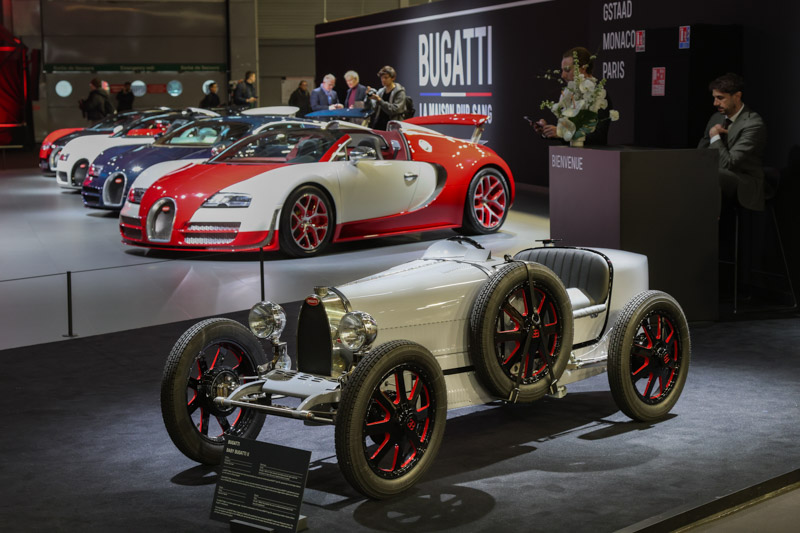
Birth of the Hypercar (Birth of the Hypercars):


However, although Bugatti CEO Mate Rimac and Messrs Koenigsegg and Pagani not only delivered cars but were also present in person, the jury knew how to surprise and chose the 1993 Jaguar XJ220 as the winner in this category.

Barchettas on the Lake
What category could be better suited to this event? Barchettas refers to open sports car bodies modeled on classic northern Italian boat building ("runabouts").
The Lancia Fulvia Prototipo F&M Barchetta from 1968 was exciting and outstanding in its own way.

As one of the most charismatic "Barchettas", the Lancia delivers an almost radical, functional rawness. The abbreviation F&M stands for two legends of the Lancia racing team: Cesare Fiorio (team boss) and Claudio Maggio (chief mechanic). In 1969, they wanted to make the Lancia Fulvia more competitive for endurance races such as the Targa Florio (where drivers welcomed the cooling breeze) or the Marathon de la Route (84 hours on the Nürburgring). They took a normal Fulvia Coupé 1.6 HF and then came the Flex: roof off, windshield gone (replaced by a smaller one made of Plexiglas), doors welded shut and everything unnecessary in the interior removed. All this resulted in a weight saving of almost 200 kg compared to the standard coupé and created a significantly flatter silhouette.

On THE I.C.E., it is fascinating to see how the driver of the Fulvia pulls the car around the bends of the frozen lake with his "left foot on the brake" and plenty of gas. The traction of the V4 engine over the front axle proves to be amazingly efficient on the slippery surface, while the rear-wheel drive Ferraris or the Maseratis demonstrate classic oversteer drifts.

The one-off with its 1.5 liter displacement (originally 1.3) is a likeable "underdog" in a world of superlatives. At less than 600 kg, the Barbier is a featherweight car in which talented engineers wanted to achieve racing success with modified large-scale production technology.
The vehicle, which is owned by a Swiss collector from Zug, will be driven by a young woman with a bit of dirt under her fingernails, as she works in the maintenance of the collection and overhauled the carburetor of the car herself, the interior of which could also only be completed two days before THE I.C.E. as a final measure.
The winner will later be a largely original and fully documented Ferrari 750 Monza (1955).


Winner of hearts
Meanwhile, members of the public are asking themselves whether the Pontiac Vivant 77 from 1965, the only one of its kind in the world and so far a rare guest in Europe, is the real winner in this category. US cars have generally had better popularity ratings in the past than they do today, but the VIVANT inevitably brings to mind a sun-drenched driveway to a beautiful yet poorly insulated mid-century house in the metallic and colorful Palm Springs of the 1970s.
And after all, the Pontiac is still honored with the "Best of Sound" award donated by Bang & Olufsen; whereby the car sounds at least as good as ordinary B&O loudspeakers.

The VIVANT is a "one-off" masterpiece with European design and, as expected, a 6.1-liter V8. It was created as a private project by Pontiac engineer Herb Adams, also known as the father of the "Trans Am" and "GTO Judge".

Looking at the design, both the front and the rear are reminiscent of the famous Alfa Romeo B.A.T. concept cars, often presented as a trio, from the pens of Bertone and Scaglione respectively.

The all-aluminum body was sculpted by the talented "Beatles of Troy", three former Rolls-Royce lead workers from the small town of Troy, near Detroit. After the premiere at the Detroit Autorama in 1966, Adams drove the car himself for twelve years. The car then disappeared from the scene for decades until it was rediscovered in 2009 in a desolate condition. This was followed by a restoration lasting over 4,000 hours, which was crowned with a class victory at the Pebble Beach Concours d'Elegance in 2017.
The VIVANT is driven at THE I.C.E. by Richard Gauntlett, the new owner who is currently reviving the legendary buggy brand "Myers Manx" with great success. Richard reports on the VIVANT that this lightweight construction with more than 400 hp and otherwise based in L.A., California, is already difficult to tame there and even on dry roads. On snow-covered ice, driving becomes a kind of special talent, which is only possible thanks to excellent winter tires. There could not have been a better advertisement for a tire manufacturer; a missed opportunity for them.
Promoting young talent and female power
Younger drivers and those who are young at heart, as well as children as co-drivers, are particularly well represented in the Barchetta group:


A moving farewell for the Patrouille Suisse
Before the active afternoon sessions on the ice, the 15,000 or so spectators on both days looked up at the steel-blue sky for a historic moment: On Saturday, the Patrouille Suisse bid farewell to the Engadin and Switzerland with an emotionally moving farewell performance: six red and white Tiger F-5E jets thundered over the frozen lake at 2 p.m. on the dot, causing goosebumps. As the ace pilots of the Swiss Air Force are facing a political and economic end - at least temporarily - this was their last major appearance, and in a fitting high alpine setting.

Back to the automotive premier class - with the usual suspects, but also a few surprises:
Icons on Wheels:
Of particular note here is the 1937 Talbot-Lago T150C SS 'Teardrop', highly deserving of the "Best of Show".
For many, one of the most beautiful cars of all time, from the Figoni & Falaschi drawing board. The design follows the famous "Goutte d'Eau" water drop shape, which was considered the ultimate in aerodynamics at the time. Fully covered front wheels, the flowing rear line and headlights integrated into the body were ultra-modern before the war. It was the short chassis (2.65 m wheelbase) and "SS" still stood for Super Sport at the time, as this model was actually developed for racing and was intended to be particularly agile; which it was: the in-line six-cylinder engine produced more than 140 hp and a top speed of 180 km/h - today only comparable with super sports cars and low-flying journeys beyond 400 km/h.
If you are also wondering how "icon" is defined, you will find many interpretations; the presence of these characteristics seems appropriate here:
- Instant recognizability (i.e. without having to read brand names, for example).
- Representing a deeper truth or era (e.g. "The golden era of motorsport")
- Timeless aesthetics or beauty
Certainly all of these apply to each of the following list of outstandingly exclusive and beautiful vehicles. But it is up to you, the reader, to discover a deeper truth in each of these vehicles. We look forward to hearing your favorites in the comments.


Finally, the special winner of the "Spirit of St. Moritz Award", signed by artist Rolf Sachs, is the Ferrari Dino 206 S, which is as rare as it is excitingly beautiful.

It's an excellent fit for the Engadin anyway, where Silvaplana will once again be the venue for the big Dino-Raduno in June this year. Anyone riding one can find more information about taking part HERE .
Overall, THE I.C.E. was "the best" this year compared to previous years, according to experienced visitors, especially in terms of the atmosphere on site and the general mood, which was that of "a big and relaxed party". The surprisingly large number of young people on show certainly contributed to this. Some of them were even interested in old cars. In addition, there was further interest in the newer hypercars, fashion or THE I.C.E. accessories (there were long queues in front of the souvenir tent), the parade of famous fashion labels on the bodies of possibly partner-seeking members of the opposite sex or simply the truffle pizza with Aperol spritz; a free sunburn included.
Thanks to all this, THE I.C.E., with an estimated 30,000 visitors over just two days, is likely to have attracted a larger and, above all, younger audience than a polo tournament or the "white turf" gallop race for the first time this year; despite all the prophecies of doom regarding the popularity of classic cars and automotive works of art. The news magazine "Der Spiegel", for example, may want to deprive its readers of their joie de vivre or stir up investment fears and declare that the classic car market is at an end; "THE I.C.E." proves the opposite, albeit - admittedly - at the very highest collector level.
We have captured further impressions for you in the picture gallery.