The Planai-Classic is a three-day rally around Schladming. It has never been as difficult as in 2018, when it was held from January 4 to 6.

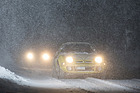
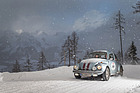
Let's start with the first day and the special stage to the Dachsteinbahn valley station. It snowed like crazy for most of the day and the amount of snow on the road was 30 centimeters or more. The snow was wet and heavy, which proved to be a much more difficult challenge than last year. Only 12 of the 49 participants reached the finish line in the allotted time, with all the others receiving 1000 penalty points.
Some also fell victim to the technical difficulties through no fault of their own. Rauno Aaltonen in the Mini Cooper, for example, found hardly any grip with the small wheels, as the bottom of the car was resting on the snow and the tires were practically spinning empty in the snow without any real pressure from above.
To the overall lead in the luxury GT
Only Alexander Deopito and co-driver Florian in the Mercedes 350SLC were able to lay the foundation for their subsequent overall victory with just 2672 penalty points. "It was quite difficult, if not the most difficult drive up the Dachstein ever. We thought 2017 couldn't be topped, but 2018 really did it."

While the ascent in the cold, dry snow of the previous year could easily be tackled without chains, this year chains were compulsory for practically everyone.
From snow to water battle ...
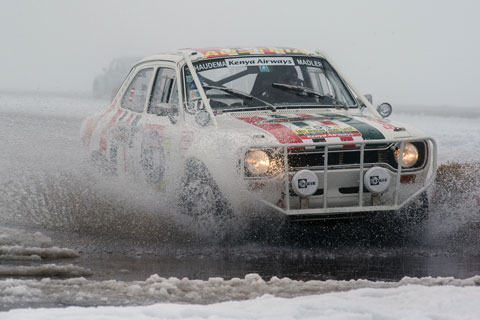
The second day turned the winter landscape into a water fight. Temperatures in the high plus range caused the snow to melt and the water on the Niederöblarn airfield was ankle-deep in various places.
... and then there was the fog
The third day with dense fog in the valley and bright sunshine at high altitude. The special stage on the trotting track in Gröbming was completely engulfed in fog, followed by spring-like temperatures on the Planai mountain stage.

So there was plenty to keep the jaded winter rally drivers happy and the program proved to be extremely demanding.
Difficult decisions
To use or not to use chains was always a hotly debated topic. The driving aids were often urgently needed for a few hundred meters, but then followed by kilometers of phases on almost dry roads, which were not really fun with the iron around the wheel and during prolonged use, one or the other chain disintegrated into its individual parts.
Windshield wipers on or off, the riders kept asking themselves. And anyway, was the fogging on the inside or outside of the windshield?
The fan, if there was one at all, was usually completely overwhelmed. And what was the reservoir doing in the footwell, where was all the water coming from, from above or from below? The clever ones put a bundle of newspaper on the floor to soak up the water and kept removing the bottom layers to keep the moisture in the vehicle as low as possible.
Fulminant race to catch up
The Planai series winners Pius Weckerle and Otmar Schlager (Porsche 911) started a brilliant race to catch up from eleventh place to the final podium position after they had already buried all their hopes on the Dachstein.

But in the end, the Deopitos made it really exciting once again: "We got to the final course with a lead of just over 500 points. However, the car stalled when I started it - it's never done that before. I had to restart it very, very quickly because I only had eleven seconds to the first light barrier. But it turned out to be very close. It was just like the Ennstal-Classic again - ultra close and super exciting. You just need the challenge! We were the first team to complete the hat-trick by winning the Planai and Ennstal-Classic as well as the Racecar-Trophy. All with different cars, so you can see that we can cope with a wide variety of material. I don't need to emphasize that we are happy," said a visibly relieved Alexander Deopito.

When bad luck catches up with you
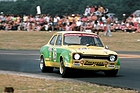
Once again, pretty much everyone was struggling with difficulties: Joachim Althammer was not even able to drive to the start because the gearbox of his Ford Escort gave up during unloading. Manfred Grundner's Volvo broke down on the Dachstein with the same problem.

The accelerator pedal broke on the Maserati Indy. The astonished receptionist at the hotel made the impossible possible and had the pedal welded overnight so that it could be reinstalled in the hotel garage at the crack of dawn.

The eventual winner also had to contend with an unexpected problem when a Postbus blocked the road fifty meters before the finish, causing him to lose important time.
The heroic solo rider
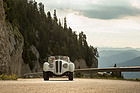
One man finally deserves a special mention at this point. Christian Baier has been driving the Planai Classic alone for years, as he can no longer find a co-driver who wants to take part in this ordeal with him. Christian always drives the oldest car of all, the Lea-Francis from 1927, and wins Epoch 1 of the pre-war cars almost every time he takes part, and not just when he is the only one.

This year, the Wolseley was the second pre-war car at the start. "I wasn't afraid, but I had a lot of respect," said Christian Baier about the conditions on the roads. After all, it's not that easy to drive safely yet quickly with these brakes and this chassis in these conditions. Last year in particular, driving for hours in a completely open car in temperatures of minus 15-20 degrees and repeated heavy snowfall would certainly not have been everyone's cup of tea ...

"The biggest challenge is driving at night with candlelight, which was called headlights back then. Oncoming traffic with modern xenon lights often blinds you for a moment. Then there's also the pre-war braking system ... So caution is the absolute priority."

How do you keep warm in these freezing temperatures?
You don't get much exercise and the wetness does eventually take its toll on your body. "I wear long thermal underwear, of course, as well as electrically insulated insoles in my shoes. Helmet and balaclava are a given anyway. Warming inserts in the gloves and on the back, plus the complete ski suit and a waterproof "complete condom" (rain suit for motorcyclists) over everything," laughed Christian.

And how does he keep the car fit so that it only very rarely breaks down during a rally?
"From mid-September, engine oil is applied to the underside of the car and the frame, which then happens every two weeks. The car stands on cardboard boxes the whole time so that everything can drip off and the floor in the garage doesn't look quite so bad.
The ignition system is wrapped so that no water can drip on it, because that would be the end of the rally. After the rally, the Lea Francis is completely hosed down on the transporter, especially the entire underside, so that the salt is washed away and then placed in the warm garage. The next day, it starts all over again: put the car on cardboard and apply oil again so that nothing can rust!
This has now worked perfectly for over ten Planai Classic events."
No wonder he is and remains the absolute crowd favorite in the entire Dachstein region. The "zwischengas" reporter on site also honors him with a standing ovation!
The problem is behind the wheel
Austrian ex-Safari Rally specialist Rudi Stohl sums up the Planai Classic 2018: "If the tires fit halfway and the car is well prepared, you'll be fine. But you absolutely have to switch on your brain. That's the main problem. The slush is not a problem, because the problem is always behind the wheel."

There was also praise from organizer Helmut Zwickl: "It was a tough and almost borderline event and certainly one of the most difficult Planai Classics to date. We had everything from the deepest winter with 30 centimeters of snow, thick fog, icy and slippery roads, sleet and hail showers. You can't offer more winter than that. Overcoming all this with old cars is a real challenge. Driving modern four-wheel drive cars in the snow is no mean feat. But what these drivers have achieved is truly remarkable - I take my hat off!"
Three winners
The winners of the individual eras were Christian Baier in a Le Francis built in 1927 (era I), Florian Kunz and Sebastian Klackl in a Mini Cooper S built in 1964 (era II) and Alexander and Florian Deopito in a Mercedes 350 SLC built in 1972 (era III).