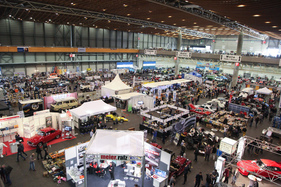


It is considered the largest classic car fair in Switzerland and every year it strategically opens its doors to German and French-speaking Swiss for two days on the language border. This makes the classic car and parts market perhaps the most linguistically diverse event of its kind, as French and German are spoken by around 45 percent of visitors, with English and Italian making up the rest. And nobody at the "OTM" would think that there is a "Röstigraben" that divides Switzerland politically and culturally.
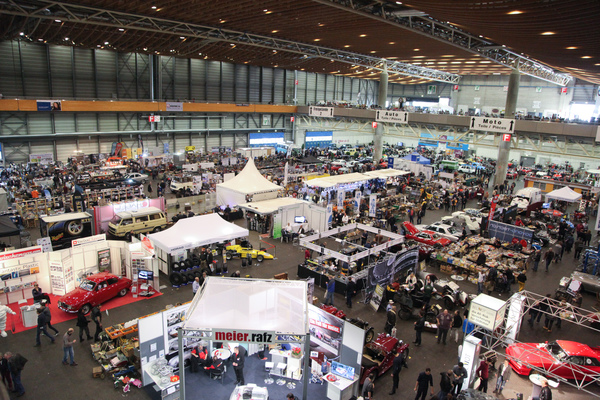
People simply parley as they please and everyone prefers to talk as they please. The fact that this can sometimes result in communication problems doesn't seem to bother anyone seriously; with a drawing or a few hand signals, it quickly becomes clear what is meant.
The unknown Griffon
If you had asked 100 potential visitors before the OTM whether they knew Griffon, 90 or even 95 would certainly not have known a clever answer - after all, there is not even an article on Wikipedia about this racing car brand. At least Jean-Louis Burgnard, the designer responsible for the construction of the formula and prototype cars, can be found there. But just three lines have to suffice to describe his career as a designer. At the OTM, on the other hand, you could learn much more about this talented car builder.

Burgnard, born in 1945, was already a car enthusiast as a schoolboy, but initially trained as an architect. However, his love of racing cars never waned and so the trained house builder went on to study mechanical engineering, which he completed with a highly unusual dissertation. He designed a racing car for it, a two-seater prototype with NSU mechanics, which was financed by Michel Christen and therefore bore the type designation "MC 1701".

The well-known racing driver Charles Ramu-Caccia soon took over the prototype with a tubular frame chassis, but replaced the NSU mechanics with a Ford F3 Nova engine and a Hewland gearbox. Ramu-Caccia immediately became Swiss champion in the 1000cc class, beating Studer and Foitek. Even years later, the sophisticated design was still competitive, as Carron from Valais was able to take Swiss championship class victories in Payerne and Marchairuz with chassis 001.
Burgnard was well established in racing, but still earned his living partly as a mathematics teacher at the Geneva technical college. Further racing cars were created, both prototypes and formula cars. Almost to this day, Burgnard is still thinking about more efficient racing cars, with one project dating back to 2013, for example, again a prototype.
In Fribourg on March 25 and 26, 2017, visitors were able to explore five of his cars, two sports cars and three formula cars. The enthusiastic constructor was of course on site, as were many of the drivers who achieved success with the Griffon racing cars.

All the vehicles on display and their backgrounds had been carefully documented in advance by Urs Hauenstein and his colleagues, with the support of the Swiss Car Register. Anyone interested could learn a lot about Swiss racing car construction.
The cars of the years between the world wars
A beautiful display of cars built in the years between the First and Second World Wars could be admired at the back of Hall 1.

There were racing cars from Bugatti, Aston Martin, Salmson and Maserati, as well as everyday vehicles from Berliet, Chenard et Walcker and Renault.

Informative club stands
The numerous club representatives also went to great lengths to present their knowledge. The information on the individual posters and boards would have been enough to fill many a publisher's book. And the club representatives knew how to explain what wasn't on paper.

There were also a number of rare vehicles on display, such as the Datsun 200 L Cabriolet, which was built in Switzerland around 40 years ago. Or, to name another example, the Fiat derivatives that were on display at the stand of the Amicales Fiat Anciennes and the Moretti Club.

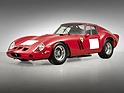
Even the Ferrari anniversary had been thought of, 70 years of Ferrari were celebrated with younger Formula 1 vehicles, but also a Ferrari 250 GTO Recreation and a Ferrari F40.

Buying, not just looking
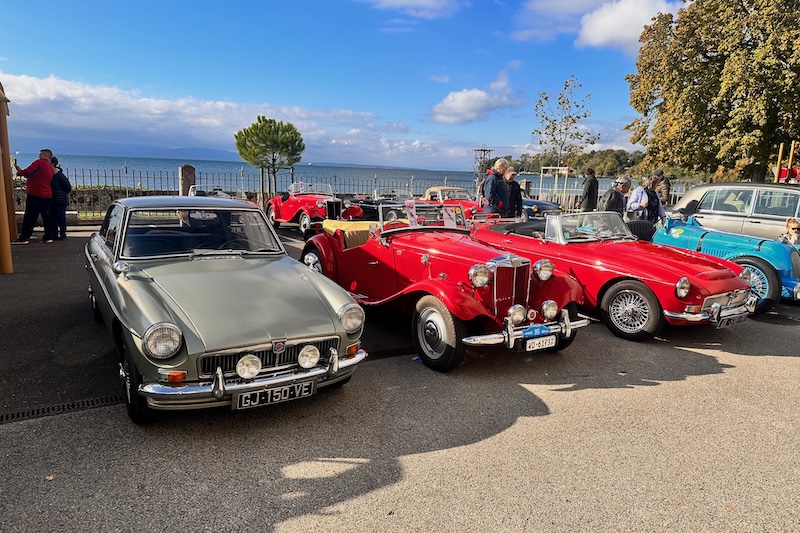
Of course, those who wanted to could also buy cars in Fribourg. There was a Ford Sierra XR4i or a Fiat X 1/9 outside, while the open MG B from the Touring Garage found a new owner early on.

There were also lively discussions at other dealerships, even if they did not always lead to the purchase of a car.

In general, many exhibitors said that they were able to hold many good discussions, both on Saturday and Sunday. However, some were not entirely satisfied with the bare sales figures, even though there was no shortage of visitors (the organizer expected 20,000).
Learning and experiencing new things
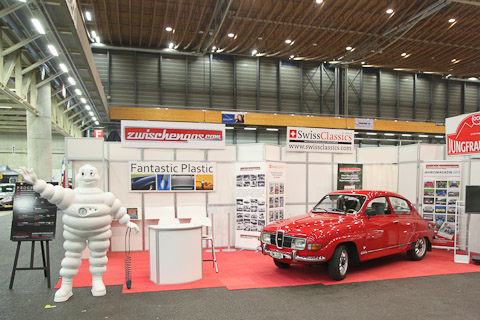
There was lively discussion in Fribourg and some exhibitors were able to find out interesting information about the vehicles they (and others) were showing. For example, the Saab 96 on display at the Zwischengas stand attracted many Saab enthusiasts, quite a few of whom had driven one of these cars with two- or four-stroke engines and had many a story to tell.

The Brazil Car Club had a lively discussion about Brazilian cars that are rather unknown here, such as the Puma, Avallone or Manzoni-DKW.

Elsewhere, the beautiful sports cars from Alfa Romeo were the topic of discussion.
Parts too
Of course, many visitors were primarily interested in spare parts and accessories, although some of those who returned home with a steering wheel or an enamel badge under their arm said that they always found something other than what they were looking for.

But searching is also fun and one or two people were actually able to discover a part that they were still missing.

Between the parts stands, model car dealers and service providers provided further variety. Not all of them were harsh enough to want to gild even the touching of a box.

Season opening
For many visitors, the OTM Fribourg was once again the real season opener this year, which, thanks to the largely dry weather, even allowed them to arrive in a classic car and meet friends on site, have a leisurely coffee or queue together for a long time in front of the barbecue stand, only to end up eating a hot sausage after all.
While the audience seems to change year after year, other things never change.