The Autodrome de Linas-Montlhéry is undoubtedly a motorsport monument. The circuit is located 25 kilometers south of Paris and was the venue for countless races between 1924 and 2005. Back then, when the circuit was built in 1924, car races were still largely held on public roads. The construction of the track was not only for racing, but also for the car manufacturers based in the region, who were able to use the track as a testing ground from then on.
The two huge banked turns with a diameter of 500 meters are what make the track so unusual. Connected by two 180-metre-long straights, they formed the original 2548-metre-long circuit, on which average speeds of up to 220 km/h were possible. However, the track was very dangerous, as the bends had no barriers at the top.

Fast too fast
It soon became apparent that the speeds on the oval were too high for the Grand Prix races. For this reason, various chicanes were built into the track after a short time. Today, the track is 3.4 kilometers long. Only the east curve is included in the layout, while the bumpier west curve is only used for demo runs by the oldest cars.

For vehicles up to 1939
The "Montlhéry Vintage Revival" is probably the largest event dedicated exclusively to pre-war vehicles. This era is characterized by an incredible variety of brands. Brands such as Frazer-Nash, Lorraine-Dietrich, Luxior, Sarolea and Gnome & Rhone are only known to experts today. At the Montlhéry Vintage Revival on May 7 and 8, the glamorous times of these and many other brands flashed back for a weekend. A total of almost 500 vehicles took to the track over two days.
Guests of honor 2022: Amilcar, BNC and Motosacoche
Traditionally, individual brands always take center stage in Montlhéry. This year it was Amilcar, BNC and Motosacoche. Amilcar was founded in 1921 and mainly built small sporty cars, which were also very successful in motorsport. The production of passenger cars was discontinued in 1939. BNC (Bollack, Netter et Cie) was founded at almost the same time as Amilcar. BNC often used built-in engines from SCAP, Chapuis-Dornier or Ruby. The cars, some of which were fitted with superchargers, also took part in the 24 Hours of Le Mans. Production at BNC ended in 1931.

The Swiss company Motosacoche was particularly well known as a manufacturer of motorcycles and built-in engines. However, it also produced bicycles, slot machines and even studio recorders in the early 1950s. Around 200 small cars were produced under the Maximag name by 1928. Motosacoche's motorcycle production was discontinued in 1956.
Several record-breaking cars at the start
As soon as the first motor vehicles hit the roads, manufacturers tried to convince customers of the quality of their products by setting speed or endurance records. One of these early record-breaking vehicles is the Darracq 200 HP, with which Victor Hemery set the first speed record at the end of 1905. Just outside Arles, he reached a speed of 175.44 km/h on a natural road. However, this record only lasted two months.

The displacement monster
One car that was hard to miss at this year's revival was the Fiat S 76, which is also respectfully referred to as "The Beast of Turin". The car was built in 1911 for record attempts in response to the Blitzen-Benz. The Fiat had an incredible displacement of 28.4 liters spread over just four cylinders. Pietro Bordino reached almost 200 km/h with the car on the Brooklands race track in 1911. Later, the Frenchman Arthur Duray increased the top speed to 225 km/h in Ostend, Belgium. However, this was not enough to equal the record of the Blitzen-Benz. Only two examples of the "Beast of Turin" were built.

A national one-off with a U-engine
The return of a unique car to Montlhéry was awaited with great interest. A racing car that was last driven on this track in 1938 and which made motorsport history - albeit not a glorious one. At the beginning of the 1930s, the construction of a French national racing car was initiated by the state in response to the superiority of Alfa Romeo and, in particular, its German arch-rivals Mercedes-Benz and Auto-Union. It would have been obvious to commission an established manufacturer such as Bugatti or Delage to do so. But instead, the new Société d'Étude et de Fabrication d'Automobiles de Courses, or SEFAC for short, was founded.

SEFAC began designing a completely new racing car for the 750 kg Grand Prix formula of the time. A sophisticated U8 engine with two crankshafts and a displacement of almost three liters was chosen as the power unit. What looked promising on paper proved to be unsuitable in practice. The car missed the 750 kg limit by a long way: it weighed around 930 kg. But that was not all. There was also a huge lack of reliability.

The mishap-laden history of the SEFAC racing car
At the 1935 Grand Prix in Montlhéry, racing driver Marcel Lehoux turned up in the car for practice. Lehoux drove a few slow laps. He found the chassis miserable and the brakes almost ineffective. In addition, the engine suffered from a blatant lack of power. To prevent a total embarrassment, the car was withdrawn from the start. The car disappeared into the garage and only returned to a race track in 1938 at the French Grand Prix in Reims. There, too, the car retired after just a few laps.
The SEFAC's last race for the time being was in April 1939 at the Grand Prix de Pau. Here, too, the car had to retire with a technical defect. A few months later, the Second World War broke out. The SEFAC was hidden away in a cellar in Montlhéry and did not reappear until 1948. This time under the name Dommartin E.P. 88, it was used in several races without any notable successes. The car was recently extensively restored. However, bad luck still clings to the SEFAC's tires. At the 2022 Revival, the car suddenly trailed a plume of white smoke behind it on the final lap. The car disappeared back into the transporter. But at least it finished the race.

Long-distance record for "Petite Rosalie"
From March 15 to July 27, 1933, the Citroën 8 CV circled the Montlhéry race track. During these 134 days, the car covered an incredible 300,000 kilometers at an average speed of 93 km/h. The Citroën 8 CV, affectionately known as the "Petite Rosalie", thus set a new record under the control of the Automobile Club of France. At this year's Vintage Revival, the mileage was naturally a little lower.

Maserati in Montlhéry
Another racing car with a well-documented Montlhéry past is the Maserati 8CM Monoposto from the Swiss racing team "Ecurie Braillard". The car won the 1934 Grand Prix de l'U.M.F. (Union motocycliste de France) in Montlhéry with Benoit Falchetto at the wheel. The vehicle competed in many other races, primarily in France.

The young and wild
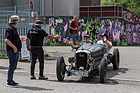
When visiting a classic car event, an increasingly problematic development becomes apparent: there is a lack of new blood in the scene. This is particularly evident in the area of pre-war vehicles. Fortunately, however, there are exceptions. In Montlhéry, it is always the young guns who attract attention, mainly with their high-capacity GN cars. Admittedly, their vehicles will never win a Prix de l'élégance. The condition of their vehicles looks rather improvised, to put it mildly. But the guys are fast with them, very fast in fact. When they drift through the bends, they are sure to be applauded by the spectators.

The 100th birthday in two years
In two years' time, the Autodrome de Linas-Montlhéry will be celebrating its centenary. There are high hopes that a vintage revival will once again take place at this historic venue. The event is unique in this form. Many thanks to the organizers around Vincent Chamon and the 100 or so volunteers. They have done a great job!