

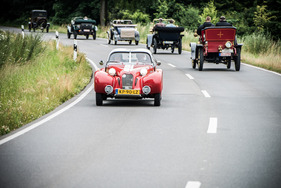


Participants and spectators at the second Kronprinz Wilhelm Rasanz, which took place at the end of June on the Lower Rhine on the German-Dutch border, were able to look back on the beginnings of over 125 years of automobile history.

Over two days, an unusual group of vehicles set off from Krickenbeck Castle near Nettetal to retrace a historic tour from the early days of the last century.

Historical roots
The vehicles' journey was a reminder of Crown Prince Wilhelm's visit to Düsseldorf in May 1907. Even then, the son of the German Emperor was enthusiastic about driving the still relatively new means of transportation, the automobile. Both owner and driver were "motorists". Wilhelm drove through Düsseldorf and the Rhineland in a then brand-new Mercedes 70 hp.
The cars of our great-great-grandfathers
Two groups of vehicles with a total of around 50 automobiles from the years 1895 to 1925 set off on the route. A unique automobile museum on wheels showed the history of the automobile from the pioneering days of Bertha Benz and Co.
Impressively, while just under two dozen vehicles took part in the first Rasanz, the number more than doubled for the second edition.

The participating vehicles puffed and hissed and chugged through the countryside at an astonishing speed with their one, two or four-cylinder engines, even though the maximum speed often barely exceeded 40 kilometers per hour.
On display were vehicles that are usually only seen in museums, "but they don't move there; you can't hear them, smell them or see them drive," says organizer Marcus Herfort. "The aim is to show the great-great-grandfathers of our modern-day automobiles in motion, to demonstrate how powerful cars were over 100 years ago." And this goal was achieved.

Early days of the automobile
There has hardly ever been such a density of vehicles from the pioneering years in the whole of Germany. There were 27 vehicles from the period before 1907 alone, another 20 were built between 1908 and 1918, while a few participants brought along almost new-fangled cars with vintages up to 1925.

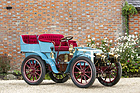
The oldest vehicles had model years with a "1" and an "8" in the first position, e.g. a Peugeot Type 26, a representative of the oldest existing car brand in the world. This car is around 115 years old and its relationship to its predecessor, the coach, was still clearly visible.
The gathering of intrepid drivers with their "brass cars" for the Kronprinz Wilhelm Rasanz brought automotive history to life for automobile enthusiasts, onlookers and classic car owners.
The starting field was international: vehicles came from Italy, Switzerland, Austria, the Netherlands, Belgium, Luxembourg, Germany, France and even from the Channel Island of Guernsey.
Not just driving
It goes without saying that technology that is over a hundred years old can be fragile and, above all, requires much more expertise than modern cars. The Detroit Electric, which was comparatively frugal thanks to its battery electric drive, was perhaps an exception here.

Ottomtor vehicles, on the other hand, had to be lubricated and repaired, so constant affection was required. The steam-powered car required completely different skills.
Although many of the old cars have now been converted to electric starters, the hand crank is still there and in some cases is the only way to bring the engine to life.

Let the owner of the Martini tell us how to start and drive the 1906 car:
"Before starting, the oil level is checked in the sump. If oil comes out of the little tap on the side of the sump, the fluid level is OK.
To start the engine, use the lever on the steering wheel to give it a little extra spark. As soon as the engine is running, switch to pre-ignition.
Although the gearshift pattern is an H, it is reversed, i.e. reverse gear is at the front left and first gear is behind it. The Martini has a four-speed gearbox, which works perfectly and is easy to shift. At least as long as you know what you're doing. This is because the transmission is naturally unsynchronized in all gears, i.e. an intermediate clutch is used when shifting up and the right amount of intermediate throttle is needed when shifting down for a reasonably quiet gear change.
There is a box with glass tubes on the dashboard. Here you can see how the oil drips. This allows you to check whether the oil level is in order. From time to time you also need to check whether the drive chains are sufficiently lubricated. Depending on this, grease (or spray) them.
The Martini is capable of speeds of around 40 km/h. It can also reach 55 km/h, but then the wheels start to shake and the vibrations in the car become so strong that you will want to reduce the speed again. Over 40 km/h is also not pleasant because there is no windshield or roof. At that time, these two elements were often dispensed with, probably also for cost reasons.
Thanks to four liters of displacement from four cylinders, the Martini had enough torque to tackle inclines with relative ease. Some of the less powerful brass cars fared worse, often failing to make the gradients with passengers on board. As a result, the driver and passengers had to get out and walk alongside the vehicle as it climbed the slope at idle speed.
The Martini proved to be very reliable, starting up immediately without any problems even after a night in the rain. It is also easy to drive, bearing in mind that the cornering speed must not be too high due to the narrow tires and the high centre of gravity.
The foot brake acts directly on the axle between the gearbox and the chain drive in the middle of the vehicle. The handbrake is used for multiple braking or if heavy braking is required. This acts directly and exclusively on the rear wheels."
Not entirely without problems
Unfortunately, some participants had to retire early due to gearbox damage or other problems. In most cases, however, a replacement was available so that the ride could be continued the next day, albeit with younger equipment.
For some of the vehicles, the two 100 km rides on June 28 and 29, 2014 were probably longer than the distance covered in the whole of last year.
In all weathers
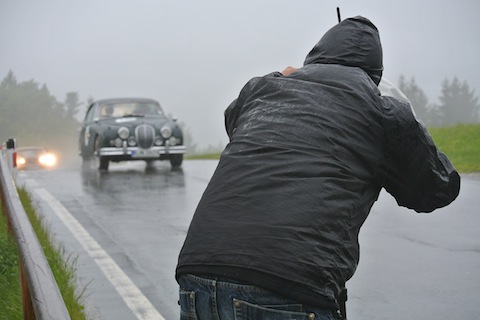
The participants in the second Kronprinz Wilhelm Rasanz had to put up with a lot from the weather. The open-top vehicles in particular had to be well dressed and in a good mood. But they put up a brave fight and consoled themselves with the fact that it wasn't any better 100 years ago.

What was particularly pleasing was the often period-appropriate clothing and the fact that young and old could ride together. In some cases, even generations were skipped.
Registered participant vehicles
| No. | Vehicle | Year of construction |
|---|---|---|
| 1 | Peugeot Type 26 | 1899 |
| 2 | De Dion Bouton Type E Voiturette | 1899 |
| 3 | De Dion Bouton Type E Voiturette | 1900 |
| 4 | De Dion Bouton Type E Voiturette | 1901 |
| 5 | Locomobile type 2 | 1900 |
| 6 | Clement Runabout 2 Seater | 1902 |
| 7 | Opel Darracq | 1902 |
| 8 | Panhard Levassor | 1902 |
| 9 | Guerry and Bourguignon | 1902 |
| 10 | Leon Buat Monocylindrique | 1903 |
| 11 | Richard Brasier Type H Tonneau | 1903 |
| 12 | Autocar | 1904 |
| 13 | Maxwell 12 hp Tourabout | 1905 |
| 14 | Buick Model F Tourer | 1905 |
| 15 | Star 70 HP Racer | 1905 |
| 16 | Renault XB Torpedeo | 1905 |
| 19 | Martini Double Phaeton | 1906 |
| 20 | Mercedes tracked car | 1906 |
| 21 | Spyker Phaeton Tourer | 1907 |
| 22 | Duhanot CG | 1907 |
| 23 | Clement Bayard | 1907 |
| 24 | Opel 10/18 | 1907 |
| 25 | Charron 12 hp | 1907 |
| 26 | Brennabor Type A | 1908 |
| 27 | Delage AC | 1910 |
| 28 | Delage | 1910 |
| 29 | Buick Tourer | 1910 |
| 30 | Overland Type 42 Tourer | 1910 |
| 31 | Delage | 1910 |
| 32 | Brasier | 1911 |
| 33 | Ford T Speedster | 1911 |
| 34 | Ford T Speedster | 1912 |
| 35 | Panhard-Levassor Torpedo | 1913 |
| 36 | De Dion Bouton | 1914 |
| 37 | Opel Torpedo | 1914 |
| 38 | Swift Cycle Car Voiturette | 1914 |
| 39 | Premier 6-48 Indianapolis Racer | 1914 |
| 40 | Maxwell 25 Tourer | 1915 |
| 41 | Locomobile M48 Speed Car | 1916 |
| 42 | Minerva NN Aster | 1918 |
| 43 | Opel 8/25 | 1920 |
| 44 | Packard Tourer | 1923 |
| 45 | Minerva AC Open Tourer | 1925 |
| 46 | Bentley Open Tourer | 1926 |
| 47 | Rolls Royce Phantom I | 1927 |
| 48 | Ford Model A | 1930 |
| 49 | Mercedes 10-40-65 | 1924 |
| 50 | Clement | 1902 |
| 51 | Renault BZ Phaeton | 1909 |
| 52 | Le Zebre Type A | 1911 |
| 53 | Mercer Runabaout | 1914 |
| 54 | Renault Type D | 1901 |
| 55 | Ford Quadricycle (Recreation 2010) | 1896 |
| Detroit Electric | 1915 |