

In the early hours of the last day of June, the Abba song "Thank you for the Music" played over the loudspeakers in the Dänikon/Hüttikon area.
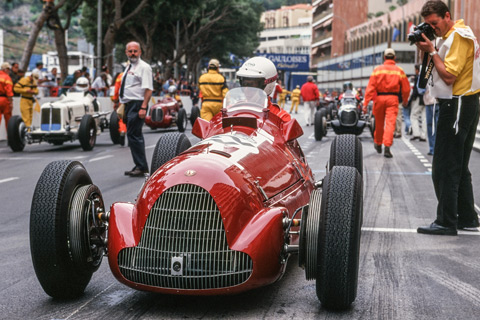
And this song title could well have served as the motto for the "GP Furttal" event. After all, most classic car fans felt that the sounds of the historic cars on the circuit really were like music and the sporty vehicles did not hold back.

Another oval course?
After the events in Lenzerheide and Brugger Schachen, the GP Furttal also presented the riders with an oval-shaped circuit. The layout of the course was reminiscent of the circuit races held in Switzerland many decades ago, such as those in neighboring Regensdorf.
What at first glance may have looked like a boring race turned out in reality to be quite demanding for both equipment and drivers.
Although the course, which was around two kilometers long and driven in an anti-clockwise direction, did indeed have four (almost) ninety-degree bends, the two long straights in between did indeed have further bends, which did not put pressure on the speed - far above the usual legal maximum on country roads - but did make braking on the tighter bends more difficult.
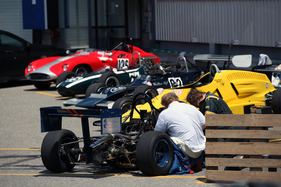
The formation of hand organ dust, which occurred with large fields, proved to be somewhat tricky, while the smaller groups, such as the formula/sports car field, were able to complete their four to five laps per "stint" largely unhindered.
In the drivers' briefing, the race director reminded them that "GP" in Furttal does not stand for "Grand Prix" but for "great fun", and this is only possible if the race is run in an accident-free and disciplined manner.
Successful concept and lucky weather
The GP Furttal, which was held for the first time, is based on an obviously successful concept that succeeded in rallying all the participating communities behind the idea of a classic car event. The clever combination with the village festival in Hüttikon and a carefully coordinated choice of dates, together with the beautiful early summer weather, brought success.

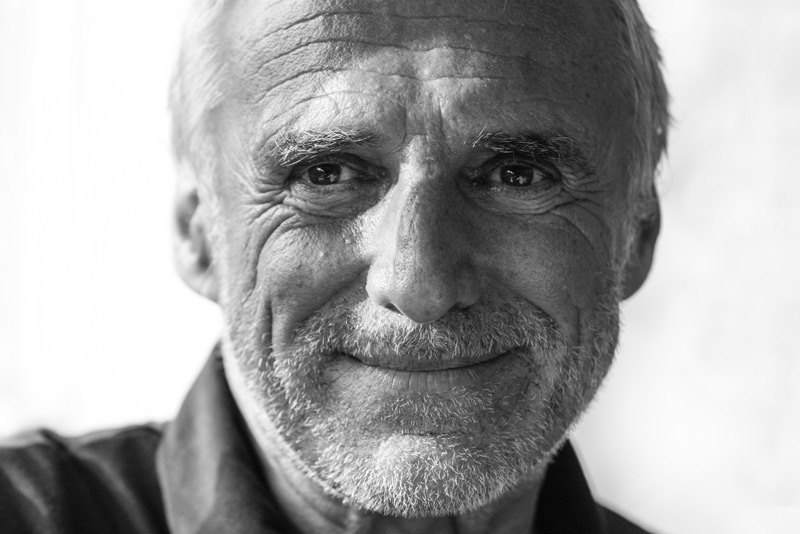
In any case, initiator Urs Schweinfurth was more than happy with the smooth running of the event and the obvious popularity of the 120 or so participants. In any case, he said that even if the program sales for the event, which was free of charge for visitors, still met expectations, the account could be closed with a black zero.
Visitor attendance
Schweinfurth estimated the number of spectators at around 5,000 to 10,000, with many enthusiastic classic car fans gathered around the narrow rank in Hüttikon in particular, for whom it couldn't be loud enough and who seemed to crave burnt rubber.

Crowd favorites such as the brute La France Type 12 or the Ford Galaxie 500 were enthusiastically applauded, but former everyday cars such as the Peugeot 203 C or the colorful American sleds were also observed with interest.
The paddock was also full of people eager to ask the owners questions. The Abba song "Money Money" provided one of the most frequent topics, namely the question of the price of the vehicle.
Rarities on the track
And there was also plenty to discover in the paddock and on the track, as some rarely seen cars were on display to the public in the Furttal valley.

Stefan Vitelli, for example, brought his 1966 Toyota Sports 800, which was finally finished after several years of restoration, to Dänikon. Equipped with an air-cooled two-cylinder four-stroke engine, this bonsai Gran Turismo was produced just over 3,000 times between 1965 and 1969. Only around 10% of production is said to have survived. Thanks to the use of aluminum and thin steel sheets, the 45 hp accelerated the car, which weighed only 580 kg, to almost 160 km/h, a speed that Vitelli probably did not quite reach at the GP Furttal, especially since he still drove the car in.

There were two BMW 328s at the start, one as a classic roadster built in 1939, the other as an Apfelbeck version with twin camshaft head and special bodywork.

Positive feedback
Participants and visitors to the event were enthusiastic, even if everything didn't always run like clockwork and one or two cars either struggled with problems or didn't show up at all.

The organizers would also like to thank the local residents for their tolerance of the event, which was quite noisy for long stretches. And as we all know, the sound of screeching racing engines is not music to everyone's ears ...