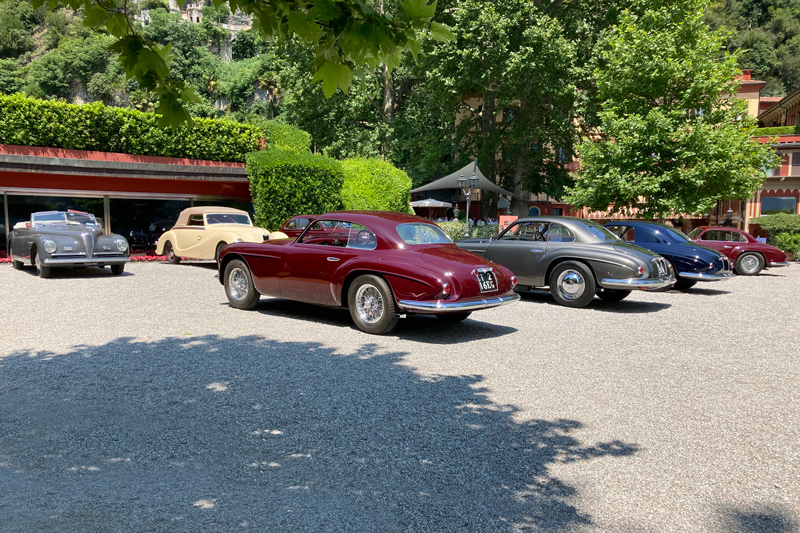
The Concorso d'Eleganza Villa d'Este is one of the best-known and most historic beauty contests in the world; the Concorso was held for the first time in 1929.

The event has followed the same pattern for many years. It always begins with the car inspection on Friday. On Saturday, the classic cars are then parked in the park of the Villa d'Este in Cernobbio on Lake Como and inspected by the jury. From around 15:30, the participating vehicles will then parade in front of the hotel and between the spectators and receive a special prize depending on the outcome. Finally, the audience prize (Coppa d'Oro) will be awarded on Saturday evening. On Sunday, the cars will drive from the Hotel Villa d'Este to the park of Villa Erba, about one kilometer to the south, where they will be presented to the public.

Finally, in the evening, class winners and honorary prizes are announced and the "Best of Show", i.e. the most beautiful of all, is chosen. The Concorso has been organized for many years by BMW in cooperation with the Hotel Villa d'Este. The jury is made up of personalities from the car and classic car scene, including Lord March and designers such as Harm Lagaaij and Patrick le Quément. They have the mammoth task of selecting the most beautiful and prize-worthy cars from the 54 presented gems.
A second glance makes all the difference
Anyone arriving on the morning of Saturday, May 21, 2016 and looking at the list of classic cars registered for the Concorso had every reason to be a little disappointed. Some of the vehicles on the list seemed comparatively normal and unspectacular, missing long-lost concept cars or never-before-seen special bodies.

In fact, some of the parked cars only revealed their merits at second glance or after an in-depth conversation with the owner. For example, there was a black Ferrari 330 GTC from 1966, certainly a beautiful example, but hardly spectacular. If you looked behind the windshield, you would see a picture of the Italian actor Marcello Mastroianni. In fact, this very Ferrari once belonged to the Italian beau, who certainly chauffeured some of the most beautiful women in Italy in it.

Clark Gable, the George Clooney of the fifties so to speak (original voice Simon Kidston), also liked to drive beautiful sports cars. In his case, it was a Jaguar XK 120, which he not only drove in the movie, but also through half of Europe. The handsome American actor even made a stopover at the Villa d'Este.

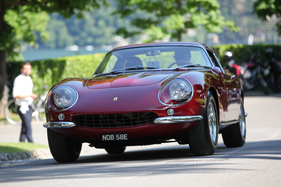
The car was entered in the "Cars of the Stars" class and competed against, among others, the 1967 Ferrari 275 GTB/4 once driven by Steve McQueen, the "King of Cool", which went on to win the class. Well deserved, because the car has seen a lot, was even converted into a spider once, only to be reunited with its original tin roof years later.

A few meters further on was an AC Aceca Bristol from 1956, which is certainly a rare car with 169 examples produced. However, the exhibited version from a Swiss owner was one of three vehicles modified by Ghia-Aigle with a revised front end and switched headlights.
Valuable rarities
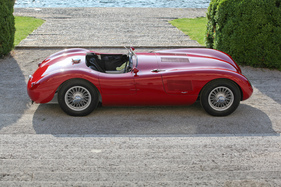
Of course, the 2016 edition of the Concorso also had extremely valuable rarities to offer. For example, there was one of the few Jaguar C-Types that were once built in England. And just a few steps away was a Ferrari 212 S from 1952 as a Spider Vignale.

The Zagato versions of the Aston Martin DB4 GT are also extremely rare; the 1961 car on display was even the exhibition car at the Turin Motor Show.

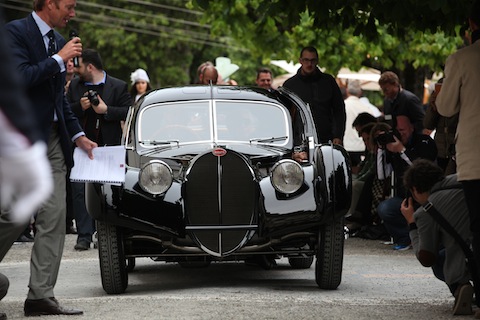
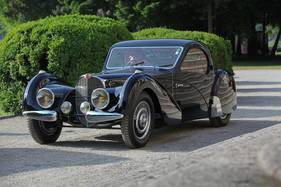
The Bugatti Type 57 SC Atalante from 1937 is also extremely rare. It belongs to a Greek owner who apparently also uses the car. He recently took the 200 hp supercharged sports car out for a meal at home, he said - pizza and beer. When asked by Simon Kidston whether this meal was really appropriate for a Bugatti driver, the owner replied that Greece was bankrupt, after all, and that it was therefore necessary to be thrifty. However, the fact that the Bugatti almost dropped out of the Concorso had nothing to do with economy or a lack of fuel, but was due to the fact that the Keygas pump, which is used to start the car, failed to work, so that the car almost didn't start when the judges were asked to prove its functionality.

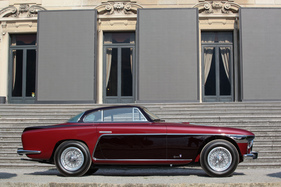
The Ferrari 250 Europa from 1953 with a Vignale coupé body designed by Giovanni Michelotti is a one-off. The unusually styled car caused some controversy when it was presented at the Paris Motor Show, eventually made its way to the USA and has remained in the same family to this day.
Pure originality
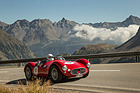
Concours cars are generally imagined as perfectly restored (or preserved) and highly elegant cars with a new car-like shine. However, this was by no means the case for all the vehicles on show in Cernobbio, in keeping with the trend of the times. For example, there was the Maserati 200 Si from 1957, which bore the signs of a long racing life in a visually unrestored condition.

Or the Alfa Romeo Giuletta SZ from 1961, with which Elio Zagato and designer Ercole Spada once developed the "Coda Tronca" version, i.e. the version with the truncated rear, which ran 20 km/h faster than the previous round-tail version. The prototype with the crested rear was shown almost in the condition of a barn find with half of the paintwork preserved. Traces of a carburetor fire were still visible on the hood and the interior was also partially untouched.

Even among the pre-war cars, there were still cars with the first coat of paint, such as an Alfa Romeo RL Nomale as a Coupé de Ville with Farré bodywork from 1925. This interesting car rightly received a prize for the best pre-war car preserved in its original condition, while the same trophy went to the Maserati among the post-war cars.
Young savages
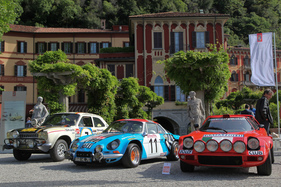
Once again, the organizers of the Concorso also invited rally cars to Como. Particularly noteworthy was a Mini Cooper S, which once had its hood folded up during a special stage, which can still be seen on the sheet metal parts today. However, the class victory in this category went to the 1972 Ford RS 1600, with which Hannu Mikkola and Gunnar Palm won the East African Safari in 1972, the first triumph for a non-African. Owner Claude Nahum clearly felt more comfortable on the gravel road at Villa Erba than on the catwalk at Villa d'Este, or so it seemed.

The Porsche 911 with Monte Carlo history or the Austin-Healey 3000 MK III and Alpine-Renault A110 works cars also thrilled the audience and the powerful-sounding Lancia Stratos is always an attraction anyway.
Pre-war specialties
With a history dating back to the 1920s, pre-war cars naturally play a special role at the Concorso in Cernobbio. There were some very special cars on display, such as the Delage CO 4 1/2 Litre with a body by Gallée from 1920, which was brought to Italy by Albert Fellner, the man who brought a six-wheeled Panther to Como the year before. This Delage is probably the only surviving example of its kind and is clearly an impressive car.

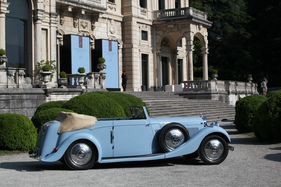
The 1932 Aston Martin International with limousine bodywork by Bertelli is also unique. You hardly ever see early Astons with saloon bodies, but this example also has a rich racing history, with various engines from Sunbeam and Rover right up to modern times.

The fully restored car also has a nice accessory in the form of a small bottle for the man and a small bottle for the woman, intended for whiskey in one case and perfume in the other.

Another very special car is the Lancia Astura Series II with drop-shaped Castagna bodywork from 1933. Interestingly, the body was originally used on an Alfa Romeo 8C and the Astura chassis had to be shortened for the transplant.

The elegant two-seater was rightly honored by the public with the Coppa d'Oro.
Special Lamborghini
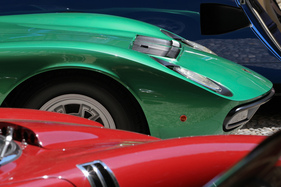
The Lamborghini Miura is probably the quintessential sports car. However, it was actually born and delivered to customers in a relatively immature state. Improved versions followed in quick succession, the last of which was called the SV and was presented in March 1971. And it was precisely this first SV that now faced the judges in the park at Villa d'Este.

The green mid-engined sports car was accompanied by a blue Countach with an equally interesting history. The LP 400 from 1976 was a version that Walter Wolf, the oil magnate and Formula 1 team boss, had built and can rightly be seen as a prototype of the later S models.

Even more special, however, is the Lamborghini Athon, which was built by Bertone in 1980 when Lamborghini was in a very bad financial situation and the brand was on the brink of collapse. The car, designed by Marc Deschamps, had no side windows, no roof and no windshield wipers. Elements of the design were later found on the Citroën BX, which was also designed by Bertone. A closer look at the interior of the Athon revealed parallels with Citroën models.
Quirky and special features
The Lamborghini Athon was by no means the most bizarre car on the course. One of its rivals for this "award" was the 1955 Porsche 550, which Michael May fitted with a huge wing in the mid-fifties to generate more downforce. The mutation was so successful that the competition had the car banned.

More than ten years were to pass before Formula 1 took up the Swiss engineer's ideas again, ushering in a new era of racing car aerodynamics. Today, the Porsche, which has since been restored, belongs to a member of the almost four-hundred-year-old Beretta company dynasty.

The Bentley T Speciale, which Pininfarina built as a one-off in 1968, was also something special. With its fastback body, the car is regarded as one of the forerunners of the later Rolls-Royce Camargue.

Another very special car was the Pegaso Z-102, which, despite enormous financial resources, only managed to produce 86 units, of which the Enasa coupé shown is said to be the oldest surviving example.

The Ferrari Testarossa of the modern era was built in its thousands, but only one example exists as an officially Ferrari-sanctioned Spider, which was created for Fiat owner Agnelli at Pininfarina.

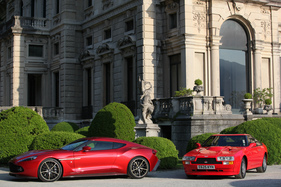
The Aston Martin V8 Zagato from 1985 is also one of the exotic cars. The sports coupé, of which a prototype series of four and a series production run of 52 coupés were built, had 432 hp and was therefore almost overpoweringly fast. The design reflects the 1980s and contrasts starkly with the Aston Zagato variants of the 1960s and the modern era.

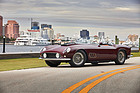
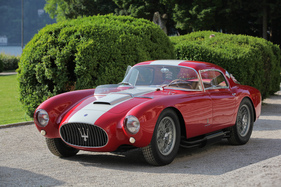
And finally, the Maserati A6 GCS as a Pininfarina coupé from 1954, which caused open mouths at the Paris Motor Show and was bought by Count Alberto Magi Diligenti to take part in the 1955 Mille Miglia. With its low height, it was certainly not comfortable and it certainly got warm in the car, but at the Concorso 2016 it was voted "Best of Show" by the jury and the 190 hp of the in-line six-cylinder engine was certainly sufficient for the drive over the victory course.
100 years of BMW
Organizer BMW naturally also used the Concorso as part of the celebration of the company's centenary and not only showed many milestones from the company's history, but also the juxtaposition of the previous "Hommage" design studies that had been created over the last few years as counterparts to important models of the last hundred years. The "2002 turbo hommage" was shown for the first time.

Actually, there is hardly a car that was shown in Cernobbio about which nothing special could be said or which would form the basis for a full evening's entertainment. There is not enough space here, but the cars are all immortalized in this article and the associated picture galleries.
Participants and award winners
The following list shows all the classic vehicles at the Concorso and the prizes/awards won. The table can be sorted as desired by clicking on the column headings.
| Class | No | Make | Type/Designation | Year | Price |
|---|---|---|---|---|---|
| A | 02 | Delage | CO 4 1/2 Litre Salamanca Gallé | 1920 | |
| A | 04 | Alfa Romeo | RL Normale Coupé de Ville Farré | 1925 | Trofeo "best preserved pre-war car" |
| A | 06 | Rolls-Royce | Phantom II Continental Hooper | 1934 | |
| A | 08 | Squire | 1 1/2 Litre Long Chassis Ranalah | 1935 | Mention of Honor |
| A | 10 | Bentley | 4 1/4 Litre DHC Hooper | 1937 | |
| A | 12 | Lancia | Astura Series IV Convertible Pinin Farina | 1937 | Class winner |
| B | 14 | Aston Martin | International Sallon Bertelli | 1932 | |
| B | 16 | Austo Daimler | ADR 6 Bergmeister Oeffag | 1932 | |
| B | 18 | Lancia | Astura Series II Berlinetta Castagna | 1933 | Coppa d'Oro (audience award), class winner |
| B | 20 | Bugatti | 57 SC Atalante | 1937 | Trofeo "best Iconic car" Mention of Honor |
| B | 22 | Alfa Romeo | 6C 2500 Sport Coupé Turinga/Touring | 1944 | |
| C | 26 | Rolls-Royce | Phantom IV Sedanaca de Ville Hooper | 1952 | Mention of Honor, Trofeo "most elegant Rolls-Royce" |
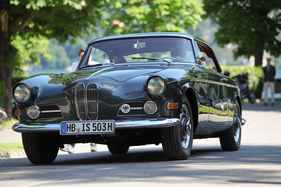
| C | 28 | BMW | 503 Coupé | 1956 | |
| C | 30 | Rolls-Royce | Silver Cloud I Convertible Freestone & Webb | 1958 | |
| C | 32 | Bentley | S2 Continental Fastback Mulliner | 1960 | Trofeo "most sensitive restoration" |
| C | 34 | Facel Vega | Facel II | 1962 | |
| C | 36 | Bentley | T Speciale Pininfarina | 1968 | Class winner |
| D | 38 | Siata | 208 S Spider Motto | 1954 | |
| D | 40 | Fiat | 8V Supersonic Ghia | 1954 | Mention of Honor |
| D | 42 | Maserati | A6GCS Berlinetta Pinin Farina | 1954 | Best of Show, Class Winner |
| D | 44 | AC | Aceca Bristol (Ghia-Aigle) | 1956 | Trofeo "car driven from farthest away" |
| D | 46 | Alfa Romeo | Giulietta SZ | 1961 | |
| D | 48 | Fiat-Moretti | 850 Sportiva SS | 1968 | |
| E | 50 | Jaguar | XK 120C C-Type | 1952 | |
| E | 52 | Ferrari | 225 S Vignale Barchetta | 1952 | |
| E | 54 | Fiat | 8V Zagato Coupé | 1955 | Class winner |
| E | 56 | Porsche | 550 RS Spyder "Michael May" | 1955 | |
| E | 58 | Maserati | 200 Si Barchetta Fantuzzi | 1957 | Mention of Honour, Trofeo "best preserved post-war car" |
| E | 60 | Abarth-Simca | 1300 GT Corsa | 1964 | |
| F | 62 | Jaguar | XK 120 (ex Clark Gable) | 1952 | |
| F | 64 | Dual-Ghia | Convertible (ex Vic Damone) | 1957 | Mention of Honor, Trofeo "best interior design" |
| F | 66 | Ferrari | 330 GTC (ex Marcello Mastroianni) | 1966 | |
| F | 68 | Ferrari | 275 GTB/4 (ex Steve McQueen) | 1967 | Class winner |
| F | 70 | Ferrari | 365 GT/4 BB "Targa (ex Clint Eastwood) | 1975 | |
| G | 74 | Pegaso | Z-102 Coupé Enasa | 1951 | |
| G | 76 | Ferrari | 250 GT Europa Vignale Coupé | 1953 | |
| G | 78 | Lancia | Aurelia B52 Convertible Vignale | 1953 | |
| G | 80 | Ferrari | 250 GT Europa Boano Coupé | 1956 | |
| G | 82 | Aston Martin | DB4 GT Zagato | 1961 | Class winner |
| G | 84 | Bizzarrini | GT Europe 1900 | 1968 | Mention of Honor |
| H | 86 | Lamborghini | Miura P400 SV | 1971 | |
| H | 88 | Lamborghini | Countach LP 400 "Walter Wolf" | 1976 | Class winner |
| H | 90 | Lamborghini | Athon Bertone | 1980 | Mention of Honor, Trofeo "most exciting design" |
| H | 92 | Rolls-Royce | Camargue "Beau Rivage" | 1982 | |
| H | 94 | Aston Martin | V8 Zagato | 1985 | |
| H | 96 | Ferrari | Testarossa Spider | 1986 | |
| I | 98 | Austin-Healey | 3000 MK II | 1964 | |
| I | 100 | Porsche | 911 | 1964 | Mention of Honor |
| I | 102 | BMC | Mini Cooper S | 1965 | |
| I | 104 | Ford | Escort RS 1600 | 1972 | Class winner |
| I | 106 | Alpine-Renault | A110 1800 | 1973 | |
| I | 108 | Lancia | Stratos | 1975 |