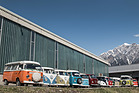
The VW Transporter is fundamentally honest. This is especially true of the early models. Because the route over the Joch Pass towards Oberjoch is mighty steep and the T1s show their effort with their extended rear wheels, their bow legs, which show that the few horsepower of the engines all have to make a mighty effort to lift the load up the mountain. The power spectrum of the five classics involved ranges from 30 to 50 hp.

The oldest bus is a museum-worthy 1954 Samba - known among insiders not without reverence as the "Barndoor Samba" - and at the same time the least powerful of the entire caravan with 30 hp from 1131 cc. In between is a 1961 flatbed with 34 hp, the 1965 T1 ambulance with a 42 hp G-engine of 1493 cc, the 1956 Arcomobil, a T1 with a slightly younger 1500 H-engine with 44 hp and the former PTT bus T2b from 1979 with a 1.6-liter engine and 50 hp. The special feature of the T1's backward-rotating half-shafts with their portal axles - there is a small reduction gear in the wheel bearing housings that changes the direction of rotation and increases the ground clearance - causes their rear end to rise due to the whip effect when they are moved under load.

So things don't move too quickly. Whenever third gear is no longer sufficient, speeds below 50 km/h are to be expected. And all too often it is necessary to reach for the gearshift because otherwise you run out of power. In keeping with the character of the VW boxer engine as a heavily throttled short-stroke engine, not too much torque is to be expected, but a very low rev limit, so a lot of shifting is required in the notoriously underpowered vans. Meanwhile, there are no heat problems, the weather tends to be cool and rainy and the engines are air-cooled anyway and generally unproblematic.

Robust and insensitive
It's amazing how this tour works with cars that are up to 71 years old. None of the caravanists worry about overheating or a technical defect. The buses work like clockwork, even after a passage on the highway, you can look forward to a traffic jam or a gridlocked town with composure. Air does not boil and, admittedly, it only heats up when the engine is running at full throttle. Luckily, the person writing this changed the exhaust before setting off and also resealed and refitted the heating connections, i.e. the fresh air pipes. This at least prevents the windscreen(s), which are about 4 meters away from the ventilation fan, from misting up.

Today, as then, the van offers what it was once designed for: uncomplicated transportation. The "Bullis" are like small spaceships. There are all sorts of things on board that you wouldn't expect to find in a car anywhere else: from a toilet to a kitchen to a bed where you can take a nap during a short stopover or, like the author's daughter, can finish her geography thesis lying down, wrapped up in cozy blankets.

Hard to stop
But once the bus is moving, it feels as if it can hardly be stopped. It moves forward, slowly but steadily. Free of any obstacles, you look at the road ahead. In our case, this was the route off the main roads across the Alps in the German-Austrian border region and the Berchtesgadener Land.

This is probably what the VW Bus community likes so much about this vehicle. It moves, but it slows down. And even better than with other rather sedate automobiles, it doesn't really matter if someone behind you has a different idea about speed. You drive slightly to the right and let him pull away. "So, you think I'm slow? Wait till I go Uphill!" is written on one of the buses, the red high-roof T2b is called Soulbird, and Markus Voneschen's flatbed sign reads: "VW Transporter, success travels with it". That's a lot of self-confidence.

Real work
The group is clearly aware of the bus's shortcomings: driving it is physical work, there is neither power steering nor power brakes. Rolf Berger, owner and restorer of the '56 Arcomobile, says that the front of the bus is little more than a sheet of metal stretched over your feet: "So that it doesn't rain on you, nothing more!" In his car, the thermometer hardly ever showed a temperature of more than 15 degrees, but that didn't stop the coachbuilder from consistently driving in his knee-length pants. The author and ambulance driver knows that, once seated, he becomes an integral part of the bus crumple zone: "No risk - no fun!"
The brakes on the T1 are not particularly convincing. Moreover, designed as duplex brakes at the front, i.e. with two brake cylinders per wheel so that both linings are in contact with the drum, they are always somewhat difficult to adjust correctly and tend to drag. In addition, the high volume of oil in the 6 wheel brake cylinders means that the brake pedal moves significantly towards the floor panel even when the linings are only slightly worn, until resistance is felt. The brakes must be adjusted regularly.

Yes, the old Bullis need a little affection. Please change the oil every 5000 kilometers - there is no oil filter, just a sieve - the front axle needs to be lubricated after 2500 kilometers. Depending on the weather and the roads used (gravel and dust roads), it is also worth changing the filling in the oil bath air filter and rubbing it out thoroughly.
But back to the brakes: according to the old formula, it makes sense to use the same gear for downhill riding that you have already used for uphill riding. This is just as slow, but just as reassuring.

Small worlds
Shortly after the start of production in spring 1950, the first vans also arrived in Switzerland. However, they still accounted for a very small proportion of VW production in Wolfsburg. Only just under 10,000 vehicles were produced in the first year, and just over 270 are said to have reached Switzerland. It is no longer possible to find out to whom the Swiss importer AMAG supplied the first VW Transporter. The first ever commercial customer for a Type 2 was the Cologne-based perfumery company 4711.

The small Swiss delegation and their cars represent a good mix of the most important Swiss van customers of the time. Simon Kuhn's 1954 Samba was used as a family car until it was parked in a barn, rediscovered in the 1980s and subsequently restored by his father.

Back then, it was still quite possible to find this or that part as NOS (New OId Stock) at a local VW garage. Today, not only the early Samba buses, but also the corresponding parts for them, are now being sold in gold.

The Arcomobil from 1956 is the work of a resourceful carpenter who converted a VW Kombi into a camper, first for himself and then for other interested parties. The highlight of the conversion at the time was that a large area of the living space could be raised using an ingenious folding wooden construction. In addition, the whole thing was insulated and thus protected against heat in summer and cold in winter. At that time, the big competitor Westfalia only had a small flap in the roof, as a kind of steam extractor, and later a small lifting roof, under which you could at least get changed in the car while standing upright.

The 1961 pick-up, on the other hand, was used by a transport company in Graubünden and served as a classic load donkey before the son of the company owner, Markus Voneschen, completely overhauled it. Perfectly executed, from today's perspective it would seem sacrilegious to load the carefully attached wooden slats on the loading area with any kind of freight. The flatbed of the truck is still the original one, including all fittings and straps!

The 1965 ambulance was part of a small series ordered by the army and has been in the author's possession since its liquidation in 1991.

And last but not least, the T2b high roof comes from former PTT stock. This bus is very easy to recognize as an ex-postman, a "Fourgon", due to its right-hand drive and the passage between the two front individual seats into the loading space. Today, instead of postal parcels, there is a cozy "living space" in the back - furnished and colour-coordinated to match the red and white theme of the exterior paintwork.

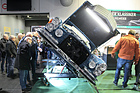
Bulli special exhibition
The organizers of the 75th anniversary meeting have traced the history of the Transporter with great relish using various time pictures. It is striking that the VW van was used in almost every situation in life. Whether in popular culture, in reports on important events or in private family albums, it is bound to appear somewhere.

That's what makes this car so very human, because right from the start it presented itself as a work colleague, family friend or good buddy on the way to discover the world. The fan community at the Bullitreffens was also a colorful mix. Both the off-road faction, nowadays on the road with a raised T6 4motion, and the originality freaks came together here. A good example of this was an unrestored 1952 Barndoor Samba in the square or the simple, gray panel van of an Austrian collector, which has miraculously survived over 70 years almost unscathed.

There was everything in between: well-kept old Bullis, rebuilt cool specimens, new cars, rats with only partial paintwork or elaborately decorated, not always quite contemporary, younger specimens trimmed to "retro" with whitewall tires. It is very pleasing in this scene that the individual desire for one's very own, specific car is accepted.


There are certainly also discussions here about the number of grooves on the horn button of very early barndoor buses or whether the later, larger rear lights of the 1960s should be installed on a 1958 bus.

And yes, there are certainly some differences between the rear-engine faction and the "backwards drivers" - as the former dub all those who, in their opinion, have installed the engine at the wrong end of the car, in the front.

One important factor, for example, is that models with contemporary engine power have also been available since the introduction of the T4. The leisurely lurching along within constant reach of the rev limit has long since given way to the headlight flasher in the left-hand lane in front-engined buses, at least in the top-engined versions.

However, many of the buses present in Salzburg had one characteristic in common, which the PR manager for the California van, the camper variants, and globetrotter Christian Schlüter describes as follows: "A car without a bed is broken!"

Well then, Markus Voneschen's 1961 pick-up didn't come with a bed, but that didn't stop the tour organizer of the Swiss delegation, graphic designer and founder of the VW website Bugbus.net, Claude Schaub, from seeking out the protective tarpaulin of the light grey truck and rolling out his mat under it at a very late hour instead of the roof tent on the author's car. "The patter of the rain under a fabric roof is much more pleasant than under the bare metal of a panel van," he said the next morning.

Making the best of the situation was probably the basic motto this weekend, because despite the adverse weather and an astonishingly cold temperature close to freezing in mid-May, the mood in the infield of the Salzburgring was always excellent.
According to the responsible organizers from Porsche Salzburg, they are already considering whether to repeat this ring meeting next year. The enthusiasts could certainly be won over again!
A big thank you goes to AMAG Import AG with VW Commercial Vehicles Switzerland, who actively supported this tour.