
Chevrolet Corvette Sting Ray 327 - addictive eight-cylinder beat


You have only
14 out of 79
images seen in high resolution
Summary
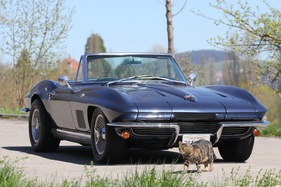
With the second Corvette, called the Sting Ray, Chevrolet eliminated many of the weak points that had stood in the way of its predecessor's success. The result convinced the trade press and the market. Waiting lists and purchases at list prices were the result. Almost twice the number of vehicles were built in half the time of its predecessor, until the C3 was launched as an even more successful successor.
This article contains the following chapters
- Still made of plastic
- Stunning design
- Advanced technology under the skin
- Further development and improvements
- Pleasant to drive
- The eight-cylinder beat
- A real sports car at last, and a successful one at that
- Affordable maintenance
- Now highly sought after
- Article and further information
Estimated reading time: 6min
Preview (beginning of the article)
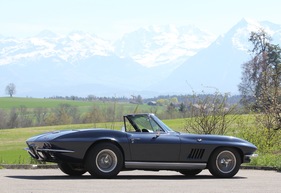
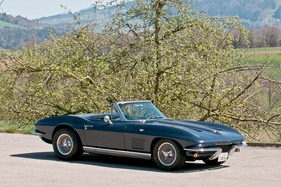
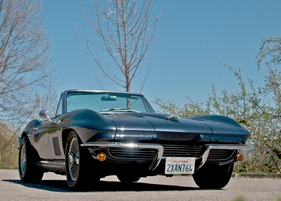
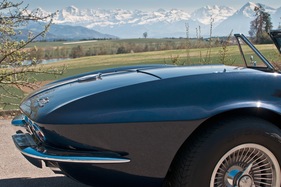
The first Corvette, which is now called the C1 and was built from 1953 to 1963, rightly had the reputation of a "boulevard sports car", i.e. it had the appearance of a sports car, but suffered from sub-optimal handling due to the mass-produced parts used. For the successor, therefore, all the stops were pulled out and the experience gained with the motorsport use of the first Corvette was used to build a "real" sports car from the Corvette. With success! The basic principles of the first Corvette - front engine, rear-wheel drive, polyester bodywork and, in particular, the box frame - were retained for production reasons, even though vehicles with a tubular frame had already been successfully used in racing. To improve weight distribution, however, the wheelbase of the new Corvette was shortened by 10 cm, which meant that 51 to 52% of the weight now fell on the rear axle, depending on the engine. The length was now 445 cm, and the vehicle was 5 cm lower and 10 cm shorter than its predecessor. With a width of 177 cm, the Sting Ray was a wide vehicle for the 1960s, but was still two centimeters wider than the 300 SL at the time. Today, when almost every mid-size car is 1.8 meters wide, the dimensions of the second Corvette seem almost compact. However, at around 1,400 kg, the Corvette was not particularly light, despite the plastic body.
Continue reading this article for free?
Images of this article



_RM.jpg)


