
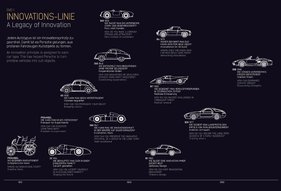


Innovations are often the driving force of a company. The variety of innovation types is almost limitless. However, if you take a closer look at the enormous range, some innovation principles appear again and again and are therefore classified as particularly promising.
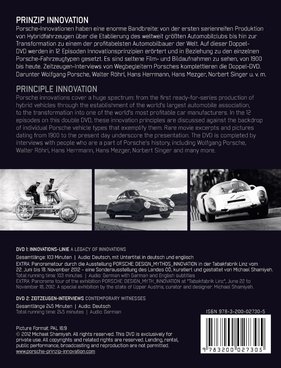
The maker of this film, Michael Shamiyeh, is professionally involved in innovation, or more precisely, in laying the foundations to enable innovation in companies in the first place. He studied the success stories of many companies and extracted the key success drivers behind them. As the success story of Porsche is so complex, the most important recipes for a company's success are explained using Porsche as an example and presented in the film in sound and vision.

It is refreshing to have an otherwise rather abstract topic (enabling innovation in a company) served up in such an entertaining way without neglecting the learning factor.
Learning from Porsche
Porsche innovations have an enormous range: from the first production-ready hybrid vehicles to the establishment of the world's largest automobile club and the transformation into one of the most profitable automobile manufacturers in the world.
The question of why a company like Porsche is so successful cannot be answered in a single sentence. The successes were achieved over decades, the foundations laid years before the breakthrough. Michael Shamiyeh has spent years researching Porsche's innovative steps and has summarized them in a set of 12 universally valid innovation principles.
These are presented in 12 chapters on the DVD, each associated with a Porsche vehicle.

Almost 6 hours of footage
In addition to the actual learning effect of having these principles explained, you also get a comprehensive overview of Porsche's history, always with factual commentary and supplemented with rare historical film material.
It is interesting to see which Porsche vehicles were associated with which innovation principle: "Understanding visions" with the VW Beetle, "Excellent team" with the Porsche 360, "Forming cooperations" with the Porsche 356, "Fans instead of customers" with the Porsche 550, "Radical renewal" with the Porsche 917, "Timeless design" with the Porsche 911.
If you want to get to know all twelve innovation principles in detail, you should watch the movie. In this film review, we have simply selected a few and present them here.
Principle: Creative ideas - innovation begins in the mind
The film begins at the turn of the century in 1900, with Ferdinand Porsche's original work, showing the innovations he produced at the time in impressive moving photos and film footage. A tinsmith became an electrician, and he later brought this knowledge to Lohner Werke, a carriage manufacturer with high standards. He experimented with electric motors and drove his self-built four-wheel-drive electric racing car at the 1902 Exelbergrennen, where he won.

The theory behind these illustrations: Innovation starts with the person. With a person who has both the ability and the will to absorb knowledge and recombine it in unusual ways until the individual parts suddenly come together to form new ideas.
Principle: Discoveries need experimental freedom
Experimental freedom is the cornerstone of all innovations. This is vividly demonstrated in the second chapter, when Porsche repeatedly presented car designs that the current employer did not want to build, because they were too risky and too expensive. Ferdinand Porsche refused to be distracted, resigned and moved on to the next client with his ideas and concepts.
However, the many new ideas and prizes that Porsche won in the course of his experiments quickly opened the doors to new clients.

In this chapter, you will learn some details of the early racing car called Sascha, which Ferdinand Porsche was able to design and build thanks to the financial support of the passionate car enthusiast Count Sascha Kolorath. With 50 hp and a weight of 500 kg, this car reached 140 km/h and competed in the 1923 Targa Florio as a PR campaign.
Principle: Radical renewal
How do you meet challenges in turbulent times? Many established companies make the mistake of gradually renewing a good idea in order to adapt it to new challenges in the best possible way. However, this runs the risk of ending up in an innovation dead end. The more promising method is to rethink every challenge from scratch. Aiming for the ideal state for a product prepares the ground for radical innovations.
In 1965, Ferdinand Piëch wanted to win the brand world championship. But the attempts to optimize the first modern Porsche sports car, the Type 904, failed.

Piëch now issued the instruction to completely rethink the sports car. To this end, he formed his own team of designers and engineers who had nothing to do with the past. The developments culminated in 1969 in the Type 917, one of the most successful racing sports cars in history. Several overall victories were achieved with it, including the 24 Hours of Le Mans for the first time in 1970.

Principle: fans instead of customers
If a company is positioned as a brand, this is an invaluable competitive advantage. Customers identify with "their" brand and recommend it to others of their own accord. They feel emotionally connected to the company and are much more loyal.
Even in its early years, the Porsche sports car manufacturer has succeeded in building up a loyal brand community that is unique in the automotive world. Important cornerstones of this development were the unmistakability of the product, the targeted cultivation of traditions and rituals, but also the sense of moral responsibility that the Porsche family has shown towards its customers. The result was a unique feeling of togetherness, which is still evident today in a pronounced sense of "we".

A dozen exciting interviews
The second DVD contains 12 very exciting interviews and provides insights into Porsche's work:
- Wolfgang Porsche: son of Ferry Porsche and grandson of Ferdinand Porsche
- Klaus Bischof: Director of the "Rolling Museum"
- Walter Röhrl: German professional rally and test driver for Porsche
- Sabine Schmitz: German racing driver and television presenter
- Hans Herrmann: Racing driver for Porsche and participant in Le Mans and endurance races
- Willi Kauhsen: One of the most successful Porsche drivers of his time
- Hans Mezger: Former head of the Porsche motorsport department
- Nobert Singer: Porsche racing engineer. Honored with the "Spirit of Le Mans" award.
- Georg Ledert: Head of advertising at Porsche for many years
- Herbert Linge: Porsche racing driver and developer of the Porsche customer service network in the USA
- Heinz Rabe: Son of the long-time Porsche chief designer Karl Rabe
- Peter Reimspiess: Son of the longtime Porsche employee Franz Xavier Reimspiess
Conclusion
The film has struck an interesting balance between conveying the theory and practice of innovation in a company, interwoven with the history of what is probably Germany's most glorious sports car brand. Although one wishes there were a few fewer photos and more moving film sequences in between, the film remains interesting right to the end. The film itself can be described as "innovative", because highlighting innovation through different episodes of a company is an innovative undertaking. A recommendable film for all those who are interested in the entrepreneurial topic and for those who would like to brush up on Porsche's history with a learning effect.
Technical information
- Order DVD at Amazon
- Language: German
- Subtitles: English
- 2 DVDs
- Publisher: Shamiyeh Associates
- Playing time: 348 minutes