

In the book with the factual title "VW Kübewagen Type 82", historian Janus Piekalkiewicz presents the history of this Kübelwagen in detail. On 190 pages, the author comes pretty close to the Kübelwagen.

Extensively researched
It should be said in advance that many a type monograph has to compete with this book in terms of research quality, book structure, image selection and image description. Piekalkiewicz has not only rummaged through the archives at Volkswagen and Porsche, but also at the Federal Archives in Koblenz and other army archives in London and France. Anyone who researches so meticulously usually has something to say in the end. The book from Motorbuchverlag is a revised new edition of the first edition published by the same publisher in 1977.
The Kübelwagen or the history of the Second World War
When the Second World War broke out in September 1939, it was another six months before the German troops received the first VW Kübelwagen, with which they continued to be deployed on three continents over the next three years. By February 1940, the Type 82 was ready for collection from the assembly line in Wolfsburg. No wonder, as the company had already been working on a military version of the KdF car since 1938.
With these first studies, the author begins to tell the story of the Type 82. The story of conquest and retreat up to the collapse. The focus is always on just one actor, the VW Type 82, until May 1945 when destroyed Kübelwagens were no longer available for delivery from the bombed-out Fallersleben plant. Piekalkiewicz is considered a proven expert on the Second World War and has written numerous non-fiction books on the subject of weapons technology. His books are considered to be exemplary in their objectivity and presentation and are extremely well researched.

150 pages of pictures and development history
During its six years of service, the Kübelwagen underwent numerous modifications and specifications. Whether for the Afrika Korps or the winter outside Moscow. VW always developed a version that could cope with the stresses and strains. The author alternately expresses this development history in text and pictures. Despite the tragic subject matter, the wealth of photographic material in particular, which always shows the Kübelwagen in action, mostly at the front, is the chronological thread that illustrates the differences between the Kübelwagen and the military requirements over 150 pages.
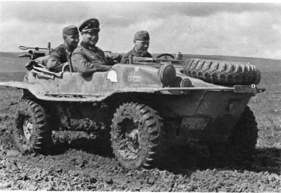
Whether in the deserts of North Africa or in the freezing cold winter on the Eastern Front, the black and white images throughout not only give a first impression of the numerous areas in which the Kübelwagen was used, but also provide an atmospheric insight into the importance this VW must have had for the German troops during the Second World War. This wealth of images is enriched by the text passages in which the technical modifications and adaptations are explained in detail.

Type 82 and its derivatives
The book is rounded off by a 30-page appendix containing facts and figures on the Kübelwagen. In particular, the various models that went beyond the simple Kübelwagen are also listed here. From the Schwimmwagen to all-wheel drive versions and half-track vehicles, this appendix rounds off the history of the Kübelwagen neatly and comprehensively.
Kübelwagen instead of KdF-Wagen
Before the Beetle literally conquered the world's civilian markets after the Second World War, the Kübelwagen had failed in its military campaign of conquest. Only just under 200 civilian Beetles, then known as KdF cars, left the Wolfsburg plant. None of these cars went into private hands, but only to Nazi departments or selected paladins of the 3rd Reich. In contrast, over 50,000 Kübelwagens rolled off the production lines and into service at the front.
This book tells the story of the Beetle before the Beetle. The book deserves particular praise for its comprehensive presentation and detailed picture descriptions. As a rule, the captions include the location, date, troops and precise comments on the situation. Numerous notes are also given on the soldiers' equipment, which is less to do with the vehicle than with the requirements of the situation. The result is an almost 200-page monograph that has been thoroughly researched and provides the interested reader with a detailed overview of this Volkswagen.
The ambivalence of the rather technocratic text on the vehicle is more than compensated for by the selection of images in combination with the detailed subtitles. In view of the prices for air-cooled Volkswagens, the Kübelwagen has also achieved collector's status. Good examples are traded at over € 50,000. In contrast, the book is a bargain at a price of € 19.95. But the Kübel definitely deserves this book. Read it for yourself.

Bibliographical details
- Title: VW Kübelwagen Type 82
- Author: Janusz Piekalkiewicz
- Language: German
- Publisher: Motorbuch Velag, 1st edition 2015
- Size: 230 x 265 mm, hardcover
- Format: 192 pages, 217 b/w pictures
- Price: € 19.95 / CHF 27.90
- ISBN: 978-3-613-03768-7
- Order/Buy: Online at amazon.de, motorbuch-versand.de or in well-assorted bookstores