As if by some twist of fate, right now—just as the Audi plant in Neckarsulm faces closure—marks the 100th anniversary of an extraordinary event that captivated the entire motorsports world at the time.
Four-for-one victory
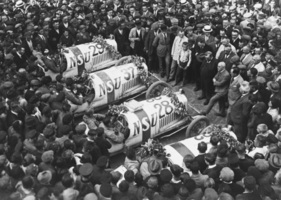
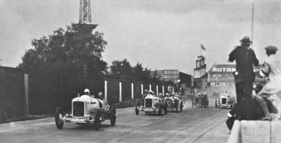
On July 11, 1926, the NSU six-cylinder supercharged race cars—developed entirely from scratch at the Sulm plant—achieved a spectacular four-way victory in the F class (up to 1.5 liters) at the first “1926 German Grand Prix.” This Grand Prix—organized by the AvD, the Automobile Club of Germany—was the first international race in Germany after World War I and, with around a quarter of a million spectators, THE motorsports event of 1926.
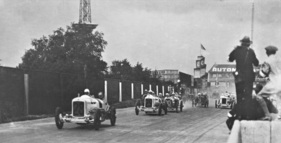
Neckarsulmer Fahrzeugwerke had developed the NSU Type 6/60 PS specifically for racing. It was NSU’s first six-cylinder model, with the “6” indicating its tax class. It produced 60 PS, weighed 830 kilograms, and had a top speed of 175 kilometers per hour. Incidentally, the car was only available in white, the standard German racing color at the time.
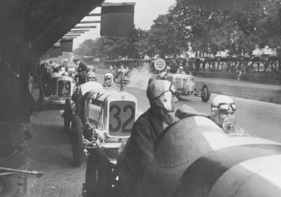
The strength of the NSU race cars lay in their new inline six-cylinder engine. The engine proved robust over the entire distance of more than 400 kilometers, enabling NSU race car drivers Georg Klöble, Jakob Scholl, Ernst Islinger, and Josef Müller—in that order—to take the top four spots in this class. This achievement attracted a great deal of attention both at home and abroad.
Upon their return from Berlin, the successful NSU drivers were given a rapturous welcome at the Neckarsulm plant: employees and the then-directors Fritz Gehr and Georg Schwarz congratulated the drivers, who then set off on a “promotional tour” to Heilbronn and Stuttgart in their race cars. My great-grandfather Fritz Gehr placed his left foot on the front axle of car No. 28 (Jakob Scholl) for the photo.
From the Race Track to the Road
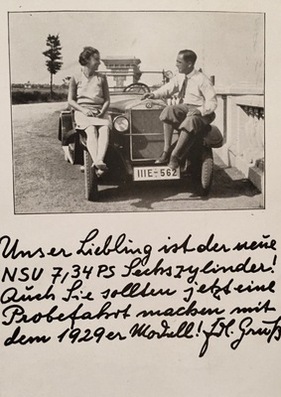
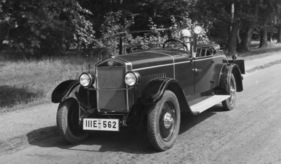
The success of the NSU Type 6/60 PS on the racetrack led to the decision in Neckarsulm to develop a new car that would fit into the then-popular 6-PS tax class: the NSU 6/30 PS. Its six-cylinder engine was derived directly from the race engine. The new car was presented to dealers as early as late 1927. However, it was not built until sometime in 1928. NSU then ceased production and shifted its focus to the technically closely related successor, the NSU Type 7/34 PS.
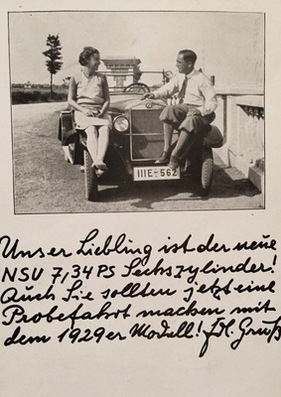
The author’s grandmother, Gretel Krauss (née Gehr), drove one of the first examples of this NSU 7/34 six-cylinder—specifically, a convertible—on her honeymoon as early as the end of July 1928. This was, of course, something very special and was permitted by her father, NSU General Director Fritz Gehr, only on the condition that many photographs of the car be taken during the trip to Blankenberghe, which could then be used later for advertising purposes.
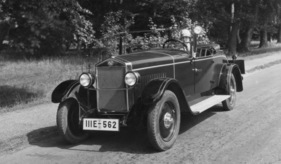
It was a good thing that Gretel Krauss had married the photo dealer Eugen Krauss, so this task was a real pleasure for him (especially with his pretty, nearly 20-year-old, newlywed wife as the model).
This is just one example of the extraordinary innovative spirit that has characterized Neckarsulm for over 100 years.
About the Author
Susanne Schartel is the great-granddaughter of NSU General Director (until 1933) Fritz Gehr and the author of the biographical novel *Hilde & Tommy*, in which she—illustrated with over 400 images—tells the stories of her ancestors connected to NSU and Tom Bullus. The exceptional English motorcycle racer Bullus not only rode from victory to victory for NSU from 1930 to 1932, but also became Schartel’s beloved great-uncle in 1933 when he married Gehr’s youngest daughter, Hilde.