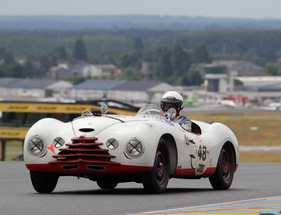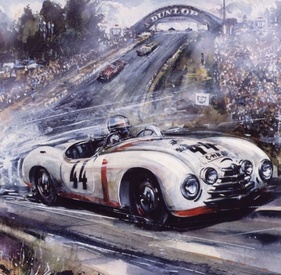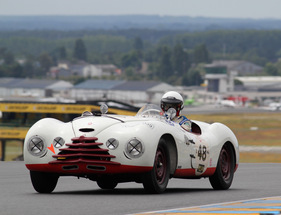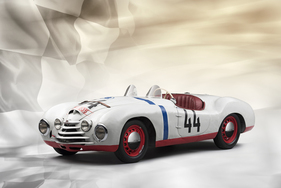
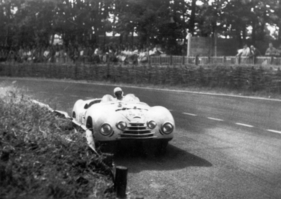
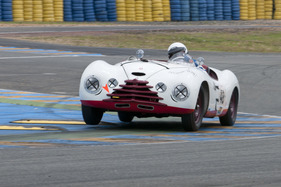
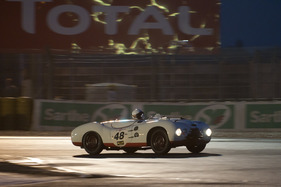
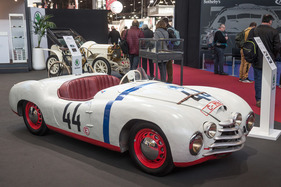
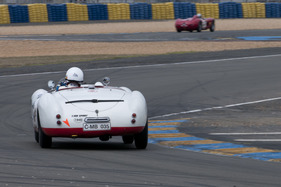
In 1950, Škoda Auto experienced a very special moment in the company's motorsport history: the only start of a Škoda model in the world-famous 24 Hours of Le Mans to date.
Successes in rallying
After the Second World War, Škoda presented a new model series: the 1101/1102 'Tudor' was based on a 1,089 cubic centimeter four-cylinder engine and quickly became very popular in many European countries and overseas markets. The technically modern, robustly constructed vehicles proved their great reliability on numerous rally tracks and in endurance races on circuits. In 1948, for example, they won all four categories in which Škoda vehicles competed in the 2,649-kilometre Raid Polski. In the South American Montevideo - Melo - Montevideo Rally, they took first and second place.
A car with only one goal: Le Mans
However, the 'Tudor' models - the name is derived from the English 'Two Doors' - also demonstrated their performance on circuits. At the 24-hour race in Spa-Francorchamps, Belgium, the three Škoda four-seaters with closed bodies each covered 1,972 kilometers and finished the endurance race in the top three places in their displacement class. To make this success clearly visible on the track, the Czech trio often completed pit stops in threes and crossed the finish line in formation.
For the 1949 season, the Czech car manufacturer developed a special racing variant based on the 'Tudor': the Škoda Sport. The open two-seater had a wheelbase shortened by 400 millimetres and a particularly flat pontoon body made of lightweight aluminum and made its debut in Brno at the Czechoslovak Grand Prix. The real goal, however, was Le Mans, the world-famous 24-hour race in the French department of Sarthe.
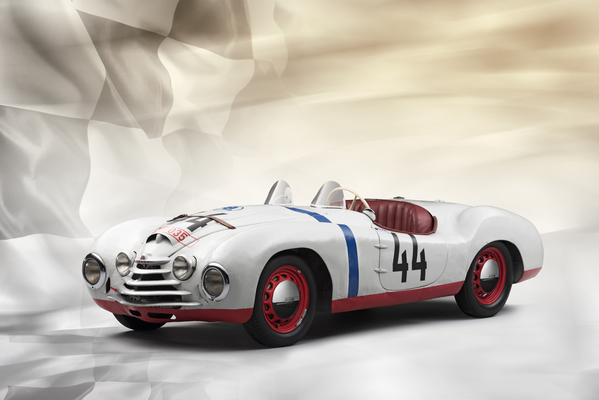
On Saturday, June 24, 1950, the Škoda works team had done it: the further developed version of the 1101 Sport - ready for the then still customary 'Le Mans start' at 4 p.m. - stood diagonally in front of the pit wall of the 13.65-kilometre 'Circuit des 24 Heures'. The drivers lined up on the opposite side of the track to sprint to their cars when the signal was given. There they jumped behind the wheel, started the engine and set off on the first lap of the race. For safety reasons, this type of race start was abolished in 1970.
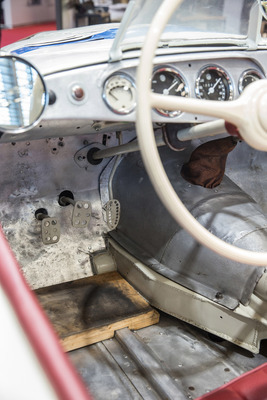
The 600-kilogram Škoda Sport was driven by Václav Bobek and Jaroslav Netušil. For the Le Mans race, it had a wheelbase extended to 2150 millimetres, which improved directional stability. Crescent-shaped air openings next to the main headlights supplied cooling air to the drum brakes on the front wheels and two additional headlights ensured better visibility at night. Otherwise, the vehicle was largely based on the standard 'Tudor', including the 12-volt on-board electrical system from PAL and the cross-ply tires from Barum. The water-cooled four-cylinder engine under the low front hood with an unchanged displacement of 1,089 cubic centimetres had a slightly higher compression ratio of 8.6:1 and was equipped with a Solex 40 UAIP carburettor.
This increased the engine's output to 50 hp (37 kW) at 5,200 rpm compared to the 32 hp standard engine. With the usual racing fuel at the time - a mixture of petrol, ethanol and acetone - the ŠKODA Sport reached a top speed of 140 km/h and consumed only twelve liters per 100 kilometers. Fully fueled and with the tools and spare parts on board that could be used during a repair stop, it weighed 700 kilograms.
Pit stop with consequences
Jaroslav Netušil and Václav Bobek, both also Le Mans debutants, gave their all and, with an average speed of 126 km/h, soon took second place in the field of 60 participants in the class for cars up to 1,100 cubic centimetres. In the special power efficiency classification, which was still common at the time, the duo even ranked fifth for a time. After 13 hours, the car with the number 44 rolled out at dawn; a minor technical defect took the Škoda Sport out of the race on its 115th lap: The securing element of a connecting rod pin was torn and a repair on site was no longer possible.
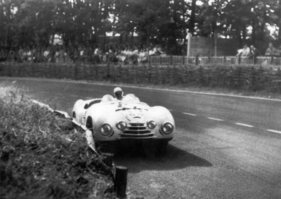
For Škoda, the start in 1950 was the only Le Mans race in the company's history to date. In the following years, the brand's special editions were no longer able to take part in the 24 Hours of Le Mans due to the difficult political situation.
Covid-19 - once again
The original Škoda Sport was restored and is now part of a private Czech collection. At the beginning of July, it should have taken to the track again in front of numerous spectators to mark the 70th anniversary of its Le Mans debut and the 125th anniversary of the founding of Škoda Auto.
However, the Le Mans Classic - a biennial event held since 2002 for historic racing cars that competed in the endurance classic before 1979 - had to be postponed to 2021 due to the COVID-19 pandemic.