


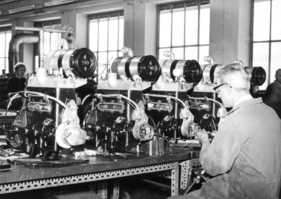
From 1953, Auto Union GmbH had been working on the development of a light all-wheel drive off-road vehicle. This was triggered by secret information on the vehicle equipment of a future German "Wehrmacht", which the VDA had sent to all German car manufacturers in strict confidence.
At the end of 1956, the DKW F 91/4 built at the Auto-Union plant in Ingolstadt, the model designation stood for "DKW F 91 with four-wheel drive", was introduced to the newly established German armed forces as a standard vehicle in the 0.25-ton payload class.
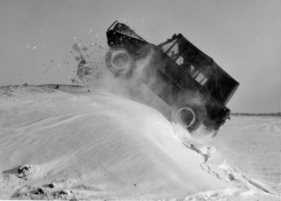
In April 1957, ADAC Motorwelt devoted a driving test to the all-wheel drive vehicle and described the DKW as follows:
"What is the Auto Union's 'Geländewagen 3= 6' actually intended for? It is intended to be used in all cases where frequent off-road driving is required. Even if the new German Wehrmacht has made use of this type of vehicle, its purpose is more than just military. The new off-road vehicle from Auto Union can, for example, provide excellent service to hunters, farmers and foresters, it can be used by construction teams for laying overland and telegraph lines, it can also be used for rescue and relief purposes, and it can make the work of inspectors on extensive construction sites much easier."
The specified dimensions were 3.456 meters long, 1.705 meters wide and 1.735 meters high. The turning circle was given as 11.7 meters and the fording depth as 50 cm. The unladen weight was stated as 1065 kg and the payload (incl. driver 465 kg).
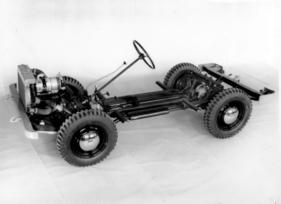
In 1962, the "DKW Geländewagen" was given the model name "Munga", an acronym for "Mehrzweck UNiversal Geländewagen mit Allradantrieb".
Production of the last DKW two-stroke vehicle ended in December 1968 after 46,750 units had been built, when the Bundeswehr contracts expired.