


A streamlined vehicle design helps - and this is particularly important today - to reduce CO2 emissions. Smoothed out in this way, the new Volkswagen Golf has a drag coefficient (cD) of just 0.27 with a frontal area of 2.19 square meters. By contrast, the rounded Beetle, seven decades older in standard trim, achieved a drag coefficient of 0.46 with a frontal area of 1.80 square meters.
But it was also possible to do better, as one of the most unusual test drives in the Wolfsburg wind tunnel proves: An aerodynamically optimized special version of the original model has now been tested here - and it came up with a record value.
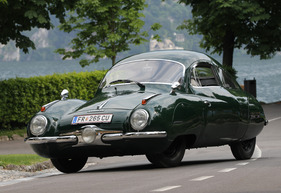
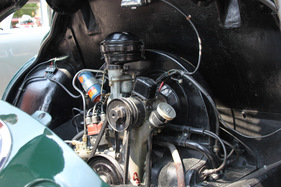
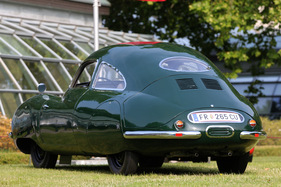
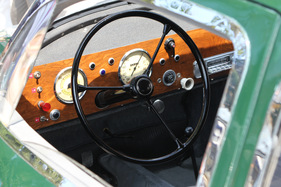
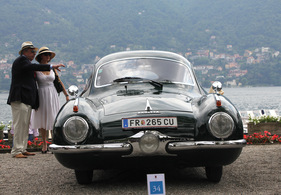
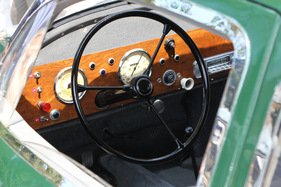
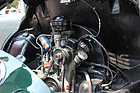
The Volkswagen Special "V2 Sagitta", named after its builder Kurt Volkhart, was completed in 1947. Volkhart had started to develop streamlined sports versions of the Beetle in the early 1940s based on basic research by the legendary aerodynamicist Baron von König-Fachsenfeld - including uncompromising streamliners with a continuous dorsal fin. But only his Sagitta project was finally completed, with a lightweight aluminum body on a tubular steel trellis frame. In the rear sat a small Volkswagen boxer engine of just 1.1 liters with 24.5 hp. Thanks to the streamlined body, which resembled the body of the Porsche 356 in some details, an impressive 140 km/h was possible.
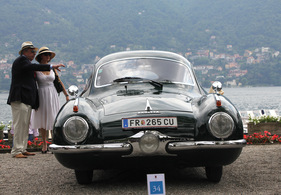
The V2 Sagitta only underwent serious technical testing in the wind tunnel in January 2013, after the car, which had been thought lost, came back into the public eye during the Concorso d'Eleganza Villa d'Este in 2012. Alexander Wittmaier from Volkswagen Research and Development had the vehicle brought from its current location in Austria to Wolfsburg in order to evaluate its aerodynamics in the wind tunnel.
As early as 1947 cW 0.217 achieved!
The two most important key figures for the aerodynamic evaluation of a vehicle are the frontal area and the drag coefficient - the lower the cW value, the more streamlined the vehicle. Both values can be determined in a relatively short time with the appropriate preparatory work. The V2 Sagitta measured a drag coefficient of 0.217 and a frontal area of 2.10 square metres - excellent values, which are nowadays impressively undercut by highly flow-optimized vehicles such as the Volkswagen XL1: Here, a cW value of 0.189 with a frontal area of 1.50 square meters has been recorded in the Wolfsburg wind tunnel.
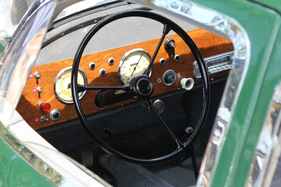
During the investigation of the V2 Sagitta, the aerodynamic effectiveness of individual measures such as the wheel arch linings was also examined. If they were removed, the cW value deteriorated to 0.252. If, on the other hand, the windscreen wipers were removed or a small rear spoiler was used, the cW value was reduced to 0.216. However, the cW value of 0.160 quoted in contemporary magazines at the beginning of the 1950s remained a fantasy value.