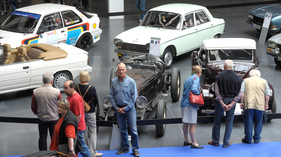
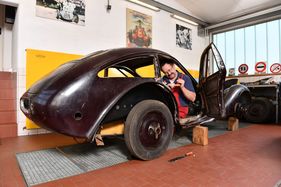
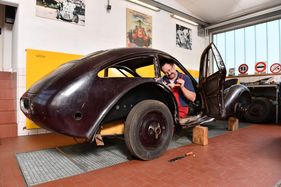
BMW 328 Streamlined Coupé? Very few people have probably heard of it, as it is a one-off. It is a sports coupé with a body shape that is strongly based on the typical streamlined automobiles of the early 1930s. This spectacular restoration project will be on display for the first time at Klassikwelt Bodensee from May 19 to 21, 2017 at the stand of restoration specialist Joachim Ohlinger.
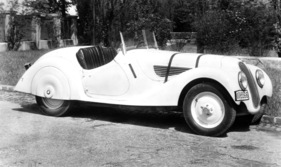
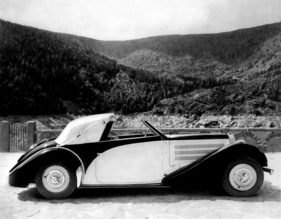
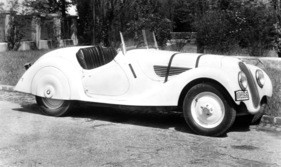
The story of the new restoration object began in 1936, when the Dane A.E. Lansner became the proud owner of a new BMW 328 Roadster. The owner was happy with the sporty convertible roadster for several years. Pictures show him with his wife and child in the close-coupled two-seater on a trip to Italy. The car enthusiast from Denmark was particularly fascinated by the low drag, the "streamline" and the legendary Bugatti Type 57 SC.
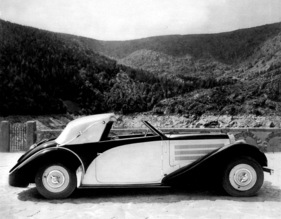
The unattainable dream of a Bugatti eventually led to a collaboration with the Copenhagen University of Technology, where the open-top roadster was converted into a sleek and streamlined coupé based on the French icon. According to Helmut Leicht, who discovered the unique model in Denmark in 1981, the focus was not on the lowest possible fuel consumption. Rather, it was the spirit of the times and the slightly larger interior, in which a third person could also sit in the rear if necessary.
It was pure coincidence, according to Leicht, that in a conversation about the restoration of the Kling K1, it was mentioned in passing that there was still a streamlined BMW 328 in Roskilde, Denmark. Car connoisseur Leicht winced briefly. An expert knows that a vehicle like this must be something very special. A streamlined shape was not offered by BMW at the factory. In fact, this hint turned out to be a direct hit. A dusty pre-war car, recognizable as a BMW, was standing underneath a crate that had been built as a precaution. In the flashlight light, it quickly became clear to the connoisseur that this must be a special coupé. The side line already indicated an unusual rear end.
Just how unusual the rear end really was became clear when the wooden crate was removed piece by piece and the car could be seen in all its glory. The initial excitement was followed by disillusionment: the car's interior was completely missing. The car was crammed full of parts belonging to the car, but there was nothing left of the seats to be seen. The dashboard had also been partially removed, but at least it was virtually undamaged. The small, elegant doors and the intact windows were still in good condition, as was the two-part tailgate. The formerly elegant chestnut-brown paint was still handsome. Under the layer of paint on the long hood, it was clear that the roadster had originally been delivered in white body color. Only the underbody was completely eaten away by rust.
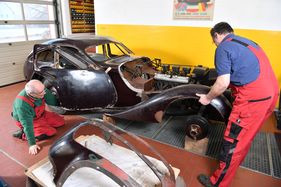
Reconstructing the seats and the interior did not pose any major problems for Joachim Ohlinger's restoration team. A small piece of fabric from the interior door panel will serve as a guide for the design of the interior. The chassis, engine and gearbox are, as Joachim Ohlinger puts it, "off the peg". What is certain is that the body retains its patinated paintwork. It is interesting to note that the no-frills rear has no opening option from the outside. Helmut Leicht also interprets the missing panels on the rear wheel arches as a sign that the Technical University of Copenhagen has meticulously designed the streamlining.
Visitors to Klassikwelt Bodensee can see this gem at the Ohlinger Automobile stand. With his typical grin, Joachim Ohlinger leaves it open as to whether there will be another hot item next to the BMW. However, it is an open secret that he came across a highly interesting French pre-war racing car this year.
Further information can be found on the official website of Klassikwelt Bodensee