


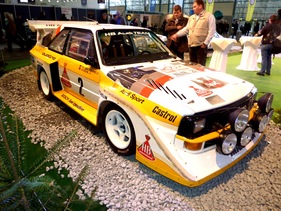


Syncro, xDrive, AllGrip, All-4, 4x4, 4Matic, 4Motion, 4Drive, Q4, Quattro - depending on the brand and model generation, countless names circulate for what is probably the most elaborate and expensive equipment detail on automotive wish lists: all-wheel drive. The fact that it has long since outgrown off-road asphalt has been proven by numerous rather well-behaved 4x4 passenger cars over the past 40 years - and even more impressively by the performance society with power on both axles.

The latter will take center stage when the Bremen Classic Motorshow traditionally kicks off the new classic car season at Messe Bremen from Friday to Sunday, January 30 to February 1. The special show 2026 is dedicated to 4x4 performance automobiles: From dream cars with road approval to uncompromising racing machines. From the 1930s to the 1990s, the classic car trade fair on the Weser will be showcasing twelve high-performance all-wheel drive vehicles. "Some that became famous through legendary victories. But also some that are virtually unknown even to real specialists," emphasizes project manager Frank Ruge.
The early pioneers: from the Jeep CJ-2A to the Land Rover
It was not foreseeable in the cradle of civilian four-wheel drive that such bolides with high triple-digit performance values and all four wheels would eventually be tugging at the terrain. The models that established the peaceful use of this technology served very down-to-earth purposes. It all began in 1945 with the 60 hp people's version of the US Army Jeep: the Willys CJ-2A all-terrain all-rounder. This was followed in 1948 by the Land Rover with 50 hp and the main task of motorizing the British colonies from West Africa to East Asia even without a road network. Two forefathers, unaware of the spheres the idea of their drive technology would one day climb.
All-wheel drive in motorsport: from experiment to rally revolution
As a result, motorsport repeatedly witnessed daring attempts to distribute the revs to both axles. On the racetrack, they sometimes remained toothless; at least in the featherweight Formula 1 monoposti, the penalty of weight gain usually negated the traction advantage on wet tracks. But in rallying, the superiority of 4x4 systems quickly became apparent, especially on loose ground, of course, with the launch of the Audi Quattro in 1981. In the wake of its success, countless all-wheel-drive vehicles sprouted up for road use in the short term. And a little later, super sports cars also accelerated with the power of four tires.
From Porsche to Lamborghini: special show presents rare exhibits
High-performance vehicles with four-wheel drive that excelled off the beaten track: The 24th Bremen Classic Motorshow rolls out the red carpet for this special species. Among the exhibits: the breathtaking Porsche 959 S, of which only 29 were built. The Subaru SVX, the most exciting production Japanese car of the 1990s. The famous Opel Calibra V6 4x4 DTM. The highly exotic Jensen FF as the 4x4 counterpart to the impressive Jensen Interceptor.

The Bugatti Type 53 from 1932, which was only built twice, and the Ford RS 200 as a Group S rally prototype. The mysterious one-off Lamborghini Diablo V16, a test vehicle for the later Bugatti EB 16.4 Veyron. The VW Golf II bimotor, the double heart among racing Golfs, so to speak. The 1984 Audi Sport Quattro S1 of rally amazon Michèle Mouton.

But that's not all: on 52,000 square meters in eight halls, there will once again be countless classic automobiles with just one drive axle. The Bremen Classic Motorshow is supported by Mercedes-Benz Werk Bremen, TÜV Süd and the National Automuseum Collection Loh.
Further information on the classic car show can be found on the organizer's website.

