


55 years ago, on November 20, 1968, Škoda launched series production of the 1203. It was the culmination and conclusion of twelve years of development work, with which Škoda set new standards in the light commercial vehicle segment. With this new release, the Czech manufacturer fulfilled an urgent need: a light commercial vehicle with a modern front-wheel-drive design had previously been completely lacking on the Czechoslovak market. "The Škoda 1203 is a classic among commercial vehicles and appeared in many variants and with countless conversions and superstructures. Its versatility and durability made it an indispensable part of everyday life for practically every citizen of Czechoslovakia," explains Andrea Frydlová, head of the Škoda Museum at the company's headquarters in Mladá Boleslav.
Creation and evolution of the Škoda 1203
The development and production of the Škoda 1203 are inextricably linked to the fortunes of the Škoda plant in Vrchlabí. The state planning commission had commissioned the development team there to design a completely new "modern large commercial vehicle". The long-standing practice of converting passenger cars with Škoda's robust central tubular frame into commercial vehicles had long since reached its limits at this time. So in 1956, the team began designing an independent commercial vehicle with a self-supporting body and one-box design with a driver's cab above the front axle. The first three prototypes presented at the beginning of 1957 bore the internal model designation 979 and had different body shapes. Ultimately, the development of the Škoda 1203 took twelve years - this long period of time was mainly due to the inefficiency of the centrally controlled planned economy. Further delays were caused by the fact that the start of series production overlapped with the discontinuation of the Škoda 1202 family - resulting in material shortages and difficulties due to the different production techniques. For these reasons, the start of series production was delayed until the fourth quarter of 1968.
Ample space, good comfort and performance
The departure from the long-established chassis with a central tubular frame made it possible to design the Škoda 1203 with an exceptionally large amount of space and extensive glazing. The van weighed just 1170 kilograms empty and, thanks to independent suspension all round, offered much better ride comfort on poor roads. The OHV four-cylinder engine installed under the front seats achieved an output of 35 kW (47 hp) with a displacement of 1221 cc. Despite its moderate output, the power unit derived from the Škoda 1202 had enough power to carry 750 kilograms of payload, which could be distributed over 5.3 cubic meters of cargo space. The first "twelve-zero threes", which came onto the market at the end of 1968, were 1.90 meters high, 4.52 meters long and 1.80 meters wide panel vans. A side swing door and a horizontally split tailgate provided access to the load compartment. This version reached a top speed of 90 km/h. Consumption at a constant 60 km/h was 11 l/100 km.
Numerous variants and continuous upgrades
A minibus in a standard or De Luxe version with space for up to eight people was soon added to the range. Subsequently, Škoda also offered the 1203 as a partially glazed estate, a platform van, an ambulance and a hearse.
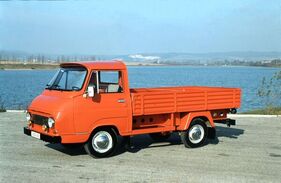
Several dozen vehicles were converted for the special needs of fire departments and veterinarians, for example; even prototypes for refrigerated vehicles and camper vans were based on the Škoda 1203. In 1981, production was transferred completely to Trnava Automobile Works (TAZ) by government decree. From April 1973 until this time, production also took place in parallel in Vrchlabí. In addition to the numerous variants of the Škoda 1203, the model underwent continuous innovations. For its 20th birthday in 1988, the Škoda 1203 received a larger engine with 1433 cc and 42 kW (57 hp) of power, a new five-speed manual gearbox, dual-circuit brakes and minor modifications to the bodywork. In 1996, the model series received a four-cylinder diesel engine from Volkswagen with a displacement of 1.9 liters. Between 1968 and 1981, Škoda produced a total of 69,727 Škoda 1203s in Vrchlabí. In Trnava, around 89,000 units of the different variants rolled off the production line by August 1999.
State-controlled supply and private demand
In Czechoslovakia's centrally planned economy, only state-owned companies, organizations and cooperatives had the opportunity to purchase the new Škoda 1203. Potential buyers had to submit an application to the state planning commission, which officials then evaluated. If the application was approved, they issued a voucher. Only with this voucher could the respective organization order the vehicle, pay the purchase price and then receive the car. Private buyers were denied the new Škoda 1203. They only had the option of purchasing a used car from government services. In other countries, however, the Škoda 1203 was freely available. For example, it was frequently seen on the roads of France, Belgium, Egypt and Turkey.