



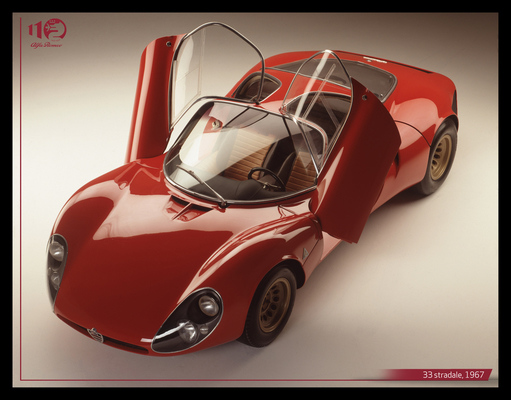
The seventh episode of "Storie Alfa Romeo" takes viewers back to the late 1960s. Ingenuity, uncompromisingness, courage in the choice of materials, unique style as a synthesis of technological creativity and innovation - these are the ingredients for the Alfa Romeo Tipo 33 Stradale super sports car. Designed by master designer Franco Scaglione, the Tipo 33 Stradale combines the pursuit of maximum functionality and optimum aerodynamics.
The humanization of cars
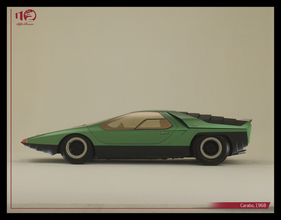
The design is testimony to the competitive spirit that characterizes every Alfa Romeo vehicle model. This ambition not only led to numerous racing victories for the Tipo 33, but also to an unequal twin brother - the Carabo show car. The design by Bertone designer Marcello Gandini, the futuristic features and the willingness to experiment with the body color made the Carabo the "car of tomorrow". The Alfa Romeo Montreal was created with the same aspiration.
The description of automobile design often uses terms from human biology. The front of the vehicle is described as a "face", the headlights as "eyes", the radiator grille as a "mouth". And the body often has "shoulders" or a "hip". How did this humanization, referred to by experts as anthropomorphism, come about and why?
The first automobiles were little more than horseless carriages without any special ornamentation. It was not until the 1930s that coachbuilders became experts in metalworking. They formed the sheet metal by hand directly onto a wooden frame, creating unique models with rounded, organic lines. With advances in industrial production, the shapes became much simpler because the steel presses of the time did not allow for fine details and pronounced three-dimensionality.
In the late 1960s, these two stylistic approaches became increasingly divergent. The difference between cars with organic or geometric lines is particularly evident in the Alfa Romeo Tipo 33 Stradale and the Carabo show car - although both have the same technical basis.
The unequal twin brothers
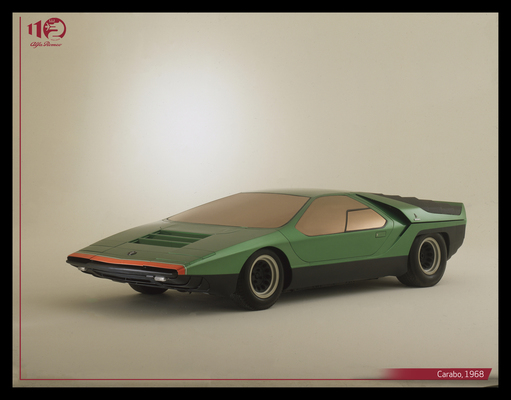
The Alfa Romeo Tipo 33 Stradale and the Carabo couldn't be more different. One shows muscles and sinews like an athlete. The other consists almost entirely of straight edges and sharp angles; a design that aims to capture the essence of mobility and transport it into the future. Tipo 33 Stradale and Carabo are so much more than just two interpretations of the same theme, they seem to come from two different worlds.
The common platform of Tipo 33 Stradale and Carabo is the synthesis of 50 years of Alfa Romeo's racing experience. It is the result of inspired and precise planning, expertise and courage in the choice of materials. The design of the Tipo 33 Stradale combines technological innovation with creativity.
Ready for the competition
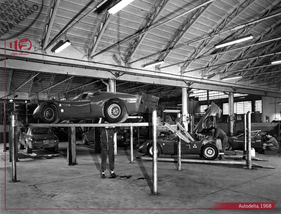
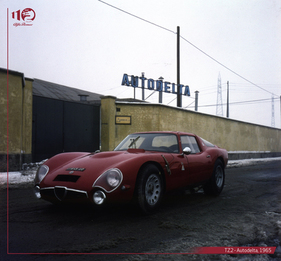
In 1964, Giuseppe Luraghi - President of Alfa Romeo at the time - decided to officially return the brand to motor racing. Luraghi acquired Autodelta so as not to waste time setting up his own works team. The company, originally based in Udine in the north-east of Italy, was already a partner of Alfa Romeo in the production of the TZ model. Together with Autodelta, Carlo Chiti, who had already worked for Alfa Romeo from 1952 to 1957, returned to the brand and took on the role of head of the official team.
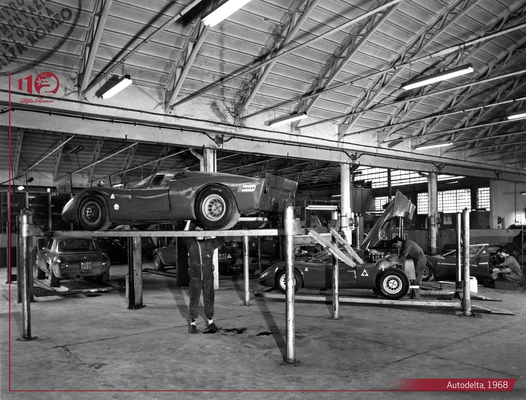
Luraghi commissioned Chiti's team to develop a racing car that would compete for success and media attention in two categories that were extremely popular at the time - the World Sports Car Championship and hill climbs. Work on the Tipo 33 project began in 1964.

Autodelta
In the mid-1960s, Autodelta moved its headquarters from Udine to Settimo Milanese near Milan. This reduced the distance to the Alfa Romeo plant in Portello, but above all to the test track in Balocco on the highway between Milan and Turin.
Alfa Romeo initially designed the supporting frame for the Tipo 33, and the first example was delivered to Autodelta in 1965. The frame consisted of three aluminum alloy tubes welded together in an H-shape. The fuel tanks were integrated into the side cavities. A magnesium subframe at the front accommodated the front wheel suspension, the radiators, the steering and the pedals. The engine and gearbox were mounted longitudinally behind the two-seater cockpit. The body was made of fiberglass to bring the vehicle weight down to 600 kilograms - the minimum weight required by the regulations. Lightweight construction was also Alfa Romeo's secret weapon in the Tipo 33.
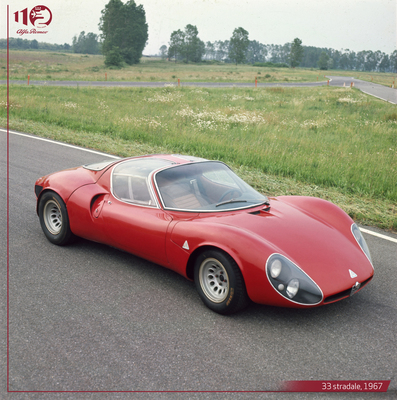
Winning the one-make world championship in 1975 and 1977
A short development time was unrealistic for such an ambitious and innovative project. In the end, almost two years were to pass before the Tipo 33 was ready for its first race outing. But that was not yet the case. For the first test drives, the technicians installed the 1.6-liter four-cylinder engine from the GT sports car TZ2. At the same time, a completely new engine was developed. With eight cylinders in a V-shape and a displacement of two liters, it initially produced 169 kW (230 hp).
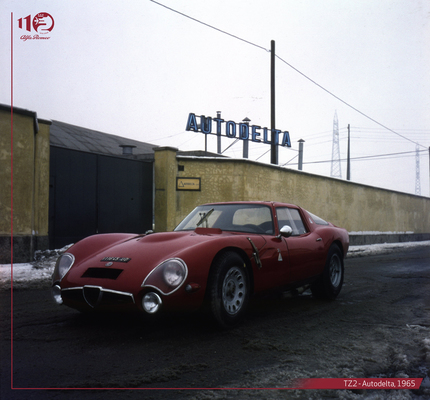
The first version of the Tipo 33 was nicknamed the "Periscopica" because the engine air intake protruding over the roll bar was reminiscent of a submarine's periscope. The premiere took place on March 12, 1967 at a hill climb in Fléron near Liège, Belgium. The pilot was Autodelta's chief test driver, Teodoro Zeccoli. After years of careful preparation, the Alfa Romeo Tipo 33 celebrated a victory on its very first outing.
The hill climb in Fléron marked the beginning of a success story for the Tipo 33, which culminated in Alfa Romeo winning the one-make world championships in 1975 and 1977. These victories made the Tipo 33 one of the most successful racing cars of its era.
The nobleman from Florence who became a car designer
The Tipo 33's success on the racetrack encouraged Alfa Romeo to develop a road-going version that could be produced in very small numbers. The task of transferring the sporty character of the racing car to the "Stradale" was entrusted to Franco Scaglione.
Scaglione was born in Florence in 1916 to an old aristocratic family. He studied aerospace engineering until he was drafted into the army. In 1941, he was taken prisoner of war on the Libyan front. He returned to Italy at the end of 1946. Instead of continuing his studies, he embarked on a career as an automobile designer. He first worked for Pinin Farina, then for Bertone and later freelanced.
Scaglione put all his technical know-how and creative courage into the design of the Tipo 33 Stradale. The result was a masterpiece in which stylistic innovation merged with the pursuit of optimum aerodynamics and functionality.
The Alfa Romeo Tipo 33 Stradale
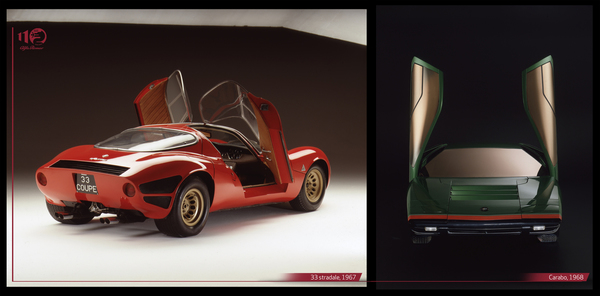
The engine cover of the Tipo 33 Stradale can be opened in its entirety to facilitate access to the mechanical components. This was the first time a road-legal car had gullwing doors. Not only did they look spectacular, they also made it easier to get into the vehicle, which was less than one meter high. The main differences to the racing car were the extension of the wheelbase by 10 centimetres and the use of steel instead of aluminum for the H-shaped frame.
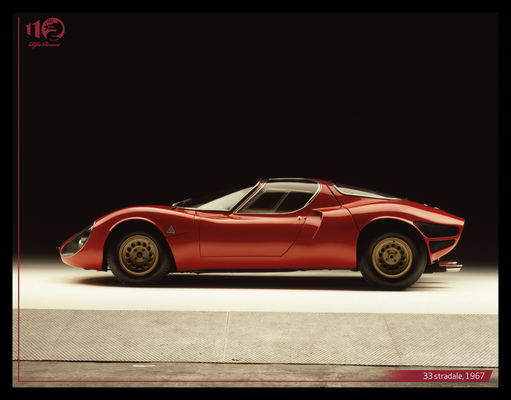
The engine of the Tipo 33 Stradale was identical to the racing version. It consisted almost entirely of aluminum and magnesium alloys, had intake manifold injection for the fuel and dry sump lubrication for the oil circuit. Both cylinder banks were equipped with two overhead camshafts as well as two valves and two spark plugs per cylinder. In such a lightweight car, the power output of 169 kW (230 hp) enabled a top speed of 260 km/h. The Tipo 33 Stradale completed the sprint from zero to 100 km/h in 5.5 seconds.
Premiere on the Monza racetrack
Alfa Romeo presented the Tipo 33 Stradale to the general public at the 1967 Turin Motor Show. A handful of experts had already had the pleasure a few weeks earlier, during the Italian Grand Prix on September 10, 1967 at the Monza racetrack. The ninth round of the 1967 Formula 1 World Championship went down in history not only for Jim Clark's epic race to catch up, but also for the debut of one of the most beautiful sports cars of all time.
At its market launch, the Alfa Romeo Tipo 33 Stradale was the most expensive sports car. At the time, it cost almost 10 million Italian lire, while its main competitors only cost six to seven million. Only twelve examples of the Tipo 33 Stradale with the body designed by Scaglione were built. Despite the high price, the buyers had made the investment of a lifetime: The Alfa Romeo Tipo 33 Stradale is practically priceless today.
The Carabo concept car
The Tipo 33 Stradale was the culmination of the concept of a car with an organic design. However, the quest for unique style also took Alfa Romeo in completely different directions. For example, the idea of a "car of the future" had already been realized in 1952 with the 1900 C52 model designed by Touring. The design of the flat Spider with pronounced fenders was so futuristic that the nickname "Disco Volante" (flying saucer) caught on.
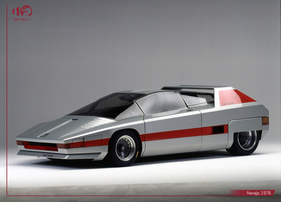
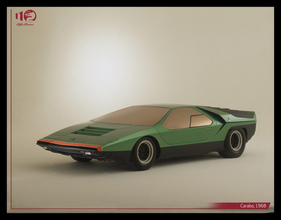
The 1968 Paris Motor Show saw the premiere of a dream car that represented the further development of this radical idea. The Carabo concept car was an early masterpiece by Bertone designer Marcello Gandini, who was only 30 years old at the time. The Carabo was based on the mechanics of the Tipo 33 Stradale, which was also used by other designers for one-offs during this era. These included the Iguana by Giorgetto Giugiaro, the 33.2 Coupé Speciale and the Cuneo by Pininfarina as well as the Navajo by Bertone.
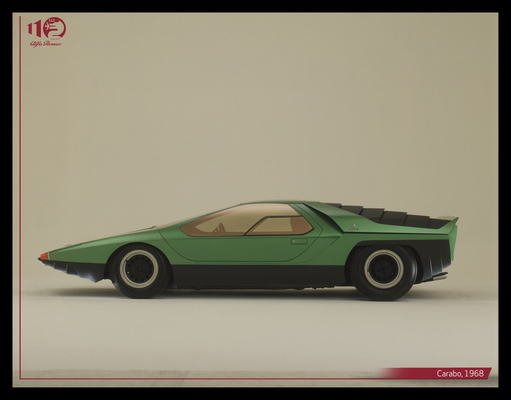
The Tipo 33 Stradale and Carabo were similar in height, but the curved lines had completely disappeared. Everything about the Carabo was sharp-edged, from the wedge shape to the scissor doors. The name Carabo was inspired by the golden ground beetle (Carabus auratus), as Gandini had the show car painted in its color: an iridescent green with orange details.
The Carabo was the starting point for Alfa Romeo's strategy of paying special attention to extravagant colors and special painting techniques in order to further emphasize the uniqueness of the brand. The same idea was behind the body colors of the Alfa Romeo Montreal.
The Alfa Romeo Montreal
In 1967, numerous nations exhibited their best technical and scientific achievements at the World Expo in Montreal, Canada. The Expo organizers asked Alfa Romeo to create a technological symbol, a vehicle representing "The highest aspiration of modern man in the automotive field". Orazio Satta Puliga and Giuseppe Busso from Alfa Romeo brought the Bertone design studio on board to provide support. Marcello Gandini was commissioned to design the bodywork and interior.
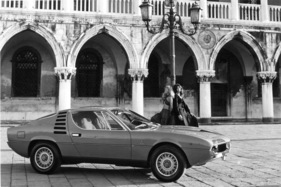
The result was a complete success. Visitors to the Expo were full of praise for the elegance and message of the Montreal concept. The public interest prompted Alfa Romeo to develop a production version, which was presented at the Geneva Motor Show in 1970.
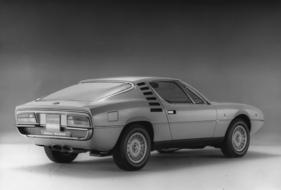
In contrast to the concept car from the Expo, the finished Alfa Romeo Montreal was powered by a V8 engine based on the Tipo 33 Stradale engine. The displacement was increased to 2.6 liters and the power output reduced to 147 kW (200 hp) to make it more suitable for everyday use. The Alfa Romeo Montreal impressed with its extraordinary palette of pastel and metallic colors: from green to silver, from orange to gold.
Experimenting with colors is an Alfa Romeo tradition that continues in the body paint finishes offered today. They are called Rosso Villa d'Este, Ochre GT Junior and Verde Montreal, for example. These colors are inspired by the brand's 110-year history and are reserved for the currently most powerful production vehicles.
