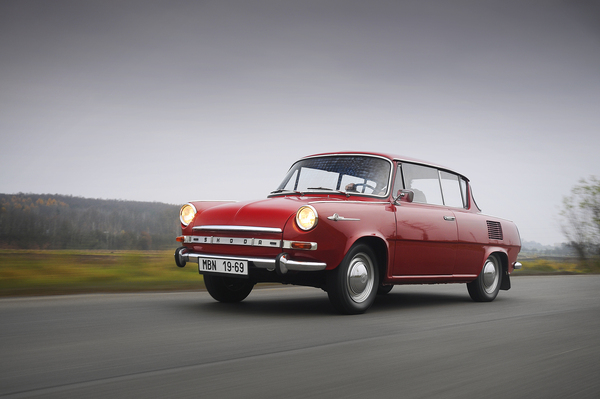
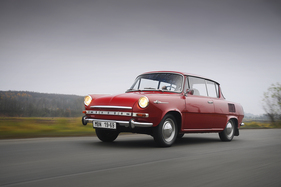
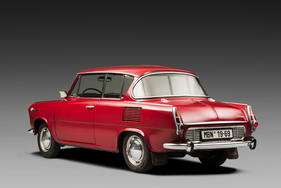
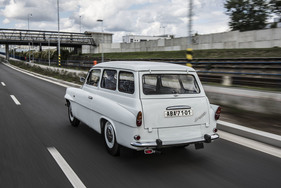
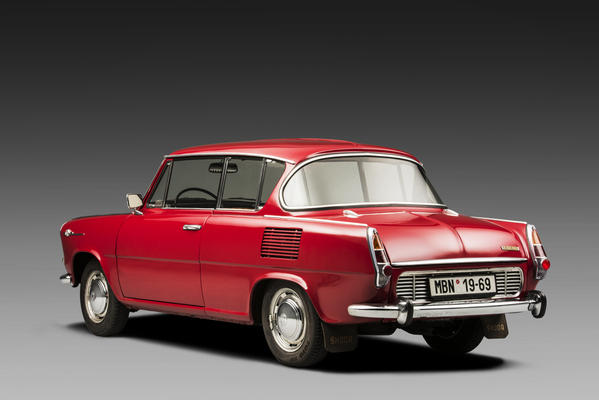
With the legendary 1000 MB, Škoda Auto presented a four-door series model with a rear engine and rear-wheel drive for the first time in the mid-1960s, which was one of the most modern vehicles in its 1.0-liter class at the time. What many people don't know: In addition to the well-known notchback version and the coupé known as the 1000 MBX De Luxe, which made its debut in 1966, prototypes of a roadster and an estate version were also created in Mladá Boleslav.

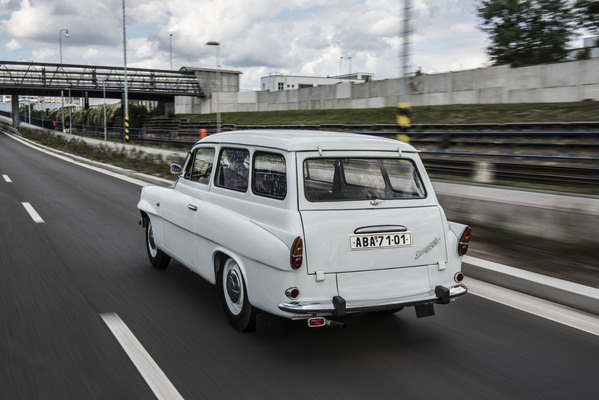
Built in 1963, the five-door model remained a one-off and is now one of the Škoda Museum's jewels. However, this Type 990 owes its nickname 'Hajaja' to a popular radio program with bedtime stories...

One of the biggest technological upheavals at Škoda
In the spring of 1959, Škoda's automotive experts were working on one of the biggest technological breakthroughs in the company's history: The new 1000 MB was to herald the change in Mladá Boleslav from vehicles with separate frames to the modern self-supporting body and the switch from the front-engine rear-wheel drive concept to rear-engine models - the state of the art in the early 1960s.
At the same time, Škoda built a new car plant for the 1000 MB at the company's Bohemian headquarters, which met the world's most modern requirements and went into operation in April 1964. Together with the production facilities in Kvasiny and Vrchlabí, this quadrupled the total production of the Škoda brand from 42,550 to 162,208 units per year within ten years by 1973.
"Hajaja"
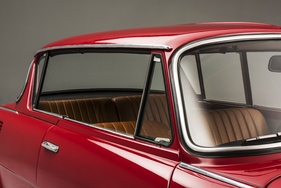
The development of the 1000 MB began in 1959 with the Š 990 NOV (nový osobní vůz/new passenger car) project. By October 1961, a small series of 50 prototypes with various body designs had been produced in addition to the four-door notchback model, of which there was a trial version without a B-pillar - a precursor, so to speak, to the Škoda 1000/1100 MBX presented at the Geneva Motor Show in 1966.
Other variants were an open roadster as a 2+2-seater with rear engine, which bore the type designation 990/991, and a station wagon with the later nickname 'Hajaja'.

A genuine hybrid
The brainstorming that led to the latter prototype was no coincidence: practical estate models have always had a firm place in Škoda Auto's 125-year history. The L&K 110, which Laurin & Klement - the company founded in 1895 by company fathers Vaclav Laurin and Vaclav Klement - offered in the mid-1920s, is considered the forefather. Their clever idea: the rear part of the bodywork could be replaced.
If the car was used as a delivery van for tradesmen on weekdays, the rear could be replaced by a module with seats for weekend trips with the family. From 1934, Škoda celebrated success with light commercial vehicle versions of its best-selling Popular. They could carry loads of up to 300 kilograms and were used, for example, in the fleets of the Moravian shoe manufacturer Baťa and the Viennese coffee roasting chain Julius Meinl, which at the time had a good 1,000 branches throughout Europe.
Station wagons suitable for everyday use
At the end of the 1940s, a station wagon (STW) based on the Škoda 1101/1102 'Tudor' was produced alongside delivery van bodies.

It impressed with significantly larger glazing, a particularly extensive range of equipment and, above all, the great variability of its interior: folding down the rear bench created a loading area up to 1.49 meters long and between 980 and 1,390 millimetres wide. The production model, which rolled off the production lines at the Vrchlabí and Kvasiny plants, was preceded by numerous prototypes. From spring 1953, the spacious Škoda 1200 STW estate model was built in Vrchlabí. It continued to be built in a modernized version as the 1201 STW until October 1961, when the Škoda 1202 followed.
Bestseller from 1960 to the present day: Škoda Octavia
However, the Octavia Combi has gone down in history as Škoda's best-selling estate model in the 1960s. The first prototype was already on the road in September 1959, and a year later the series production version met with a great response at its premiere in Brno. From 1961 to 1971, a total of 54,086 vehicles of this type left the factory gates in Kvasiny.
The body variant also enjoyed high demand in the export markets: in 1966, 72 percent of all Octavia Combi were sold abroad - a record! In 1996, the Octavia returned to Škoda's model range in a modern form and quickly became the heart of the brand. The particularly popular Combi adaptation followed a year later. The bestseller is currently in its fourth generation of the modern era.
Hajaja and bedtime stories
But back to the 'Hajaja': The one-off - today one of the special rarities on display at the Škoda Museum in Mladá Boleslav - was based on prototype number 34, which was retrofitted as a notchback saloon in February 1963 after 31,000 test kilometers. However, the conversion proved to be more complicated than expected: in order to solve the problem with the trunk floor, the in-line four-cylinder engine was installed horizontally at the rear.
The cylinder head pointed to the left, with the water cooler to the right. And because the machine looked as if it had gone to sleep in this configuration, the one-off quickly lost its nickname: 'Hajaja', at the time the title of a popular fairytale radio program with bedtime stories.

The luggage compartment of the 4.15 meter long, 1.62 meter wide and 1.40 meter high estate was easily accessible thanks to a tailgate that swung upwards. At 2.40 meters, the wheelbase remained unchanged compared to the notchback saloon. There was space for objects up to 1.60 meters long in the load compartment. Because the engine was now located in the rear, additional storage space was created under the hood. The unladen weight of 811.5 kilograms put 61 percent of the load on the rear axle. The maximum payload was 380 kilograms, enough for four adults and around 80 kilograms of luggage.

Despite being associated with a bedtime story - plenty of power
As part of a three-week test program in May and June 1963, the estate prototype covered a further 7,000 kilometers and achieved an average fuel consumption of 7.6 liters per 100 kilometers at an average speed of 74 km/h. The 988 cc four-cylinder engine developed an output of 31 kW (45 hp), which helped the 'Hajaja' reach a top speed of 115 km/h.
The testers were also particularly impressed by the airy interior space and the generous stowage volume in both luggage compartments. A disadvantage, however, was the complicated engine installation in the rear, which made maintenance and service work considerably more difficult. The cooling of the four-cylinder also caused problems - ultimately the knock-out criteria that spoke against series production of this model variant.

Extended career of the Octavia Combi
Instead, Škoda concentrated entirely on the production launch of the successful notchback version of the 1000/1100 MB. A total of 440,639 of these were delivered to customers between 1964 and 1969. As already described, the attractive two-door 1000/1100 MBX followed in 1966 as the only derivative of this model series. It had no B-pillar and exactly 2517 units were built by 1969. Meanwhile, the demand for a practical estate model extended the career of the Octavia Combi until 1971.