Under the title "Porsche Unseen", Porsche is publishing previously secret design studies from the years 2005 to 2019 for the first time. The sports car manufacturer is presenting 15 spectacular vehicle visions. The early studies cover the segments "Spin-Offs", "Little Rebels", "Hypercars" and "What's next?". Porsche thus provides an exclusive insight into its design process - from the first drawing to the finished production model.
"The timeless and innovative design of our sports cars inspires people all over the world," says Oliver Blume, Chairman of the Executive Board of Porsche AG. "Visionary concept studies form the basis for this success: they are the pool of ideas for the Porsche design of tomorrow and combine our strong tradition with pioneering future technologies."
The previously unpublished design studies are presented exclusively by Porsche Newsroom in a series of articles. The web TV format 9:11 Magazine also devotes a feature to selected studies and, together with Porsche Chief Designer Michael Mauer, highlights the connection between studies and current production models. For fans of the brand, the book "Porsche Unseen" is being published today by Delius Klasing. It gives interested readers a detailed look behind the scenes of Style Porsche. Some of the studies can also be admired live later: The Porsche Museum will integrate a selection of the models into the exhibition in 2021.
The design process: from the first drawing to the drivable prototype
The design process begins with a sketch. In the next step, this is visualized as a 3D model. As soon as an idea is to be developed further, small 1:3 scale models and finally 1:1 scale hard models follow. "The virtual world is the first step, but the unexpected models in particular need to be experienced in reality in order to understand how small, large or surprisingly proportioned a car is," says Michael Mauer, Head of Style Porsche. In contrast to the development of a series model, in which several models with different styling themes are always developed, in vision projects only one vision model is initially created as the protagonist of the central idea.
"Porsche deliberately operates just one design studio - and it's right next to the development department," says Mauer. "Weissach is our epicenter. Instead of opening advanced design studios in the distant metropolises of North America and Asia, our designers from all over the world come to Porsche in Weissach to create the latest production sports cars and automotive visions in the heart of the brand." More than 120 designers, experts for interiors, exteriors, colors and materials, model makers, modelers and studio engineers work in the Porsche Design Studio.
The design studies: A journey into the future of mobility
"Our visions are not about putting every car on the road. It's about opening up spaces of possibility and establishing a relationship with the future," says Michael Mauer with regard to the design process and adds: "There are two ways to develop as a brand: Either you improve your products from the present, step by step. In this process, it is difficult to be truly innovative. Or you can give free rein to your creativity. The idea is to jump mentally into the day after tomorrow and then move backwards from there into tomorrow."
On this basis, Porsche creates the product and brand identity that characterizes and ensures the appearance of all models in the long term. The design language for future models is developed from the long-term vision. The overriding aim is to combine the Porsche design DNA with state-of-the-art vehicle technology. On the one hand, this ensures the innovative capacity of future Porsche models and, on the other, an evolutionary link to the rich history.
Porsche Vision Spyder
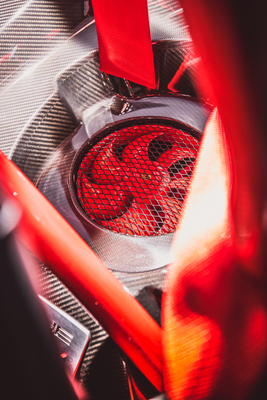
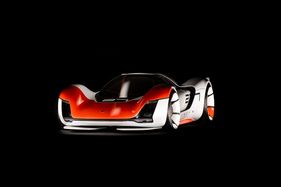
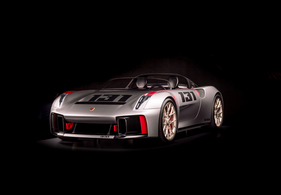
With its purist, reduced cockpit, the characteristic radiator grilles above the mid-engine, the red graphic accents and the hinted fins at the rear, the compact Porsche Vision Spyder (2019; 1:1 scale hard model) is reminiscent of the Porsche 550-1500 RS Spyder from 1954. At the same time, the study served to further develop Porsche's design identity and as a storehouse of ideas for future details - such as the ultra-modern roll bar.
Porsche Vision "Racing Service"
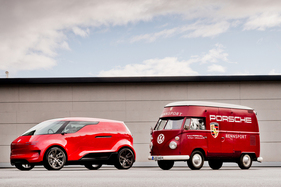
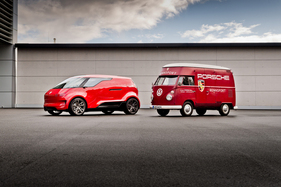
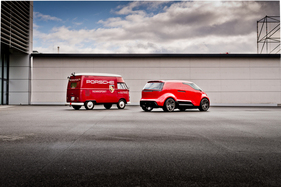
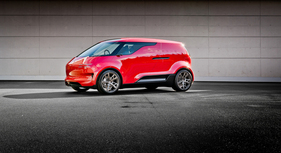
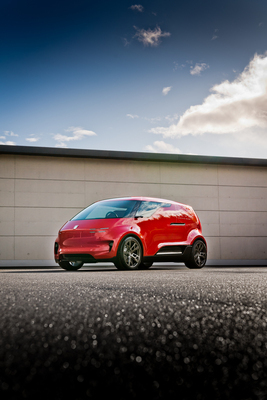
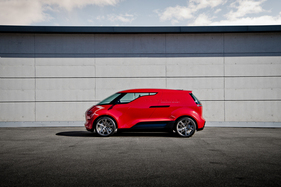
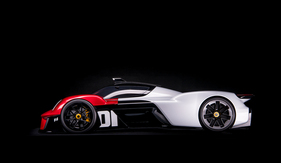
The Porsche Vision "Renndienst" (2018; 1:1 scale hard model) is a free interpretation of a family-friendly space concept for up to six people. The design team created a futuristic "space glider" with exciting proportions. The study shows how the Porsche design DNA with the characteristic modeling of the surfaces can be transferred to a vehicle segment unknown to the brand. Inside, passengers can expect a comfortable and modular cabin. The driver sits in a central driver's seat. The all-electric drive technology is located in the underbody.
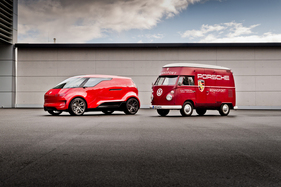
Porsche 904 Living Legend
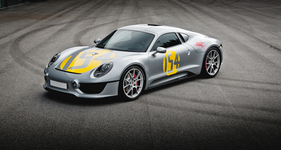
Sometimes the past and present are surprisingly close to each other. The designers at Porsche also realized this with the 904 Living Legend. Volkswagen had been researching an enormously efficient vehicle since 2002, which was to get by with just one liter per hundred kilometers. This idea gave rise to the VW XL, which appeared in 2014. When the designers at Porsche took a closer look at its corporate brother, they realized that its proportions were surprisingly close to those of one of the most legendary cars from Zuffenhausen, the 904. This insight led to the creation of the 904 Living Legend as a 1:1 scale hard model. It has compact proportions and weighs barely 900 kilograms. An extremely high-revving V2 motorcycle engine was even considered for the drive.
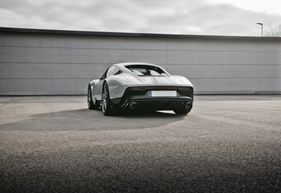
Porsche 906 Living Legend
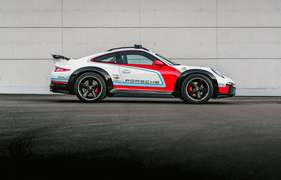
As with all the cars already presented, Porsche also looked back to the brand's eventful history with the 906 Living Legend, or more precisely to the 906. The red-painted front and the proportions are almost exactly the same as the 906. A striking feature of the 906 Living Legend is the integration of the front lights into an air intake. The same applies to the rear lights. Here, too, Porsche produced a 1:1 scale hard model. Looking at the 906 Living Legend, it is hard to believe that the study is already 15 years old.
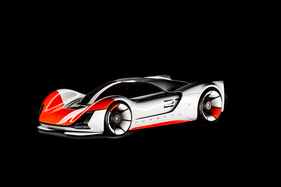
Porsche 917 Living Legend
Now for the cream of the crop in this presentation of ideas from Weissach, at least as far as historical relevance for the Porsche brand is concerned. Porsche has already won the 24 Hours of Le Mans nineteen times and it all began with the 917. With the return to Le Mans in the LMP1 class in 2013, Porsche revived the legend once again and produced a 1:1 scale clay model.
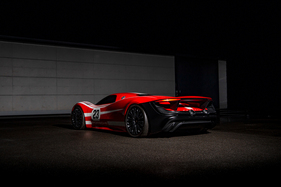
The paintwork is based on that of the winning car from Porsche Salzburg in 1970. The 918 Spyder served as the technical basis. However, it must be said that the 917 Living Legend is a little less "unseen" than its brothers. It was exhibited in the Porsche Museum back in 2019 as part of the 50th anniversary of the 917. But it too is undoubtedly a testament to the Porsche designers' passion for the company's own history and bringing it into the modern age, if not even further into the future.