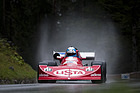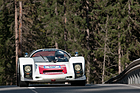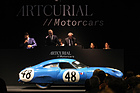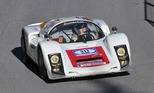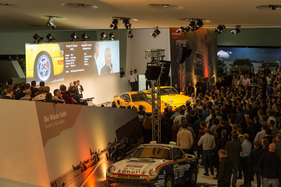
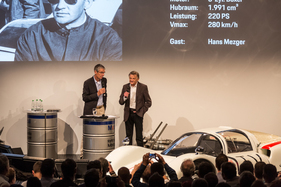
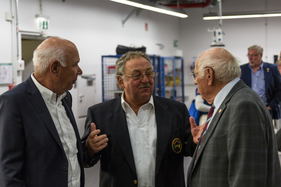
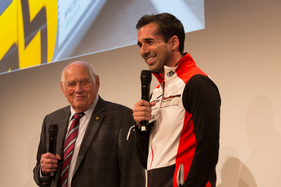
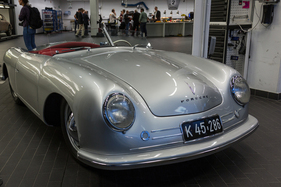
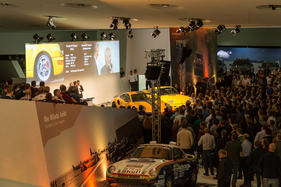
The Porsche Sound Night took place for the seventh time at the museum in Zuffenhausen, for the first time without Dieter Landenberger, who initiated this event many years ago, but whose expertise is now in demand in Wolfsburg. This was not the first time that Walter Zipser, the Austrian presenter and journalist, opened the sound night together with Achim Stejskal, the director of the museum, and it was set to be an entertaining evening.
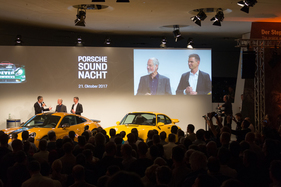
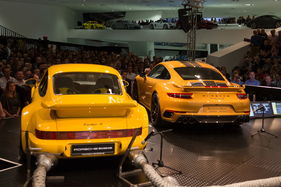
Porsche 911 Turbo S, Type 964, and Porsche 911 Turbo S Exclusive Manufaktur
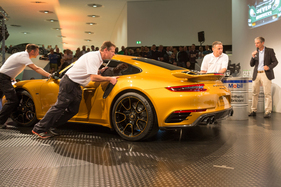
To mark its 25th anniversary, the company's Exclusive department kicked things off with a Turbo S Type 964 and the latest model, the new 911 Turbo S Exclusive. Rolf Sprenger, a man of the first hour whom Ferry Porsche had asked to take care of customers with special wishes, thus laid the foundation for what is now called Exclusive Manufaktur.
Boris Apenbrink, whose first days at Porsche overlapped with Rolf Sprenger's last, is continuing his legacy. Porsche customers have always had special requests. The requests for a special chassis, different rims, an increase in performance or other individualization measures have more or less remained the same.
Rolf Sprenger talks enthusiastically about the 964 Turbo S, a vehicle for customers who love fast cars. Saving 180 kg compared to a series turbo was a real challenge with the 964. No underbody protection, no insulation, no window regulators etc. were the measures that led to success. The only thing that was retained was the leather finish that the customer wanted. Stiffening of the vehicle prepared the car for the use of the performance-enhanced engine with 381 hp and 490 Nm torque.
When the car was new, it held the title of "fastest Porsche" for six months, but more importantly, it was faster than its Ferrari counterpart. Lightweight construction also helped with braking; the revised braking system enabled incredible deceleration values of 2.6 seconds from 100 to 0, which is still hard to imagine today. At a price of DM 295,000 for the left-hand drive version and DM 315,000 for the right-hand drive version, these cars were not cheap fun, but they were sold quickly, although not to the USA. The doors and hoods of the lightweight car were made of carbon-fibre-reinforced plastic, which meant that the car could not be type-approved for the USA.
This work could not have been carried out in Plant 1 without the support of Weissach. Peter Falk and Roland Kussmaul played a key role in this. This lightweight construction project laid the foundation for the GT vehicles at Porsche. The prototype shown was to be presented in Geneva in March 1992, but not with the Ferrari yellow paint. This was the birth of the "speed yellow" color. By the fall, the planned 86 units had already been sold. Little has changed in the media's interest in fast vehicles from Zuffenhausen since then.
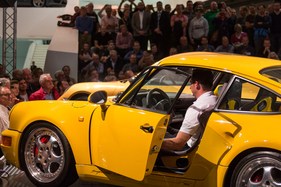
As far as the wheel styling and design of the current 911 Turbo S are concerned, Boris Apenbrink says that he and his colleagues still take inspiration from the earlier vehicles. The production process of the extremely complex forged and then milled rims can be viewed in minute-long films on YouTube, with over 1 million clicks testifying to the keen interest in them. The current series has already been sold in its entirety; with additional extras, the price is roughly the same as that mentioned above, albeit in € and not in DM. This sounds very expensive at first, but the difference to the price that is usually charged for the series turbo with a few extras quickly puts the additional price into perspective.
Both vehicles thrilled the audience with their sound after the presentation.
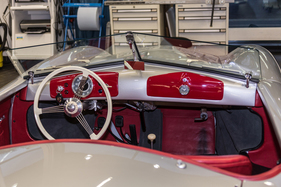
Porsche 550A Spyder 1956
Egon Alber and Herbert Linge as contemporary witnesses and Neel Jani, who had traveled all the way from Switzerland, were the next to take the stage after the silver Porsche icon had been placed there. The audience laughed uproariously after Egon Alber also gave free rein to negative memories of the car, as he was at war with the VW gearbox. Servicing was much easier with the later tunnel gearboxes. Herbert Linge also reported that the nights were short and the days long back then, but this was the only way to get the cars onto the track in the best possible condition.
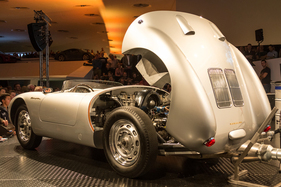
Neel Jani was allowed to chauffeur his boss from the LMP1 team, Fritz Enzinger, in the car, a perfect starting point for the upcoming contract negotiations. Shortly afterwards, Eninger's hand was on his leg, which was not an attempt to get closer, but a sign to pick up the pace. The feeling of great freedom that the car still conveys today also inspires the young racing driver, who is otherwise much faster in current designs. When asked about the brake line, he said "it does brake, but it's a special feeling". Back then, you still had to pay attention to the material and work together with the car, the sound is still fascinating, especially at higher engine speeds, which is where the vertical shaft engine is really fun.
Even though only the Leonberg tunnel to Ditzingen, which was closed on one side, was available as a test track during development, the 110 hp achieved by the car with the design number 550 was a real statement at the end of 1953. As early as 1954, Egon Alber and Hans Hermann won the sports car class and came fifth overall at the Mille Miglia, followed by the first overall victory at the Targa Florio in 1956. The car that went down in history as the James Dean Porsche was one of Porsche's first steps into motorsport.
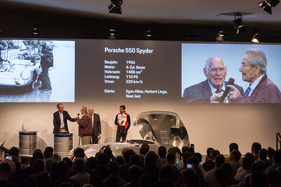
Neel Jani, the Porsche racing driver, reports enthusiastically about taking part in the Ermstal Classic in the rain with the car. "You can drift beautifully with it and we didn't go easy on the car," even if the museum technicians frowned at these words. "Don't rev it so high, they said, but they weren't there." Well, that's how racing drivers are.
Porsche 911 GT1 from 1988
Norbert Singer was the next contemporary witness, well known to the audience, and there are only 6 vehicles of the 911 GT1 shown: 1 road vehicle, 1 test vehicle and 4 racing vehicles.
The regulations required a vehicle that was approved for the road without having to build a large number of them. The "Le Mans people" accused Porsche of negotiating something with the German TÜV for this and to counter this, the car was approved in France by the French TÜV. Porsche set itself high goals, not the "low volume typing" permitted for small quantities, but a normal road approval was the goal, i.e. without facilitations, with crash test, etc.
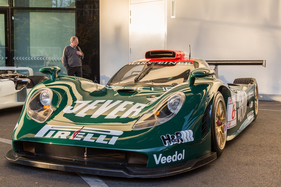
As a result, there are also requirements that otherwise play no role in racing, such as: the windshield must clear from 18 degrees below zero within 15 minutes in order to clear a certain field of vision. An almost impossible task for a car without space for a heater; a heated windshield provided a remedy. Headlights, indicators etc. would also all have had to be checked and inspected at great expense, but this could be avoided by using the parts used in the 911, which had long since been tested.
At Le Mans, it was the first vehicle with a carbon monocoque, a 911 with a mid-engine. The race itself was a race of giants. 6 works teams from Porsche, Toyota, Mercedes, BMW, Nissan and Ferrari were at the start. Toyota had gearbox problems, but their design made it possible to change the gearbox in 15 minutes, which took Porsche 45 minutes. Porsche confidently said that our synchronized gearbox would hold, there was nothing to change, and so it was.
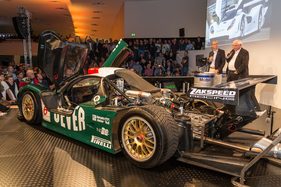
In the course of the race, Toyota had to retire early to change a gearbox, Mercedes was the first team to retire, BMW a little later as well. Nissan drove through, albeit a little too slowly, and Ferrari couldn't keep up the pace either. Porsche's great lead was sorely needed, because Jörg Müller was a little too fast in a chicane in the rain and came back to the pits at around 6.00 a.m. on Sunday morning without an underbody, the second car came in immediately afterwards, water pipe breakage on the engine, so both cars were in the pits and had to be repaired at the same time, while Toyota returned to the track with a replaced gearbox.
Towards the end of the race, the car that hadn't refueled was always the one in front, it got tight, then Toyota stopped with gearbox damage and didn't make it back to the pits. This resulted in a one-two victory for Porsche at Le Mans.
The sound of the winning car had already thrilled the fans when the engines were warming up before the event, but it was even more impressive on stage.
936/81 Spyder - 40 years of Le Mans victory
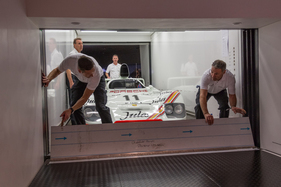
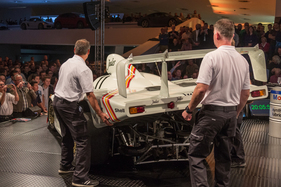
Jürgen Barth, a regular at Le Mans since 1971, was the next guest and brought the presenter a surprise gift. One of the first hot-off-the-press copies of his new cookbook "Schnell mal essen", which had just been presented at the Frankfurt Book Fair. Anyone who knows Jürgen Barth knows that he not only likes to drive fast, but also likes to cook and eat. 24 race tracks are the inspiration for just as many dishes, and the book is sure to find its way onto the shelves of many fans. The winning car from 1981, the 936 Spyder, was skillfully pushed onto the stage by the museum team as always, and it became quiet in the museum. Porsche actually wanted to enter the race with the 924, but Peter Schutz said no, we have to win the overall title, but that wasn't possible with the 924. So they brought out the Spyder. Norbert Singer and Hans Mezger then had to perform a miracle: the air-cooled engine was replaced by a water-cooled ex-Indianapolis engine. But, said Jürgen Barth, that wasn't too much of a problem for our engineers.
With Manfred Schurti, Barth, who did not miss the opportunity to take part in the 924, finished sixth behind the prototypes, so the little Porsche was not that slow either. The same team was used as in 1977/78/79, so they could draw on a wealth of experience, which meant that Porsche was less affected than other teams by the fact that they had to race at Le Mans that year without a qualifying session.
Jürgen Barth and Jacky Icks acquired the Jules stickers at a rendez-vous at Dior a week before the scrutineering, and then had to apply the advertising themselves a few days before the race. Another anecdote shows how things went back then. In 1977, Barth had already won Le Mans with the car, and the following week he was sent to Australia with his toolbox to work there as a racing mechanic. 1981 was a year of round numbers for Porsche: 30 years after Porsche's first start at Le Mans and the 50th anniversary of the founding of Porsche AG, which was certainly one of the reasons for the company's strong commitment to Le Mans that year.
Back then, racing drivers had to be more careful with the technology than they are today. In 1976/77, the then 74-year-old Professor Fuhrmann was constantly standing in front of the pits with a stopwatch. In the drivers' briefing, he urged the drivers to count 1-2 before engaging the next gear. Any rapid gear shifting on the way onto the track would have been punished immediately. The already synchronized gearboxes thanked us with high stability. It was simply a different time back then. Prof. Fuhrmann and Mr. Bott personally dismantled a racing engine during a test at Paul Ricard in order to track down a fault.
Before his visit to the museum, Barth started the first race of the Porsche Sports Cup in Hockenheim with 46 drivers on the grid, so he certainly won't get bored with his current task.
Porsche 911 RSR from 1973
Targa Florio winner Giys von Lennep from the Netherlands and his car skillfully rounded off the first half of the sound night. He is still enthusiastic about the RSR, the fabulous grip on the rear axle was one of the success factors at the Targa Florio, along with the short gear ratio. Four participations in the Targa Florio gave him a lot of experience, but he still did a lot of testing before each race, often in test vehicles, which is the only way to get to know the track inside out.
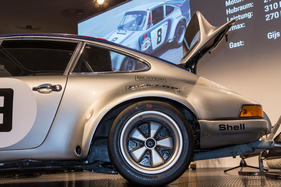
5, 6 or 7 laps a day, between sheep and donkeys through normal traffic, back then that was still possible. Police checks were carried out according to the motto: Stop "Open the hood", followed by shouts of "bella macchina", the traffic was stopped and the journey continued. The route, no less than 72 km long, which was circumnavigated in 37 minutes in the race, was completed in 42 minutes in normal traffic. You have to imagine that, madness! The fact that nothing really went wrong was nothing short of a miracle. At that time, the average speed during the race was around 115 km/h. With 720 bends, that meant up to 1,500 gear changes, which was real work for the driver and gearbox.
After the fuel crisis hit in 1974, the Targa Florio was canceled. Herbert Müller and Giys van Lennep won the last Targa Florio ever with this car.
Porsche 906 Carrera 6
After a short break, during which the 911 official visitors were able to fortify themselves, the show continued with Hans Mezger, who was not here on stage for the first time either. With the 906 Carrera 6, used as a camera car, the ZDF made spectacular recordings of the 1000 km race at the Nürburgring in 1967, long before on-board cameras were used in races. As Porsche did not have large engines at the time, a two-liter engine was used here and lightweight construction was the order of the day in order to be competitive.
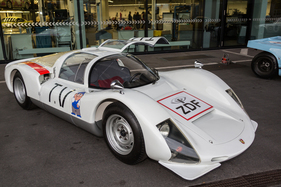
The homologation weight was 580 kg, which was achieved in part by using the pipes of the frame as an oil line, thus eliminating the need for heavy oil lines. The racing engine itself weighed 50 kg less than the standard machine, the tubular frame weighed 53 kg although it required 30 m of steel tubing, consistent weight savings at every turn, good for 66 class victories at Daytona, Sebring and on many other racetracks around the world.
One of the most beautiful victories was the overall victory at the Targa Florio in 1966 with opponents such as Ferrari with the Dino 206, Alfa with the Julia TZ2, a Ford GT40 and many more. The drivers at the time included Herbert Linge and Hans Hermann, who arrived at that very moment to the applause of the crowd.
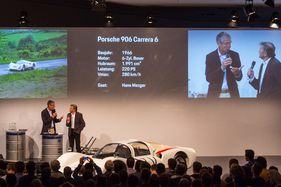
50 vehicles were required for homologation, 67 were ultimately built. Hans Mezger still remembers exactly how the gullwing doors came about. At that time, the so-called Le Mans start was common at the races, where the drivers had to run to the vehicles as quickly as possible, get in and close the door, for which conventional doors were rather a hindrance. "So, standing next to the body designer Scholder in front of the first prototype, I came up with the idea of trying gullwing doors, and that worked," said Hans Mezger. ZDF made history with the footage from the camera - it must have been an Arri 16 or 32mm, a huge thing from today's perspective - and Porsche made history with the vehicle itself.
And its sound still thrills all fans of the company today.
Porsche 911 GT2 RS Type 991
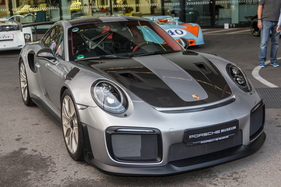
A much newer vehicle was then brought onto the stage from the transport elevator by the museum crew. Andreas Preuninger, Head of the Motorsport GT Road Vehicles department, was impressed by what can be done with road-legal vehicles on the racetrack. The team performance and the performance of the drivers are also impressive, everything just fits together here. As the engineering team responsible for the racing cars is also responsible for the road-legal vehicles, many solutions conceived for racing are directly incorporated into the series, and you can see that in the cars.
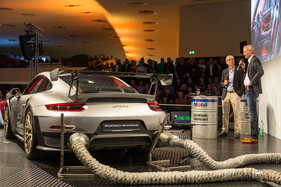
Andreas Preuninger's recruitment criterion: "Anyone who can't complete the Nordschleife in this car in under 8 minutes has no place with us."
The current GT2 RS is not limited, but the small series is not expected to be much more than 1000 units for the EU countries and just as many for the rest of the world.
The film about the car with Mark Webber and Walter Röhrl, in which both drive a GT2 RS in Le Castellet, was also mentioned. Mark Webber says "I'll show you how to drive a fast corner" and later gets the answer "You were faster, but I had more fun" from Röhrl, who drifts spectacularly in the movie.
We recommend searching for "The new 911 GT2 RS - Walter Röhrl vs. Mark Webber" on YouTube.
The question of whether Röhrl would really be so much slower than Webber if he had set his sights on a fast lap remains unanswered. Andreas Preuninger is impressed by how little Röhrl steers during the final set-up work on the new cars, how calmly he drives and how, quote, "super-fast it simply is".
917 KH hatchback coupé
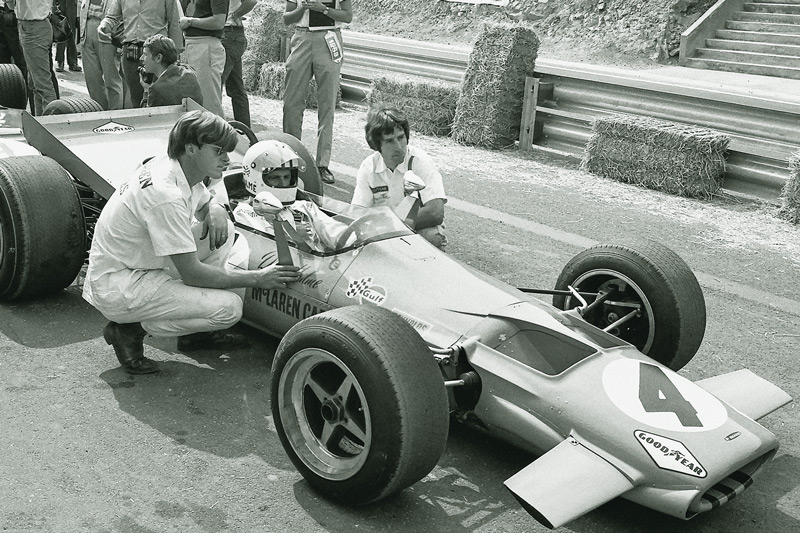
The vehicle known as the Gulf cab from 1970, formerly driven by Kurt Ahrens and Rudi Lins, came onto the stage under the heading of restoration. We weren't really prepared for how difficult this car was to drive, began Kurt Ahrens. Many drivers refused to drive the car, especially at Spa. The car was uncompromisingly developed and brought Porsche the Sports Car World Championship in 1970 and 1971.
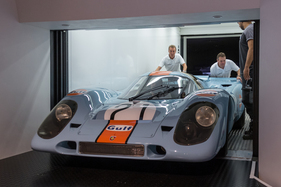
Rudi Lins describes it as a supercar. Only a few drivers were allowed to drive it and you have to imagine: he drives a car with 40 hp at home in the snow in 1970, gets on a plane and drives the 630 hp sports car on the track without ever having driven a kilometer in it, "that's a real surprise". The fact that there were also many cars on the road at Daytona, for example, that were a good 100 km/h slower, made things "really exciting from time to time".
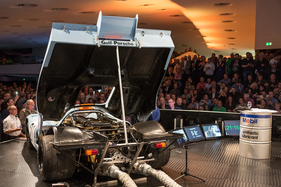
After its international career, the car shown went to Weissach for many years as a racing cab, with 630 hp, a weight of 800 kg, powered by a twelve-cylinder engine with a displacement of 5 liters, which resulted in a top speed of over 360 km/h, probably the fastest cab in the world. The first time in Le Mans, the car was supposed to travel at just under 400 km/h, but the road becomes really narrow from 380 km/h. It was later discovered that the tires were only approved for speeds up to 350 km/h, which resulted in numerous punctures during further tests. Despite all this - a great time.
Hearing the sound of the twelve-cylinder engine live was the experience of the evening for many participants.
Porsche 911 GT3 RSR Type 991
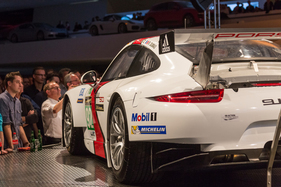
The Le Mans winners Marc Lieb, Richard Lietz, Romain Dumas and with them the Program Manager WEC, Alex Stehlig, took the winning car from 2013 almost back to the present. Marc Lieb was delighted to see the car again and passed on to Richard Lietz with the words "the end of the race was a bit lucky". "The weather situation was special, it had started to rain, the safety car came onto the track, but with the slick tires it was not possible to catch up with the safety car as required, the car was already well below 80 km/h.
By the time the team had decided to put on rain tires, I had already passed the pit lane and had to continue on slicks. That was absolutely the right decision; we won the race by saving the tire change." The development of the car began in 2012 and was not easy. After the last race in Spa, there were only serious faces everywhere, but the engineers promised a new aero package for Le Mans and that worked out well, the tires were right.
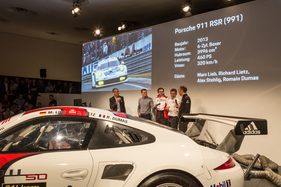
It was not unusual to do up to three 50-hour simulations with the car before the race - the technology is just getting more and more perfect. A stint at Le Mans is 70 minutes, up to three in a row, so everything has to be just right, both for the driver and the material.
Romain Dumas, who was attending the sound night for the first time, was delighted with the keen interest shown by the guests - a great feeling in the Porsche family, he said.
If you want to be there next year, you have to be quick. In the pre-sale, which this year ran via easy ticket, no tickets were available after just a quarter of an hour.
Porsche 908/03 Spyder 1970
After Porsche had won the one-make world championship in 1969, everything was done to defend the title in 1970. A maneuverable car was needed for certain race tracks, especially the Nordschleife, and the 908 Spyder, about which Peter Falk answered questions, was the result of this development. For the Targa Florio in particular, it was clear that the 917 would not work, we needed a different car. The 917 works on fast racetracks like Daytona, but not on the Nürburgring.
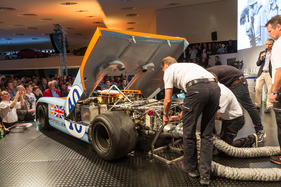
Based on the 909 mountain car, a lightweight racing car was created in a short space of time, which was later praised by its drivers as the best racing car they had ever had the pleasure of driving. A total of 12 of these were built. The double victory at the 1970 Targa Florio was the crowning glory and, to quote Falk, "quite easy with this car. Fourteen days later, at the Nürburgring, the next one-two victory was achieved with the car, and the pithy sound of the car could be heard in the museum.
In 1971, the Targa Florio did not work out, but the next race at the Nürburgring was a one-two-three. When the factory no longer needed the cars, they were used as customer vehicles and were also very successful here, for example in the Joest team. In 1976, the turbo engine gave the car a second lease of life, and in 1986 the historic Targa Florio was driven by the factory and also won.
Porsche 911 GT3 Type 996
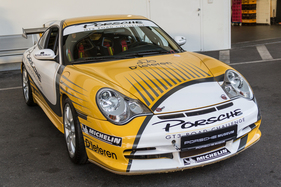
Finally, proof that the 911 is an all-round talent that can also be used in rallies. Roland Kussmaul and Romain Dumas were allowed to answer questions. In 2004, the Royal Belgian Automobile Club announced a Grand Tourismo class for the national rally championship, customers expressed interest to Porsche and this vehicle was developed as a result. Kussmaul initially worked in road testing and developed dampers for the Safari. "That was all good, including the test bench trials, but at some point I had to take it out on the highway at night," said Kussmaul.
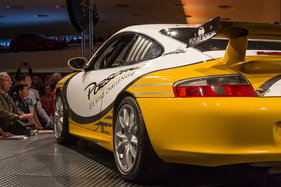
All within the framework of the traffic regulations, of course, but during the measurements there was a rollover at 250 km/h, harmless for the driver but the car was actually broken. It had a sliding roof and the rails of the same probably saved Kussmaul's life over the 330m slide, they were ground through to the ground and thus prevented worse.
The next day, in the company as usual, something like that doesn't stop you from working, someone from the department said, "you've done a great job, now you have a car for rally testing". Was he accused of doing this on purpose so that he would have a car to test the dampers?
A lot of things were done with this car afterwards, including driving VIP guests around Weissach, which fits in with an anecdote that Kussmaul told: "Mr. Kreisky, the Austrian Chancellor, came one day and Mr. Fuhrmann took me aside and said to me: "Watch out, you're driving Kreisky around now, but you stop with the nonsense, you drive so decently that nothing happens".
"I took that to heart," said Kussmaul, "drove Kreisky around and after three quarters of a lap he said: "Well, is that all?".
When I replied that I could do more, but my boss didn't want any more, he said: "You know what, I'm his boss and now it's time to drive around properly so that I get something out of it". There was a small ski jump just before the place where everyone was standing, so Kussmaul drove the jump with safety, the car "jumped only 20 to 30 meters" and when he had stopped, Fuhrmann came and yelled: "That has consequences, didn't you listen to me?" Kreisky said next to him: "Now watch out, I'm your boss and I told him to drive fast" ...
Romain Dumas also has a story about the car. When he was in Weissach one day to test the Spyder, he saw the car in a garage and said to his boss, "If we win the championship with the Spyder, then I want to drive a rally with the car. His father had already driven Porsche hill climbs, so he was an early fan of the brand. "After we won the championship, I said I'd like to have the car now." But the car had engine trouble, so Roland asked me when the next rally was? Next weekend in the south of France! But you guessed it, that worked out too.
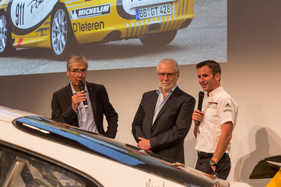
Roland Kussmaul briefly commented on the background to the whole thing. The whole thing was actually a press coincidence, because the press department asked if we had a car for Walter Röhrl as a zero-series car for the first German World Championship Rally. We said to ourselves that a simple GT3 car or something like that wouldn't work, because when Walter is sitting in a car, he's not going for a drive.
Then we did everything to the car that you need for a rally. Walter then drove the fourth special stage, the car flipped, then it bounced up, it was hanging in the air at an angle over the road, but thankfully the car fell back onto its wheels. Walter called on the radio and said that the rally was over and the tank had run out of oil. Kussmaul said to himself, "It's not going to happen that quickly. We towed the car to the next village and welded the whole thing back together at a farm.
"So Walter was able to drive the next special stages again and I already knew what was coming when the next city special stage on asphalt came up. Walter drove for his life and set the best time with the zero car against the world championship cars with Loeb and all his comrades from the good times," said Kussmaul with a broad grin on his face.
This then led to the Belgians who were at the Deutschland Rally saying that the car was absolutely fine, which subsequently happened, as you can read at the beginning of this article. These little stories on the fringes of the event and the direct contact between the fans and their idols and the cars - that's what makes the Porsche Sound Night so special.
We are already looking forward to 2018.