


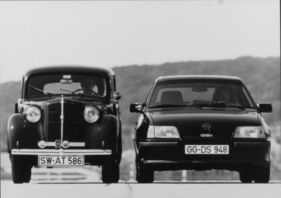




The sixth Opel Astra generation will set new standards in the segment - and thus continue the tradition of 85 years of successful compact class models from Opel. For it was the automobile company from Rüsselsheim that was the first manufacturer to launch a family-friendly and above all affordable compact car for customers in 1936 - the Opel Kadett.

In the German "economic miracle years", the Kadett A really took off - practical, compact and affordable cars were in high demand. In 1962, Opel built a completely new production facility in Bochum specifically to manufacture the Kadett. Another magic word for the continued success was: Innovation. And so each new model generation brought innovative technologies to the compact segment. These included the water-cooled four-cylinder engine of the Kadett A in 1962, the uniquely aerodynamic body of the Kadett E in 1984 and the adaptive forward lighting (AFL) of the Astra H in 2004.
In 2021, Opel opens another chapter in the successful compact class history with the new Astra: With its bold and clear design and state-of-the-art technologies, the next-generation Astra is entering a new era for the first time electrified as a plug-in hybrid. It's worth taking a look back.
Revolutionary: The first Opel Kadett with a self-supporting all-steel body
Opel has been setting standards in the compact class for 85 years. It all started in 1936 with the first Kadett. After the Opel Olympia - the first German car with a self-supporting all-steel body - the Kadett also relied on this revolutionary technology. The advantages of this construction principle over the classic chassis and wooden body design: driving performance and fuel consumption benefit from the lower weight, and the safety level increases thanks to the rigid passenger cell and lower center of gravity.

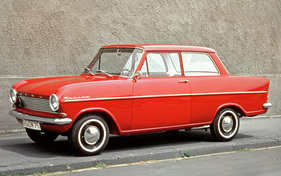
From 1962 to 1965, the Kadett A scored points with a lively one-liter engine, a large trunk and plenty of space for passengers. The external fuel filler cap also contributed to its success - something you would look in vain for from any other manufacturer at the time. "You'll never have the smell of petrol in the trunk," is the tongue-in-cheek greeting to Wolfsburg. Thanks to this design, the spacious load compartment is reserved exclusively for luggage.
Opel also opened a pioneering chapter with the Kadett D (1979-1984). For the first time, the new generation was not rear-wheel drive but front-wheel drive "made by Opel". The space-saving, transversely arranged drivetrain made the Kadett even more spacious - a package that was second to none. Although the Kadett D is shorter than its predecessor, it offers more space inside than its predecessor - and above all more space than many of its competitors.
New name for the Opel compact class: Astra F embodies the zeitgeist of the 1990s
At the premiere of the Opel Astra F in 1991, the world was changing. If there is one model that perfectly represents this time, it is the Astra, the 7th generation of the successful Opel compact class. Not only was the name, taken from its British Vauxhall counterpart, new on the continent, the Astra also offered a variety of new safety systems for its time. The new model is also at the forefront when it comes to conserving resources: Many of the materials from which it is made are recyclable. This overall concept convinced and delighted customers: From 1991 to 1997, around 4.13 million Astra Fs rolled off the production line. This makes it the best-selling Opel model to date.
Fit for the future: The sixth Astra generation ushers in a new era
With the all-new Astra, Opel is entering a new era in the compact class in 2021. CO2 is the new currency of the automotive industry. Electromobility is therefore a decisive factor in reducing emissions. The new Astra plays a key role in the electrification of the model portfolio - the 11th generation of the Opel compact class will be available as a plug-in hybrid for the first time.
The new Astra is also a design statement for the brand. It takes the new bold and clear Opel design philosophy to the next level. The Opel Vizor brand face, muscularly sculpted wheel arches and exciting lines give the Astra a sporty, self-confident appearance. And inside, the driver-oriented, fully digital Pure Panel takes Astra drivers into a completely new cockpit world.
85 years after the "original" Kadett, the new Opel Astra continues the tradition of its predecessors and takes the Opel compact class into the future.
1936-1940: Opel Kadett - a car for the heart and mind
After its premiere, the Opel Kadett, with a speed of almost 100 km/h, wins the hearts of the public and the goodwill of the press: "As the first test drives confirm, the Kadett is by no means an everyday vehicle for this price range," wrote the Braunschweig daily newspaper on December 5, 1936. The chassis with synchronous suspension and leaf-sprung rear axle came from the Opel Olympia, the side-valve four-cylinder cast iron engine with 23 horsepower from a displacement of 1,073 cc from the Opel P4. The adoption of technology from the modular system brought further advantages: the Kadett could be offered to buyers at a particularly attractive price.

Like its big brother Olympia, which it also resembles visually, the Kadett is a thoroughly modern car. It is characterized by harmonious proportions with a hatchback and integrated headlights. In 1938, as part of a major facelift, the Kadett was given a pointed radiator in the style of late Art Deco - experts today consider this version to be an intermediate generation.
"Just as nimble, agile and obedient to the driver's every command [...] as you would expect from a career-making Kadett," wrote the Kölnische Zeitung newspaper in 1936 about the new Opel model series. The name "Kadett" was as new as the segment itself. Until the introduction of the first Astra in 1991, Opel's compact class series would be called this for over five decades. With the Admiral and Kapitän luxury class models, the company presented two model series in 1937 and 1938 whose names also came from the marine sector.
Pioneering: self-supporting bodywork and state-of-the-art production
After the Olympia, the first German production car with a self-supporting all-steel body, the first Kadett also had such a sheet metal skeleton. The advantages of this construction principle over the classic design of chassis and wooden body are manifold: driving performance and fuel consumption benefit from the lower weight, and the safety level is higher thanks to a stiffer passenger cell and lower center of gravity. The self-supporting design enables a new production method that is still used today: the body and units (engine, transmission, axles) are "married" on the assembly line with the help of hydraulic lifting tables. In 1936, the brand operates the largest body pressing plant in Europe with the Blitz in Rüsselsheim.
Headlights integrated into the bodywork instead of the usual top lamps give the Kadett a fresh appearance. No wonder, because Opel made modern automobile design popular in Europe: a design department was founded in Rüsselsheim at the initiative of GM chief designer Harley Earl as early as the beginning of the 1930s, shortly after the company was integrated into the General Motors Group.
A lot of car for the money
As early as 1936, the first Kadett offered the good price/performance ratio that is still typical of the brand today, thus democratizing luxury. Details such as hydraulic four-wheel brakes, direction indicators, draught-free ventilation via triangular vent windows and a dust-tight luggage compartment accessible from the inside were unusual in the class at the time - the Kadett had them all ex works.
The Kadett was the first Opel model to have an in-house developed downdraft carburetor with a so-called Venturi tube. In this nozzle, named after the Italian physicist Giovanni Battista Venturi (1746-1822), the fuel is mixed into the intake air flow before the throttle valve. The Venturi tube is a smooth-walled piece of pipe with a constriction. When air flows through the pipe and passes the narrower area, it must flow faster at this point than in the other zones. This creates a negative pressure at the constriction (like on the top of an airplane wing). A small tube filled with gasoline is located at the constriction. The fuel is sucked in by the negative pressure in the Venturi tube and carried along.
The first generation of the Opel Kadett was built from 1936 to 1940; 107,608 units were produced as two-door and four-door sedans as well as a two-door convertible sedan. They were all equipped with a 1.1-liter petrol engine with 23 hp and had a self-supporting all-steel body.

1962-1965: Opel Kadett A - For the economic miracle
A large trunk and plenty of space for four people; a new, high-revving engine and low maintenance costs are the Kadett A's recipe for success. Opel builds almost 650,000 cars from 1962 to 1965. The lines of the two-door notchback model are functional and modern: The beltline is low, the large glass surfaces ensure good visibility. A trim strip running along the entire side line emphasizes the elongated shape. The front fenders run into the headlights, while the rear ends are designed as "arrow corners". The space in the interior will amaze previous small car drivers. The trunk is a real luggage compartment and - the fuel filler cap is on the outside!

"Opel Kadett in a nutshell: O.K.", praise the advertising copywriters, who can't resist a dig at their main competitor from Wolfsburg. "You'll never have the smell of gasoline in the trunk," they say with a wink. With its modern, water-cooled front engine, the Kadett offers another design advantage over the Beetle: the 993 cm3 four-cylinder engine delivers 40 hp and also powers the new Kadett Caravan from March 1963.
1965-1973: Opel Kadett B - "The car"
If you say A, you have to say B - in 1965, the new model series replaces the first Kadett. The new model measured over four meters and was therefore a whole lot bigger. The designers were inspired by their overseas colleagues for its fashionable lines: The flat sloping rear is reminiscent of the fastback models from the USA and signals "power and speed even before you hear the engine", according to Automobil Illustrierte in 1966. The horsepower figures increase in line with the length. The Opel engineers increased the bore of the four-cylinder engine by three millimeters: The now 1,078 cm3 basic unit produced 45 hp. Alternatively, the higher-compression 1.1 S engine with 55 hp is available.

The Kadett quickly becomes a success: with more than 2.6 million models produced between September 1965 and July 1973, the Kadett B becomes a millionaire. Its success is not limited to the country of birth: in 1966, the export share reaches 50 percent. The Kadett is sold in 120 countries around the globe.
1973-1979: Opel Kadett C - The sports car
A smart family car, a chic second car with a practical tailgate or a powerful sports car in war paint: the Kadett C family has many faces. A total of 1.7 million models were produced from 1973 to 1979. The rear-wheel drive Kadett C made its debut in August 1973 with a clearly designed body and a new double wishbone front axle. Characteristic design features include the flat radiator grille, the hood with the brand-typical crease and the front spoiler.

A car "that is not only pleasing to drive, but also conscientiously designed and cleanly finished, which is also easy to maintain and repair and economical to run", praised the testers of auto motor und sport in issue 20/73. The GT/E made its debut at the IAA 1975. Its 1.9-liter engine with L-Jetronic injection from Bosch delivers 105 hp and is good for 184 km/h with an unladen weight of only around 900 kilograms.
1979-1984: Opel Kadett D - The front-wheel drive car
The fourth generation of the post-war Kadett heralded a new compact class era at Opel: The modern Kadett D, Opel's first front-wheel drive model, made its debut at the IAA 1979. The packaging is impressive: Although the new model is 12.6 centimeters shorter than its predecessor at a length of 3,998 millimeters, the Kadett D offers a longer interior than its predecessor and significantly more space than many of its competitors. However, it is not only the drive layout and chassis (with a twist beam axle at the rear) that break with tradition; the Kadett gets a new 1.3-liter OHC engine with 60 and 75 hp. The fact that a new era has begun in the compact class is also made clear by the body range: In addition to the spacious Caravan with up to 1,425 liters of cargo volume, Opel only offers hatchback versions.

In January 1983, the sporty Kadett GTE followed for a fun GTI chase. The GTE, which reaches speeds of up to 187 km/h, is equipped with a 115 hp 1.8-liter four-cylinder engine. Further technical modifications include a firmer and lowered chassis, new steering dampers and ventilated front disc brakes. From 1979 to 1984, a total of 2.1 million Kadett Ds were produced.
1984-1991: Opel Kadett E - The aerodynamics world champion
The second front-wheel drive Kadett, built from 1984 to 1991, is voted "Car of the Year 1984" and is an absolute success. With a total of 3,779,289 units, it is the best-selling Opel to date and a true aerodynamics world champion. The Opel engineers achieved a great success in 1984. On the technical basis of its predecessor, but with a completely new hatchback body, the Kadett E made a huge career for itself. With a drag coefficient of 0.39, the Kadett D was already the best compact car - but its successor made this figure pale in comparison: After 1,200 hours of fine-tuning in the wind tunnel, the E model achieves a sensational cW 0.32. And the sporty GSi is the world's most streamlined saloon with a cW 0.30 and a drag coefficient of 0.57 square meters.

After just a short time, customers enthusiastically embraced the new shape and the Kadett E took off, with 625,000 new registrations across Europe in 1987. The Caravan had long since become the load master of all classes, and in the fall of 1985 a notchback version was available for the first time since the Kadett C. The GSi finally became an icon when, from 1987, it simply left the competition standing with its pioneering 150 hp 16-valve engine.
1991-1997: Opel Astra F - The bestseller
Around 4.13 million Astra Fs were built between 1991 and 1997. This makes the series the most produced Opel model of all time to this day. Contemporary design, more space, comfort and environmental protection were the focus of development. The successor to the Kadett takes the name of its sister model in the UK - where the fourth generation of the compact car has been sold as the Vauxhall Astra since 1980.

Safety is a top priority in the new model. All Astra models feature the active belt system with belt tensioners on the front seats, height-adjustable belt suspension points and seat ramps as well as side protection including double steel tube reinforcements in all doors. For the first time, all engines have a catalytic converter.
1998-2004: Opel Astra G - The versatile model
In spring 1998, the Astra with coupé-like design is launched as a three-door model, a five-door saloon and a Caravan. The notchback saloon, coupé and convertible follow at a later date. Progressive, independent design, dynamic chassis and drive technology as well as almost doubled torsional and bending stiffness are features of the completely newly developed second generation of the Opel Astra.

The fully galvanized body contributes to the high value stability. In addition to the 30 percent higher light output of the transparent H7 headlights, the newly developed DSA chassis (Dynamic Safety Action) also contributes to active driving safety. It combines comfort with agile and safe handling, even with a full load. The wheelbase has been increased by around ten centimeters, allowing for more space, in particular more knee room in the rear and an increased trunk capacity of 370 liters.
2004-2009: Opel Astra H - The power type
With twelve engines from 90 to 240 hp and seven body variants, the model diversity of the Astra H, of which over 2.7 million were sold, is unique. Progressive design, high driving dynamics and technical innovations - these are the outstanding features of the third-generation Opel Astra, which was launched in March 2004 and immediately won numerous comparative tests in the specialist media.

The technical highlights of the Astra include the adaptive IDSPlus suspension system with electronic damper control, which is otherwise only found in luxury class vehicles and exclusive sports cars, as well as the AFL headlight system with dynamic bend lighting. The Astra is also at the top level when it comes to safety. The bestseller is considered one of the safest hatchbacks in the compact class.
2009-2015: Opel Astra J - The designer piece
Sculptural elegance meets German precision: The Opel Astra J not only embodies Opel's new design philosophy, it also supports its drivers with technologies that have already contributed to the success of the mid-size bestseller Insignia. The "Opel Eye" front camera recognizes traffic signs and informs drivers about speed limits and overtaking bans. It also ensures that the car stays in the right lane. With the AFL+ headlamp system, the Astra can look around corners and even automatically fade up and down if necessary. Thanks to the new chassis - also available with adaptive FlexRide technology on request - the Astra can make full use of its dynamic talents.

Driving pleasure, improved handling and comfort are guaranteed by a new rear axle design: a so-called Watt linkage improves wheel guidance. Astra drivers can lean back and relax in the particularly ergonomic and spine-friendly seats, for which Opel has been awarded the seal of approval by the independent experts of Aktion Gesunder Rücken e.V. (AGR).
2015-2021: Opel Astra K - "European Car of the Year 2016"
Up to 200 kilograms lighter, more spacious inside despite smaller exterior dimensions and more efficient than ever before thanks to the latest generation of engines - the Opel Astra K represents a quantum leap in development and is voted "European Car of the Year 2016". The successful model from Rüsselsheim is once again available as a sporty hatchback sedan as well as a spacious Sports Tourer. The Astra K continues the tradition of its predecessors: it also shines with pioneering lighting technology. It is the first car to bring the Intelli-Lux LED® full-LED matrix light from the luxury and premium class to the compact class.

The portfolio of state-of-the-art driver assistance systems also includes traffic sign recognition, lane assist with active steering correction, distance display and forward collision warning with automatic emergency braking function. Newly developed, AGR-certified ergonomic seats are also available on request. The driver and front passenger seats now have additional optional comfort features such as ventilation and massage function.
From 2021: Opel Astra L - The electrifying challenger
With the new Astra, the German manufacturer is now opening the next chapter - for the first time, the compact class model is also available electrified. Opel will offer the new Astra in two performance levels as a plug-in hybrid. There will also be versions with highly efficient gasoline and diesel engines in combination with particularly low-friction 6-speed manual and 8-speed automatic transmissions.

The new Opel Astra is also a design statement for the brand: more dynamic than ever before, with clear, exciting lines without superfluous flourishes and with the new Opel Vizor brand face. With the next compact class generation, Opel shows that the Astra is entering a new era.
