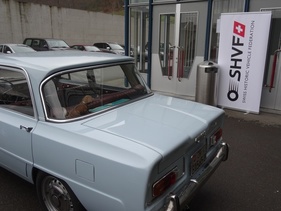
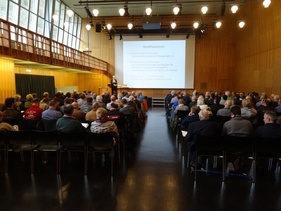
On January 27, 2018, the Swiss Historic Vehicle Federation invited the vehicle inspectors from its member clubs to a technical seminar at the Vocational Training Centre in Baden.

Felix Aschwanden, Technical Manager, and Lukas Oberholzer, President, welcomed 157 participating inspectors from a total of 247 listed experts and five guests. The main topic of this year's seminar was innovations and changes in the FIVA Identity Card creation process.
Turin Charter as the basis
The basis for the new FIVA Identity Card is the Charter of Turin, the statutes, internal regulations and guidelines, the Technical Code and parts of the Event Code and the Driver Guide of the international association FIVA (Féderation Internationale des Véhicules Anciens) on the one hand and the requirements and instructions of the national association, the Swiss Historic Vehicle Federation, on the other.
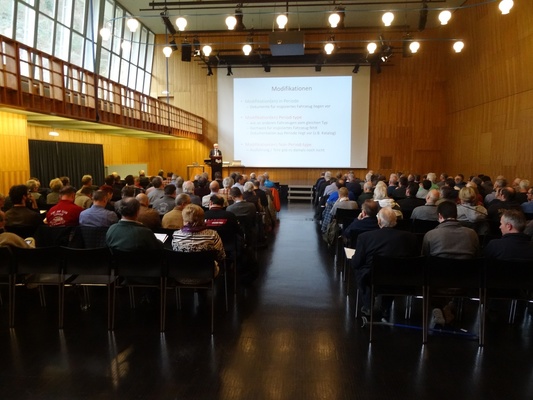
The FIVA Technical Code 2015 describes in detail how originality and authenticity of the vehicle are defined and how deviations from the original or delivery condition of the vehicle in question must be described. In the 2015 Code, vehicle history is given a higher priority and the classification of vehicles into categories is simplified.
Soon only online
A new FIVA online tool has been created. The vehicle owners, the national umbrella organization, the inspectors and the FIVA use the same platform in English. The vehicles are recorded in a central database. This is not only intended to eliminate sources of error, idle time and duplicates (e.g. several vehicles with the same chassis number can be recorded). A very important innovation here is that each vehicle is given its own identification number, which then remains reserved for the vehicle. This means that the history of the vehicle can be accessed or continued even after a change of owner.
Future procedure
How will the FIVA Identity Card be obtained in future (from November 2018)?
- The vehicle owner registers on the FIVA online tool with their name, full address, telephone number, email address, details of where the vehicle is located and where it is to be registered.
- The vehicle owner fills in the online questionnaire about the vehicle as completely as possible.
- The registration on the FIVA online tool is then complete and finalized.
- The system informs the ANF (SHVF) about the registration. The ANF checks the documents for completeness and may have questions for the applicant.
- If everything is clear and the applicant has transferred the processing fee, an inspector is appointed to inspect the vehicle on site based on the documents submitted. Together with the application, the inspector prepares his inspection report and forwards his findings to the SHVF Technical Commission.
- The Technical Commission then makes the final decision on the issue of a FIVA Identity Card. If the decision is positive, the card is printed out and sent to the applicant.
This process will be tested in 2018. Manually completed application forms (in the old version) can still be submitted until November 2018. After that, only electronically completed applications will be processed. The association expects the introduction process to be completed by January 1, 2019.
From summer 2018, the exact description of how to select the application in the FIVA online tool and complete the questionnaire will be available on the Swiss Historic Vehicle Federation website.