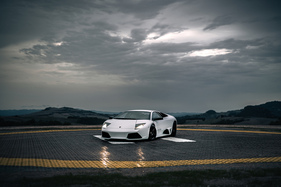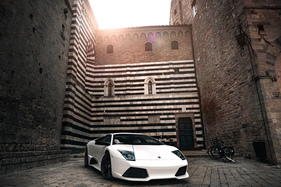
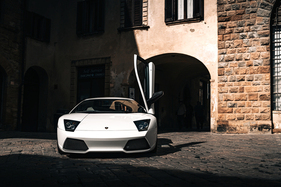
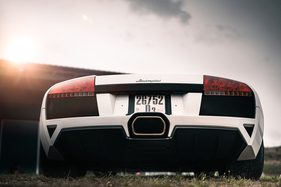
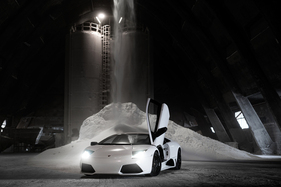
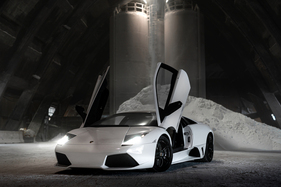
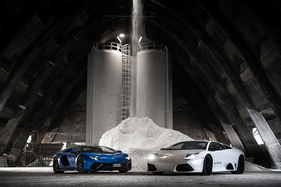
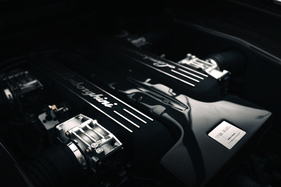
In 2022, Lamborghini is celebrating its V12, the legendary twelve-cylinder engine that has powered the brand's most famous models for almost 60 years. This includes the Murciélago, the Lamborghini model that made its debut at the Frankfurt Motor Show in September 2001 and was tasked with bringing the already legendary V12 engine into the 21st century. It fulfilled this task exceptionally well, because even at the premiere of this model, its engine, which had been enlarged to a displacement of 6.2 liters, developed a maximum output of 580 hp. A very high output considering the large catalytic converters that were required for the vehicle to be approved for all markets worldwide, especially those with particularly strict emissions regulations.
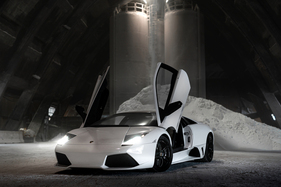
The Murciélago was the first Lamborghini to be designed entirely using the CAD-CAM system. This guaranteed a particularly high level of planning accuracy and enabled significantly higher quality in assembly and details such as gap dimensions. The aesthetics of the Murciélago were created entirely in the new design department, the Centro Stile Lamborghini. It was headed at the time by Luc Donckerwolke, who had already redesigned the Diablo, but had the rare privilege of starting with a blank drawing board for both the body and the interior design of the Murciélago. The overall height was limited to just 120 centimetres, and the characteristic feature of the scissor doors was retained.
The development of the twelve-cylinder
At the time of its creation, the Murciélago was only available as a closed version and with a 6.2-liter engine that produced 580 hp at 7200 rpm. Thanks to dry sump lubrication, the Murciélago's engine was five centimeters lower than that of the Diablo, which brought obvious advantages in terms of handling. It accelerated from 0 to 100 km/h in 3.8 seconds and reached a top speed of 330 km/h.
The Murciélago Coupé was supplemented by a roadster version in 2004. The second generation of the Murciélago, officially called the Murciélago LP 640-4 (Coupé and Roadster), was introduced in 2007 and produced until 2010 with a V12 that had been further developed to 640 hp at 8000 rpm. In 2010, the Murciélago LP 650-4 Roadster was launched on the market with a manual top and an engine enlarged to 6.5 liters with 650 hp at 8000 rpm. In 2009 and 2010, the 670-4 SV (Super Veloce) with 670 hp and a top speed of 341 km/h was produced. Its weight was reduced by an impressive 100 kilograms thanks to the use of carbon fiber for various components.
All Murciélago models were equipped with all-wheel drive, a system taken directly from the Diablo. The Ferguson viscous differential was able to send up to 70 percent of the torque to the rear axle, while 30 percent was applied to the front axle. The chassis consisted of carbon fiber components together with an aluminum composite platform structure and was the stiffest chassis Lamborghini had ever produced at the time. The chassis was completely redesigned with a new suspension and new geometry.
Manual transmission
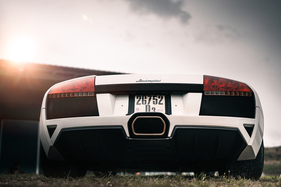
The Murciélago was the last V12 Lamborghini to be available with a manual transmission, in this case a six-speed gearbox plus reverse gear. Later, an electronic, automated gearbox was offered as an option to the manual gearbox, with gear changes made via shift paddles behind the steering wheel.
Racing
In 2004, the Murciélago made its racing debut with the R-GT. It was developed for the International GT Championship under the auspices of the FIA and the ACO for the Japanese championship. Nine vehicles were built, all exclusively with rear-wheel drive. Thanks to the consistent use of carbon fiber components, they were significantly lighter than the production cars. They were also equipped with larger wheels and brakes.
The name
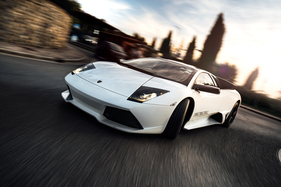
It is a tradition for the manufacturer from Sant'Agata Bolognese to choose its model names from the world of bullfighting. The name "Murciélago" means "bat" in Spanish. Legend has it that a bull of this name that survived the bullring was given to Don Antonio Miura. The Miura bulls of the famous breeder are said to have been sired by this specimen. In reality, there is no proof of this legend, which is also chronologically inconsistent.
Limited editions
The Murciélago was also produced in a series of limited editions, starting in 2003 with the 40th Anniversary. The model was developed to celebrate the 40th anniversary of Automobili Lamborghini and was produced in 50 units. The 40th Anniversary was recognizable by the special green shade "Verde Artemis", some exterior details in carbon fiber, revised rims, an open exhaust system and a numbered plaque inside the leather-trimmed interior with a unique design.
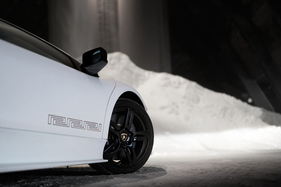
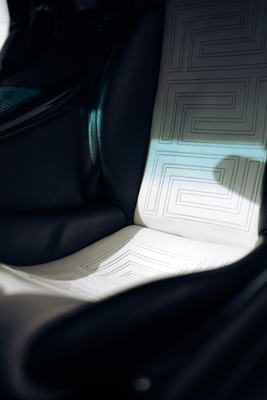
The Murciélago LP 640 Versace, which was only available in two colors - black or white - was introduced in 2006. Lamborghini Ad Personam and the stylists at Versace created a special two-tone design for the interior and a matching luggage set, which was also produced by Versace. A scarf and driving shoes, both featuring the Versace logo, are also specially designed to match the model.
The 670-4 SV "China Limited Edition" was intended exclusively for the Chinese market and was produced in a limited edition of just ten units. It could be recognized by the longitudinal stripes on the hood and roof.
The speed record in Nardò
In February 2002, Lamborghini took a Murciélago to the test track in Nardò (Apulia) to set a new world speed record for production road-legal vehicles. At the wheel was test driver Giorgio Sanna, now head of Lamborghini Squadra Corse. The goal was achieved despite an unscheduled tire change during a refueling stop: the Murciélago covered 305.048 kilometers (189.55 miles) in one hour. The average speed of the fastest lap at the time was 325.98 km/h (202.55 mph). Records were also set over distances of 100 kilometers and 100 miles respectively.
Murciélago in the movies
Several dozen films and music videos have used the Murciélago in prominent roles. Its most famous film appearance is undoubtedly that in Batman Begins from 2005, in which it can be seen as the personal vehicle of Bruce Wayne/Batman, played by actor Christian Bale.
The Murciélago's career in video games is also extraordinary, where it was used in Gran Turismo 7, Forza Horizon 1 to 4, Asphalt 7, Drive Club and Horizon Chase, for example.
Production of Lamborghini's "pure" V12 combustion engine in its final evolutionary stage will come to an end with the latest Aventador Ultimae at the end of 2022: From next year, the Aventador successor will be launched with a new plug-in hybrid V12.
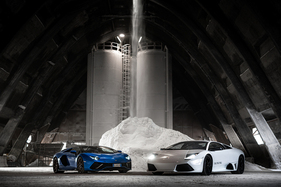
Murciélago produced (2001-2011): 4099 (entire series).