


While the Škoda 130 LR was still driving around the domestic rally tracks in September 1987, a real paradigm shift took place at the International Engineering Fair in Brno, where Škoda presented the Favorit for the first time to great public interest. The short-tail model with front engine and drive was a completely new development, for which the Czech car manufacturer believed it had good sales prospects in the demanding Western European markets. Mladá Boleslav therefore immediately began developing a rally version, the success of which was to promote the new model internationally.
Works driver Vladimír Berger played an important role in the development of the racing car. He drove the then not yet officially homologated Škoda Favorit for tuning purposes at selected rallies of the 1988 Czechoslovak Championship. On January 1, 1989, the vehicle was homologated under the registration number A-5373, before the Favorit celebrated a successful debut shortly afterwards with the driver teams Křeček/Motl, Sibera/Gross and Berger/Petera at the traditional 'Valašská zima' rally. Internationally, the favorite made its debut at the Finnish Hanki Rally and drove to class victory with Kalevi Aho at the wheel. The favorite continued to dominate and drove almost exclusively to class victories. He also prevailed against the competition in demanding WRC events such as the Monte Carlo Rally, the RAC Rally, the Finnish 1000 Lakes Rally and the Acropolis Rally. Particularly impressive is the winning streak of the duo Pavel Sibera/Petr Gross, who won their class at the Monte Carlo Rally four times in a row between 1991 and 1994.
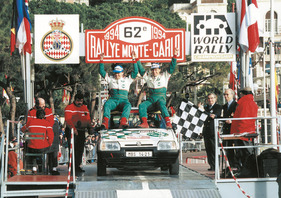
With the announcement of the World Cup for vehicles with naturally aspirated engines, a maximum displacement of two liters and a driven axle - known as Formula 2 from 1995 - new rules came into force in rally sport in 1993. In the first season, the Škoda Motorsport works team took second place, before beating numerous well-known competitors the following year and securing the world championship title in the 2-liter class.
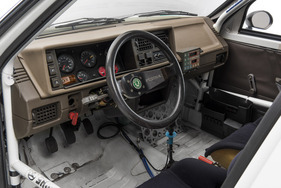
As a class A rally car, the Škoda Favorit looked very similar to the production model at first glance, but it was a pure racing car. A certified safety frame improved the rigidity of the body, which was made of thinner sheet metal. Compared to the standard version, the roof had a mechanical flap that ensured better ventilation of the interior. Although the windows and door panels were taken from the standard model, the upholstery and rear seat were removed and, thanks to numerous other measures, it was possible to reduce the kerb weight to 750 kilograms.
The dashboard remained unchanged, but the displays and switches were adapted and positioned so that they could also be operated by the front passenger if required. A brake force distributor, which could be adjusted according to the current road conditions, directed the brake pressure to the rear wheels. A sports steering wheel simplified the handling of the Favorit.
The engine had OHV valve timing and the displacement increased from 1,289.4 to 1,299.6 cubic centimetres compared to the standard engine. Connecting rods, cams and other parts were new. The engine initially produced 76 kW at 6,500 rpm, later increasing to 88 kW at 7,000 rpm thanks to a Pierburg twin carburetor. A five-speed gearbox initially provided the power transmission, which was subsequently replaced by a six-speed gearbox with spur gears. The top speed of the Favorit was between 150 and 210 km/h, depending on the overall gear ratio.
The white body was originally adorned with red and blue stripes, which later gave way to a checkerboard pattern in the same colors. This was replaced in 1993 by a green "V" victory sign and a red stripe - the current emblem of the RS vehicles.
The Škoda Favorit 136 L/A modified for racing purposes also held its own off the rally tracks on circuits and in hill climbs. The Favorit 136 L/H, developed for circuits in 1989, was particularly interesting from a technical point of view. The four-cylinder 790.16 OHC engine was a prototype with a displacement increased to 1,596 cc. The car had two Weber twin carburetors and produced 123 kW (167 hp) at 6,500 rpm. The torque of 176 Nm was available at 5,500 rpm. The vehicle reached a top speed of 240 km/h and accelerated from 0 to 100 km/h in six seconds. The engine was later fitted with direct injection and the power output increased to 129 kW (175 hp). The upgraded Škoda Favorit competed in the 24-hour race at the Nürburgring, where the Kvaizar/Samohýl/Obermann trio took a class victory.
Although the more modern Škoda Felicia replaced the Škoda Favorit on the rally track in 1995, the Favorit remained on the starting lists of numerous races for many years as a powerful and affordable motorsport vehicle.


