The young event "The I.C.E. St. Moritz" offers classic cars in an extraordinary setting: On February 24 and 25, 2023, a diverse field of historic automobiles will be presented on the frozen and snow-covered Lake St. Moritz. On Friday, the vehicles will present themselves statically to the public and the Concours of Elegance jury in the "Parc Fermé". On Saturday, they will take dynamic laps around the ice.
Wendlinger at the wheel
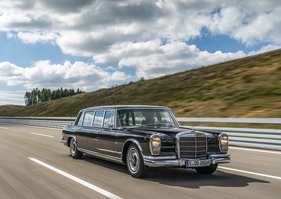
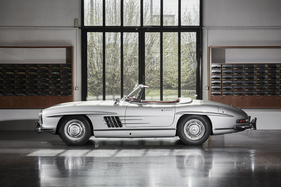
Mercedes-Benz Classic starts with a C 111-II with V8 engine (1970) and a 300 SLS touring sports car (W 198, 1958). The drivers include former works driver and current Mercedes-AMG brand ambassador Karl Wendlinger. The brand's Heritage division is presenting a Mercedes-Benz 600 (W 100, 1963) to mark its sixtieth birthday and also a 300 SL Roadster (W 198, 1958), which is being offered for sale.
"Mercedes-Benz Classic is open to new ideas. This includes 'The I.C.E.' in St. Moritz. The event showcases outstanding classic cars - in the middle of the cold season, when historic automobiles tend to stay in the garage. Mountains, snow, ice and hopefully sunshine provide the setting for this fresh concept," said Marcus Breitschwerdt, Head of Mercedes-Benz Heritage.
Circuit on 50 centimeters of ice
The name "The I.C.E." officially stands for "International Concours of Elegance" and also plays with the ice as the surface of the circuit. The course only exists for three months of the year: when Lake St. Moritz has a layer of ice around 50 centimetres thick in winter. The oval course, including snow cover, is created on top of this. The area is used for various events, including horse polo.
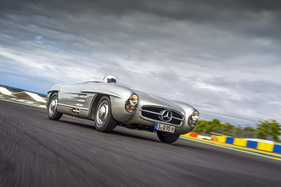
At "The I.C.E.", the vehicles compete in categories such as "Open Wheels", "Barchettas on the lake", "Le Mans 100", "Concept Cars & One Offs" and "Queens on Wheels". A winner will be chosen in each of the categories. The Mercedes-Benz C 111-II with V8 engine appears in the "Concept Cars & One Offs" class and the Mercedes-Benz 300 SLS ("Super Light Sport") in the "Barchettas on the lake" class.
The history of the event goes back to the winter of 1985, when a group of Scots and Englishmen discovered the marked-out racecourse on the frozen lake of St. Moritz as a track for their classic Bentleys. More than 30 years later, one of the spectators at the time took up the idea. This led to the successful trial run of "The I.C.E." with sports cars in 2019. After a break due to the pandemic, the ice revue has been taking place again with a full program since 2022.
The Mercedes-Benz Classic vehicles at "The I.C.E." 2023
Mercedes-Benz 300 SLS touring sports car (W 198), 1958
Use: dynamic (Saturday, February 25) and static (Friday, February 24)
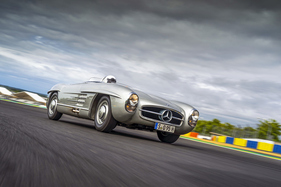
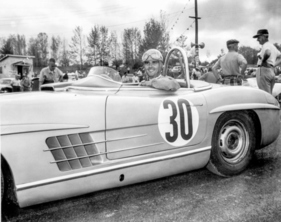
The Mercedes-Benz 300 SLS ("Super Light Sport") is a special version of the 300 SL Roadster (W 198) for racing. Two examples of the touring sports car were built in 1957 for the American sports car championship, after the series version of the new model could not yet be homologated for the "Standard Production" category in the 1957 season. In order not to be left without a chance in the only alternative possible racing category D, a production roadster is optimized to become the 300 SLS, which weighs just 970 kilograms and has a power output of 173 kW (235 hp). That is 360 kilograms less and 15 kW (20 hp) more than the 300 SL Roadster. With the 300 SLS, Paul O'Shea, supported by the factory, wins the American sports car championship in category D with a clear lead over the competition. He had already won the title in 1955 and 1956 with the 300 SL "Gullwing". Mercedes-Benz Classic uses an authentic replica of the original 300 SLS for "The I.C.E.".
Technical data
- Mercedes-Benz 300 SLS (W 198)
- Use: 1957
- Cylinders: 6/row
- Displacement: 2,996 cm3
- Output: 173 kW (235 hp) at 5,900 rpm
- Top speed: 260 km/h
Mercedes-Benz C 111-II with V8 engine, 1970
Application: dynamic (Saturday, February 25) and static (Friday, February 24)
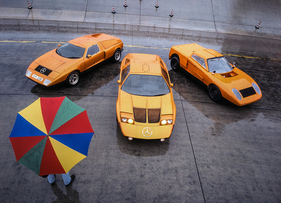
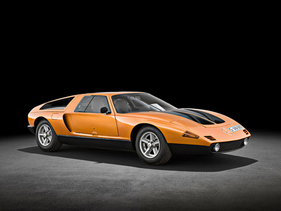
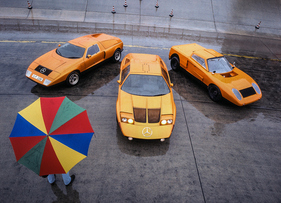
Mercedes-Benz presented the C 111 at the International Motor Show (IAA) in Frankfurt am Main in September 1969. The research vehicle with its extreme wedge shape and gullwing doors has a body made of glass fiber reinforced plastic (GRP) and is powered by a three-disc Wankel engine with an output of 206 kW (280 hp). The futuristic-looking sports car is capable of speeds of up to 270 km/h.
The following year, the revised version C 111-II was presented at the Geneva Motor Show, now with a four-disc Wankel engine and 257 kW (350 hp). In this version, the C 111 accelerated from a standstill to 100 km/h in 4.9 seconds. The top speed is 300 km/h. Despite numerous orders, the C 111 remained a purely experimental vehicle and was not built in series. Instead, Mercedes-Benz later developed a series of record-breaking vehicles on this basis: the C 111-II D (1976) and the C 111-III (1977-1978), both with a five-cylinder diesel engine, and the C 111-IV (1979) with a V8 petrol engine and turbocharging.
In 1970, the C 111-II also formed the basis for a V8 variant with the M 116 series engine (147 kW/200 hp) for drive comparisons with the Wankel sports car.
Technical data Mercedes-Benz C 111-II with V8 engine
- Production period: 1970
- Cylinder: V8
- Displacement: 3,499 cm3
- Output: 147 kW (200 hp) at 5,800 rpm
Mercedes-Benz 300 SL Roadster (W 198), 1958
Use: static
Mercedes-Benz presented the 300 SL Roadster (W 198) at the Geneva Motor Show in March 1957 as the successor to the 300 SL "Gullwing" coupé of the same model series presented in 1954. In technical terms, the open-top sports car largely corresponded to the coupé, although the modified tubular frame now allowed the installation of conventionally hinged doors. They make the open version possible and offer more comfort when getting in and out. The chassis has also been further developed: The single-joint swing axle with a lowered pivot point is used instead of the classic two-joint design, and the 300 SL Roadster has a compensating spring for the first time.
From the fall of 1958, the Roadster was also available with a removable coupé roof on request. The Mercedes-Benz engineers derived the 300 SLS racing variant from the standard 300 SL Roadster, with which Paul O'Shea won the 1957 American Sports Car Championship in Category D. This closed the circle.
This closes a circle, as the 300 SL is based on the racing sports car of the same name (W 194), which was highly successful in motorsport in 1952. In 1961, the 300 SL Roadster was fitted with disc brakes and in 1962 with a cast aluminum engine block. Production of the sports car comes to an end in 1963. A total of 1,858 examples of the highly exclusive sports car were built in seven years. Today, it is one of the most sought-after classics.
Technical data Mercedes-Benz 300 SL Roadster (W 198)
- Production period: 1957 to 1963
- Cylinders: 6/row Displacement: 2,996 cm3
- Output: 158 kW (215 hp) at 5,800 rpm
- Top speed: up to 242 km/h
Mercedes-Benz 600 (W 100), 1963
Application: static
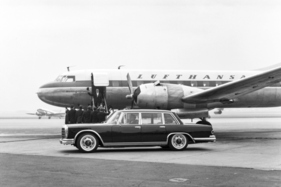
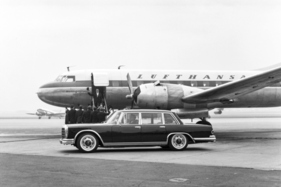
"The 'Great Mercedes' 600 - The exclusive vehicle of great representation": with this headline, the Mercedes-Benz press release for the premiere in September 1963 at the International Motor Show (IAA) in Frankfurt am Main positioned the Mercedes-Benz 600 in the top group of the automotive industry. Some of its highlights: the first V8 engine in a Mercedes-Benz passenger car, driving performance at sports car level, numerous hydraulically controlled comfort features for seat adjustment, opening and closing the doors, windows and trunk lid. There is also air suspension, power steering and central locking as well as an electronically controlled heating and ventilation system. The equipment was unique at the time in terms of all the details and marked the state of the art at the time.
The luxury saloon, known internally as the W 100, maintained its position as the international benchmark in the top automotive category for almost two decades. During the 17-year production period, 2,677 units were built, 487 of them as Pullman versions. The V8 engine with a displacement of 6.3 liters produced 184 kW (250 hp). Buyers from all over the world opted for the "600": royalty, heads of state and equally outstanding personalities from business and show business.
Technical data Mercedes-Benz 600 (W 100)
- Production period: 1963 to 1981
- Cylinder: V8 Displacement: 6,332 cm3
- Output: 184 kW (250 hp) at 4,000 rpm
- Top speed: 205 km/h