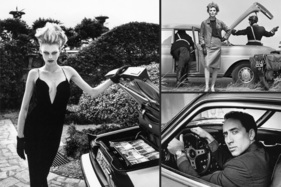
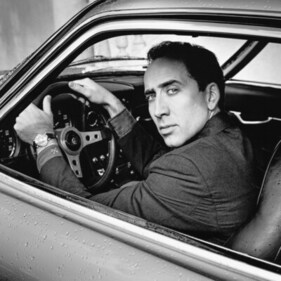
On May 15, 2026, the Newton Foundation, in collaboration with the Italian luxury brand Larusmiani, will open the exhibition Helmut Newton. Cars. The venue is the garden of Villa Olmo on Lake Como, which will be transformed into a kind of open-air museum as part of the FuoriConcorso event "KraftMeister - where automotive culture becomes art". On 20 large-format panels, Newton's photographs, taken between 1956 and 2001, pay homage to the automobile. It is also the first exhibition on this important theme in Newton's work, which will be explored in greater depth in a larger presentation at the Newton Foundation in Berlin in the near future.
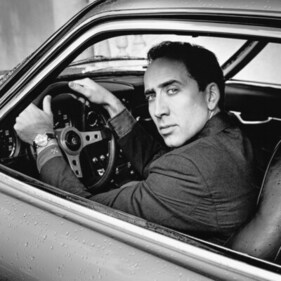
Newton has repeatedly worked in Como itself since the 1970s, above all in the Villa d'Este and its famous garden. The exhibition is curated by Matthias Harder, Director and Curator of the Newton Foundation.
"There are collectors who accumulate, and patrons who preserve. I have always believed in the second path: that of those who do not merely possess beauty, but assume the responsibility of transmitting it, of keeping it alive for those who will come after us. Helmut Newton was an interpreter of elegant matter. He knew how to see in the automobile what I seek to see in fabric, in cut, in the silhouette of a garment, that unresolved tension between function and desire, between technical precision and pure seduction. His photographs do not document cars: they inhabit them. And in that inhabiting, they reveal something true about the era, about the human condition, about taste as a form of thought. To bring this exhibition to Villa Olmo, on the lake that Newton himself loved and frequented, has been for Larusmiani a natural act, almost inevitable. We are founding partners of FuoriConcorso because we believe the automobile deserves the same curatorial dignity accorded to architecture, to fashion, to art- for this has been, for one hundred years, our most authentic vocation." - Guglielmo Miani, CEO, Larusmiani
Cars as a lifelong passion
Helmut Newton also had a lifelong passion for cars; it is therefore not surprising that the motif played an important role in his fashion photography over the decades and that he later even photographed advertisements for numerous renowned car brands. It all began in the mid-1950s, when Newton used his white Porsche 356 as a background motif for a private portrait of his wife June on a vacation trip to Rome on the Via Appia, or a little later, back in Melbourne, again at a fashion shoot for Australian Vogue. In the early 1960s, he photographed menswear for Adam magazine in Coventry at the Jaguar factory and plein air in color for French Vogue womenswear, this time in conjunction with a red Fiat 1200; in 1963, he portrayed Françoise Sagan in a Jaguar E-Type, also for French Vogue, while the British model Jean Shrimpton, again in a Newton fashion shoot for British Vogue, became a Rolls Royce radiator figure in 1966, shrunken and collaged in the photo template.
Newton experimented a lot in those years: he photographed for Adam from the rear of a Facel Vega sports car with the dashboard facing outwards, while fashion became a secondary motif on the hood; in Rome, he had a model protrude from the sunroof of a Fiat 500 for Italian Vogue, or told a story for French Vogue.For French Vogue, he told the story of a mysterious young woman who is checked by customs officers at the Franco-Belgian border in her Mercedes-Benz 190 in a large-scale sequence of images.
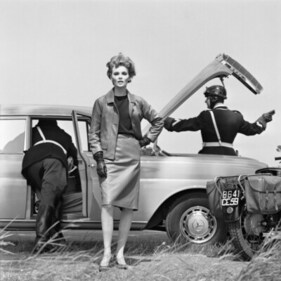
He also created such unusual narratives or condensed individual images in the 1970s, 80s and 90s, as we can see in this small but representative selection of 38 photographs from six decades. The car as a motif appears hundreds of times in a wide variety of situations in his photography, sometimes in the background, as a luxurious accessory so to speak, but also as an equally important motif. In his advertising campaigns, for example for the New Beetle, realized in Milan in 1999, or for Italdesign in the same year, he naturally shifted the focus of the content even more towards the automobile and its design, without, however, dispensing with people as models.
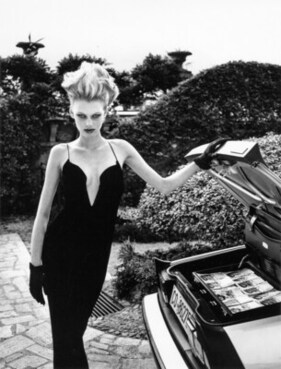
The highlight of the current exhibition is a fashion picture from Como, which was taken in 1996 for Italian Vogue: a blonde woman with high-tousled hair in a tight black cocktail dress stands next to an Alfa Romeo Spider. In the open trunk we see an open briefcase with bundles of 100,000 lire bills. The sports car has a Como license plate. Of course, we can only speculate about what this briefcase is all about - a characteristic and ambivalent ingredient in Newton's fashion image.
In 2022, Larusmiani celebrated its 100th anniversary and looked back on the success of three generations, the main pillars of the company. Today, the brand stands for true "Made in Italy" and preserves the traditions of craftsmanship while always looking to the future and exploring new modern trends. Larusmiani is also a founding partner of FuoriConcorso - a role that goes beyond mere sponsorship. Since the event's inception, the brand has helped to define its aesthetics and positioning, helping to shape a format that showcases automotive culture in conjunction with design, fashion and lifestyle. This approach also reflects Larusmiani's vision, in which craftsmanship and contemporary culture coexist. Find out more on the Larusmiani website.
This year FuoriConcorso presents "KraftMeister" as a tribute to the soul of German craftsmanship. FuoriConcorso KraftMeister pays homage to German engineering, transformed into an immersive experience showcasing defining production cars, motorsport icons as well as avant-garde concept cars together with a selection of renowned German tuners. It is a visionary journey into automotive history, characterized by dominance, speed and precision. Design is pure function here: find out more on the event website.