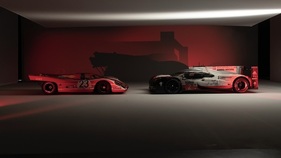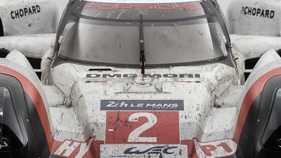
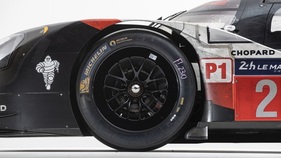


The victory at Le Mans in 1970, exactly 50 years ago, is one of Porsche's most important successes in motorsport. Reason enough for a meeting of the protagonists from the past - and now: Hans Herrmann with his Porsche 917 KH and 2017 winner Timo Bernhard with the Porsche 919 Hybrid.
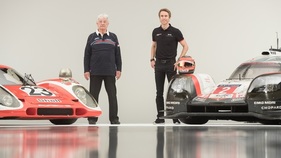
You only have to look at the helmets. Then you know what progress in motorsport means. The old one: a filigree, gray half-shell. It gives the impression that it could be easily pressed in. The new one: a colorful high-tech protector, ergonomically perfectly shaped - it looks as if even a hammer blow couldn't leave a scratch. We are in a photo studio in Friolzheim between Stuttgart and Pforzheim, and the atmosphere is sizzling. This is not due to the hot spotlights directed at the protagonists, but to the participants themselves: Hans Herrmann, Le Mans winner in 1970, in front of his original car from back then, the Porsche 917 KH, and with his head protection from the past. And Timo Bernhard, the last Porsche Le Mans overall winner to date, with the 2017 Porsche 919 Hybrid and his helmet. All four are celebrated champions; the two drivers each drove the last lap in their victories, Timo Bernhard even drove the starting lap.
Safety is the top priority
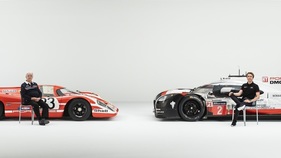
When these absolute motorsport giants meet, one topic always comes up first: the progress made in safety over the years. "We used to drive in pairs," recalls the now 92-year-old Herrmann, adding with a wink: "The young lads of today are lazy by comparison: There are three of them on the road. One of them can sleep for eight hours." But even back then, the differences in speed between the various classes were really dangerous: "The top speed of the slowest was around 200 km/h. We flew past at 384 km/h." "Of course, motorsport is still dangerous," adds Bernhard. "But you can't compare it today with back then. Fear was a constant companion 50 years ago, that's no longer the case with us." And Herrmann remembers: "When I bought a tube of toothpaste back then, I was still thinking in the store: 'I hope you get the chance to use it up."
The technology of cars
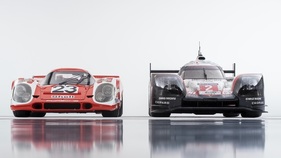
The two racing cars facing each other in the studio illustrate what the two protagonists mean. The 917 KH with starting number 23, entered by Porsche Salzburg, weighed just 800 kilograms and was powered by a 4.5-liter twelve-cylinder engine that drove the rear wheels with 580 hp. The engine only had to warm up for around ten minutes before the car was ready to race. The synthetic resin skin is only 1.2 millimeters thick. The interior is so tight that the driver's helmet can hit the roof. A tubular lattice frame protects against excess weight, but not against the consequences of possible cold deformation.
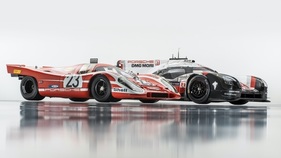
On the other side is the much larger and massive-looking 919 Hybrid, which two technicians and a race engineer have to prepare in a two-hour choreography before it can be allowed onto the track. The record-breaking winner was a rolling test laboratory for Porsche's future technologies: a two-liter V4 turbo petrol engine with 368 kW (almost 500 hp) for the rear wheels, plus an electric motor with 294 kW (over 400 hp) for the front axle - making the hybrid Porsche an all-wheel-drive car. The electric motor is powered by a lithium-ion battery, which in turn is fed by braking energy from the front axle and exhaust gas energy. The driver doesn't really have much space here either, but he is incomparably better protected. The battle scars of the 2017 racer with starting number 2 are wonderfully preserved with clear lacquer. Incidentally, the 917 is also original, even if it looks like it's fresh from the racing department.
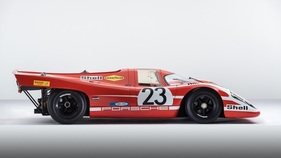
"The 917 was the high-tech car of the time. Porsche showed how to build the best prototype according to the regulations of the time," says Bernhard. "This also applies to the 919 Hybrid. With this car in particular, Porsche proved how to develop technology for the road in motorsport - keyword Taycan." Did Bernhard ever drive the 917? "Yes, twice. Not at the limit, of course, but at least enough to get a good impression of racing at the time" - which now makes Bernhard respect Herrmann and his colleagues even more. And would Herrmann like to get into the 919? "For God's sake - just not."
Le Mans - still the measure of all things today
As much as the technology may have changed: "The enthusiasm for the race is still unbroken," Bernhard is certain. "Le Mans actually still has the same significance today as it did 50 years ago. But now it is probably one of the last motorsport adventures, because no other track layout still combines a race track with public country roads." Hans Herrmann has also watched every race since retiring from active motorsport - including every Formula 1 race. Consistently - as always in life: "After my close second place in Le Mans in 1969, I resolved to put an end to racing in 1970. I had also promised my wife that. Nobody knew that at the time. The fact that I was actually able to end my career with a victory at Le Mans and one of the most important successes ever for Porsche was of course particularly wonderful."
The joys of racing drivers
So many dangers and excitement naturally need a counterbalance. Bernhard likes to tell the story of his then 85-year-old neighbor, who sat in front of the TV screen all night when he drove around the Sarthe circuit and said afterwards: 'Mr. Bernhard, you keep me awake all night, I can't switch off at all...'. "It's easy to see how the race captivates many people who otherwise have nothing to do with motorsport," states one of the world's best racing drivers, who has been a brand ambassador for Porsche since 2020.
It's time to leave Hans Herrmann and Timo Bernhard alone. Because the two of them certainly still have a lot to tell each other. For more than six decades, Porsche has been associated with the 24 Hours of Le Mans, the largest and most traditional motorsport event in the world, with a total of 19 overall victories, 108 class wins and indescribable emotions. This makes the sports car manufacturer from Stuttgart-Zuffenhausen the most successful brand in the almost 100-year history of Le Mans. On June 14, 1970, Porsche achieved its first overall victory there with the 580 hp 917 KH sports car. At the 85th edition of the 24 Hours of Le Mans in 2017, Timo Bernhard and his team-mates Earl Bamber and Brendon Hartley drove the Porsche 919 Hybrid to the finish line in first place after a dramatic race.