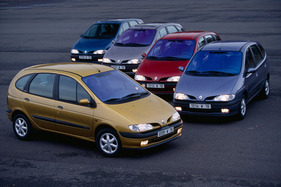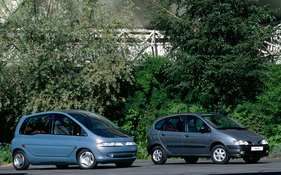
At the IAA 1991, Renault presented the Scénic concept car as an "invitation to travel". The study of a compact MPV with its striking shape reminiscent of a cocoon provided a first glimpse of the Mégane Scénic, which made its debut five years later. The revolutionary new model quickly became an icon. Working on it was an absolute career highlight for the designers at the time, as Louis Morasse recalls. "The opportunity to develop a car from the inside out probably only comes along once in a lifetime," says the designer responsible for the interior of the Mégane Scénic.
A unique project of its kind
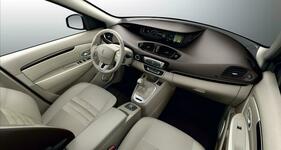
"Cars for life" - that was the Renault brand claim in the nineties. And just like the larger Espace, which has been on sale since 1984, the Mégane Scénic was to embody this statement as perfectly as possible. Morasse and the other designers involved in the project had a clear vision in mind: in a light-flooded interior, everyone was to have their own seat in an elevated position so that they could enjoy an uninterrupted view of the traffic and the surroundings. Everything revolved around the feel-good atmosphere on board. The new compact van was to take its passengers on a journey - literally and figuratively.
With this in mind, Renault decided to take an unusual approach when developing this unusual car: instead of working from the outside in as usual, the designers and engineers worked from the inside out.
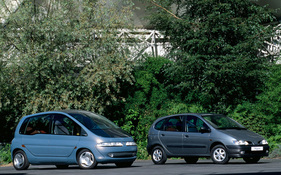
"In the Scénic, the passengers enjoyed absolute priority. Unlike in 'normal' cars, sitting in the back of the Scénic was not a punishment."
While most models of the time were more or less exclusively tailored to the needs of the driver, the Mégane Scénic was aimed at the whole family. Its interior with five individual seats, outstanding versatility, a multitude of storage options and a large trunk set new standards. Its sandwich construction not only enabled additional lockable storage compartments in the absolutely flat vehicle floor, but also resulted in a higher seating position, which guaranteed a better overview and thus increased active and passive safety. With these many qualities, the Mégane Scénic immediately became an absolute bestseller. In 1999, the bestseller dropped the suffix referring to its technical basis: it was now simply the Renault Scénic.
The second and third generations also push boundaries
With the introduction of the second generation in 2003, the single model became an entire model series with three variants. In addition to the five-seater Scénic with a length of 4.30, customers could also opt for the 20 centimeters longer Grand Scénic with a choice of five or seven seats. In the interior, the second generation of the Scénic further expanded the innovative concept of the compact van pioneer. In addition to a sliding center armrest, it also offered a new dashboard with centrally positioned digital instruments and a raised gearshift, as well as a total of 91 liters of additional storage space spread across the entire interior. The larger windshield and the optional panoramic glass roof let even more light into the interior, creating an even more inviting atmosphere on board.
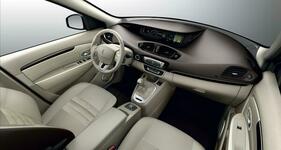
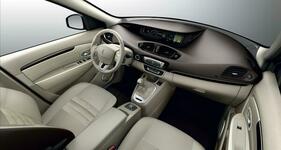
The third generation of the Renault Scénic, which was launched in 2009, improved on the space available. Not only was 92 liters of storage space available in the interior, but above all the legroom in the second and the general amount of space in the third row of seats set the benchmark in the segment. Variability also reached an even higher level thanks to the folding and removable second-row seats and the folding front passenger seat backrest. Larger window areas also let even more daylight into the interior.
"With the introduction of the Scénic in the nineties, we came as close as we could to the ideal of the 'car for life'," says Louis Morasse, looking back on the beginnings of this success story. "We simply wanted to develop a true family car with space for everyone." The interior designer and his colleagues succeeded in doing just that.