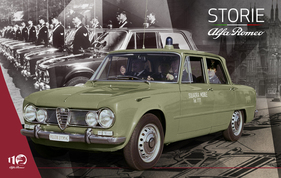


This episode of "Storie Alfa Romeo" is set in the era of the Italian economic miracle. From the 1950s onwards, the police relied on various Alfa Romeo models in the hunt for criminals, and the Alfa Romeo Giulia can still be found in the law enforcement fleet today.
During this era, Alfa Romeo developed into a large-scale manufacturer, but at the same time retained the charm of an exclusive manufacturer. Sales figures increased significantly. With more than 177,000 units built, the Alfa Romeo Giulietta became Italy's favorite from 1954 onwards. The Alfa Romeo Giulia, launched in 1962, became an Italian icon with more than 570,000 units sold.
Flying, panthers and police
In post-war Italy, Alfa Romeo cars became legendary. The vehicles from Portello proved that they were the fastest both on the racetrack and on the road. Their technical characteristics and image also attracted the interest of the "Polizia di Stato", the Italian federal police.

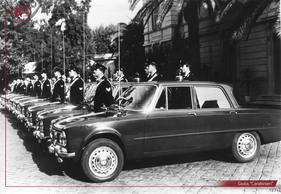
The connection between Alfa Romeo and the various police forces is an interesting chapter in the history of the Italian Republic. From the 1950s onwards, various models of the brand were used as official vehicles by the law enforcement agencies. Because of their speed, they were known as "volanti" (the flying ones) and were even given nicknames.
The Alfa Romeos used by the state police were known as "pantera" (panthers), while the carabinieri and military police used "gazzelle" (gazelles). Two metaphors that emphasized the power and agility of Alfa Romeo's sporty limousines.
The very first "Panther" was an Alfa Romeo 1900 built in 1952, whose aggressive silhouette inspired the nickname. The first "Gazelle", an Alfa Romeo Giulietta, was put into service a few years later. The most famous police car was the Alfa Romeo Giulia Super. Over the decades, the police ordered practically all Alfa Romeo models, from the 1900M "Matta" off-roader to the Alfasud, 75, Alfetta and 156. Today, many law enforcement officers drive the current Alfa Romeo Giulia.

"Alfa Romeo is a lifestyle"
Parallel to the growing relationship between Alfa Romeo and the police, the brand continued to develop. An important protagonist during this time was Orazio Satta Puliga (1910-1974). Born in Turin of Sardinian descent, the trained engineer joined Alfa Romeo in 1938. In 1946 he became head of the development department, and then director of Alfa Romeo in 1951. Satta Puliga was a passionate fan of the brand. He wrote: "There are many car brands, but Alfa Romeo stands out from them all. It is a kind of passion, the enthusiasm for a means of transportation. Alfa Romeo is a lifestyle, a special way of perceiving a motor vehicle."

As head of design and director, Satta Puliga had a difficult task ahead of him in the post-war period. Not only did he have to rebuild a company that had been completely destroyed. His job was also to transform a factory that had previously worked according to the rules of the trade into a modern industrial company. Satta Puliga followed the path taken by his predecessor Ugo Gobbato.
When Satta Puliga joined Alfa Romeo's design department in 1938, the company produced every single mechanical part itself at the Portello plant according to strict criteria of exquisite craftsmanship. More than a decade later, Satta Puliga rationalized the manufacturing process, outsourced the production of individual components and reduced costs. At the same time, the plan for a new model matured, which was to be built in large series using the most efficient technical and organizational methods.
Alfa Romeo 1900 - the first "Panther"
Designed by Satta Puliga, the Alfa Romeo 1900 from 1950 was the brand's first model with a self-supporting body and left-hand drive. The traditional six and eight-cylinder engines for Alfa Romeo were no longer an option. Instead, the Alfa Romeo 1900 was fitted with a newly developed four-cylinder in-line engine with an aluminum cylinder head and two chain-driven camshafts. The mixture was prepared by a single carburetor, which offered high performance and achieved a low tax classification. In its original version, the Alfa Romeo 1900 had an output of 59 kW (80 hp). The new saloon was agile and fast, as you would expect from an Alfa Romeo, but also very easy to drive. The Alfa Romeo 1900 had what it took to appeal to a wider customer base.
The Alfa Romeo 1900 was also the brand's first model to be produced on an assembly line. A true revolution for the former manufactory. The total production time per vehicle was reduced from 240 to just 100 hours. This new strategy led to unprecedented sales success. In the end, Alfa Romeo sold more units of the 1900 model than of all previously offered model series combined.

This commercial success was also due to careful product management. The original model was followed by several high-performance variants. As the TI, Sprint, Super Sprint and Super, the Alfa Romeo 1900 even celebrated international success in motorsport. This led to the advertising slogan "The family car that wins races".
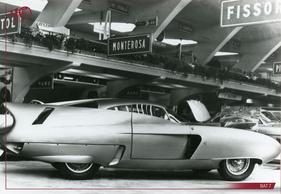
Parallel to the assembly line production of the 1900 series, Alfa Romeo continued to work with the established coachbuilders. Between 1953 and 1955, three aerodynamic concept cars with the abbreviation BAT (Berlinetta Aerodinamica Tecnica) were built on the platform of the Alfa Romeo 1900. BAT 5, BAT 7 and BAT 9 were early masterpieces by Franco Scaglione, at that time in the service of Carrozzeria Bertone.

The engine of the Tipo 1900 was also used in the all-wheel drive off-road vehicle Alfa Romeo 1900 M, better known as "Matta" (The Madman). The model was used by the Italian armed forces as the AR51 reconnaissance vehicle (Autovettura di Recognizione).

A Milanese with a passion for culture and boxing
While Alfa Romeo had embarked on the road to series production with the 1900 model, the Giulietta completed this transformation. The driving force behind this chapter was Giuseppe Luraghi (1905-1991).
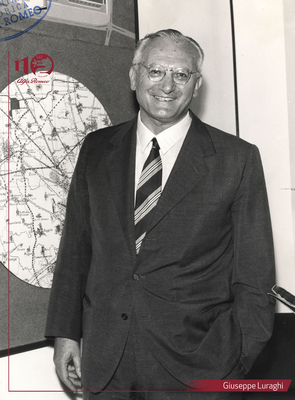
Born in Milan, he studied at the private business university Luigi Bocconi, where he also learned the art of boxing. When Luraghi started at Alfa Romeo, his reputation as an outstanding manager already preceded him. After several years at Pirelli, from 1951 to 1958 he was General Manager at the state holding company Finmeccanica, which controlled Alfa Romeo, among others. After a brief period at Lanerossi, Luraghi returned to Alfa Romeo in 1960 as President, a position he held until 1974.
As an enthusiastic author, journalist and publisher, Luraghi particularly promoted cultural initiatives within the company. In 1953, for example, he commissioned Leonardo Sinisgalli, known as the "poet-engineer" due to his dual talent, to launch a magazine that would create a dialog between humanist culture, technical knowledge and art. The result was the magazine "La Civilità delle Macchine" (The Civilization of Machines), whose authors included the Italian writers Giuseppe Ungaretti and Carlo Emilio Gadda.
The start of the economic miracle
Luraghi recognized the potential of Alfa Romeo. The brand had an extraordinary public presence, its sporting successes inspired millions of people and made them dream. For Luraghi, the time was ripe to turn this image into sales. The so-called economic miracle was just around the corner, and the car had become the most desirable consumer good. Luraghi wanted to make owning an Alfa Romeo the hallmark of those who had made it in life. To achieve this, he first had to revolutionize the company's production and brought engineers Rudolf Hruska and Francesco Quaroni onto the team.

From luxury product to object of desire for a broad public - Alfa Romeo had now channeled all its design and production resources in this new direction. And the Giulietta was to become the model that would herald a turning point in Alfa Romeo's history. A car that would increase sales and at the same time confirm the brand's technical tradition and sporting spirit.
Alfa Romeo Giulietta - the first "Gazelle"
The Alfa Romeo Giulietta renewed the connection with the Italian police forces. The carabinieri relied on the saloon version built from 1955, the first "Gazelle". In the language of the police, this animal represented the patrol car driver: fast, agile and brave. Its car also had to have these characteristics. Alfa Romeo supplied the Giulietta for patrol duty ex works with a walkie-talkie.

The Giulietta model was shorter, narrower and lighter than the Tipo 1900. With the Giulietta, Alfa Romeo once again covered a new segment and reached a younger audience. The four-door saloon offered a modern design, a high level of comfort in the interior as well as sporty handling, good acceleration and high speed. Its 1.3-liter four-cylinder engine, made almost entirely from aluminium, produced 59 kW (65 hp) and enabled a top speed of 165 km/h.
Alfa Romeo initially presented the Giulietta Sprint coupé version at the 1954 Turin Motor Show. Bertone had designed a flat, agile and compact car that undoubtedly had what it took to become a classic. The coupé was based on the mechanics of the saloon launched a year later. Alfa Romeo was thus one of the pioneers of the so-called platform strategy. A similar approach applies to the current Alfa Romeo Giulia with the top-of-the-range Quadrifoglio model.
The Alfa Romeo Giulietta was a complete success and so popular that it was nicknamed the "darling of Italy". In total, more than 177,000 units were produced - another record for Alfa Romeo.

Alfa Romeo Giulia - the next revolution
Only an even more revolutionary vehicle could oust the Giulietta from the top of Alfa Romeo's internal bestseller list. Satta Puliga knew this only too well. His team of engineers Giuseppe Busso, Ivo Colucci, Livio Nicolis and Giuseppe Scarnati and test driver Consalvo Sanesi set to work. They developed a vehicle that was definitely way ahead of its time.
The Alfa Romeo Giulia was one of the first vehicles in the world with a deformable structure. The front and rear areas of the body were designed to absorb energy in the event of an accident. The passenger compartment, on the other hand, was designed to be extremely rigid in order to provide optimum protection for the occupants. Alfa Romeo thus anticipated safety solutions that only became standard some time later.
The engine of the Alfa Romeo Giulia with a displacement of 1.6 liters and two overhead camshafts was a further development of the 1.3-liter four-cylinder engine of the Giulietta and featured sodium-filled exhaust valves for better cooling. The design of the Giulia was also revolutionary: compact, with pleasing proportions and unique style. The low front and steeply sloping rear were in line with the latest findings in aerodynamics. The advertising described the Alfa Romeo Giulia as "designed by the wind". In fact, thanks to the innovative development work in the wind tunnel, the air resistance was exceptionally low for its time: the Cd value was just 0.34.
The Alfa Romeo Giulia became an Italian icon and an overwhelming sales success. The sporty saloon sold more than 570,000 units, more than three times as many as the Giulietta.