

The sports cars of the time were characterized above all by style and style. In addition, the 1950s were also the first time that perfection was achieved in technical terms, which pointed to the modern era of motor racing. We take a look at the participants of the Ennstal-Classic 2025 (from July 16 to 19) from this era.
The aftermath of the Second World War was slowly being overcome, the upswing towards the economic miracle was in full swing. And in the automotive industry, the focus was slowly but steadily shifting away from pure transportation and towards a means of transportation for competitions on the one hand and a status symbol on the other.
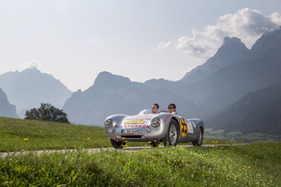
Porsche 550 Spyder
As early as 1953, for example, the young Porsche sports car brand achieved fame and glory around the globe when contemporary legends of the day appeared in the brand's vehicles both on and off the racetrack. The fact that the tragic accident that turned the young James Dean into an eternal legend happened in a Porsche 550 Spyder did nothing to diminish the myth-making.
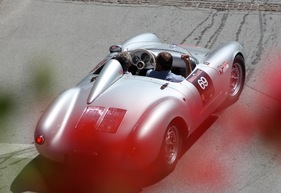
A Porsche 550 RS Spyder in the expert hands of Lothar Höss and Alexander Armbruster will compete in the Ennstal-Classic 2025, i.e. the 70th anniversary of the fatal traffic accident (Donald Turnupseed is not expected, nor is a Ford Tudor, although that would be something, actually).
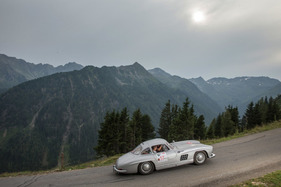
Mercedes-Benz Gullwing
In the Roaring Fifties, the Mercedes 300 SL Gullwing was regarded as an absolute status symbol - and little has changed in this respect to this day. However, a distinction must be made here between the W194 model series, the pure racing version, which achieved rather unexpected racing successes for the brand from 1952, for example at Le Mans or the Mille Miglia, and the W198 model series produced from 1954, which is still one of the most sought-after vehicles on the international classic car scene today.
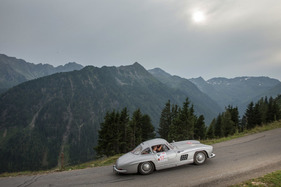
A total of three exhibits of the supercar built until 1963 can be found in the starting field of the Ennstal-Classic 2025, the oldest of which, starting number 36, will be driven over the mountains of the Enns Valley by Johannes Kleissl and Iana Petrivska.
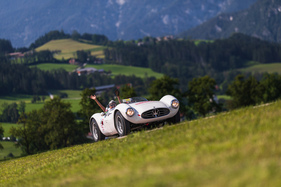
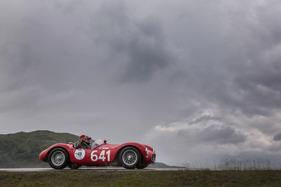
Maserati A6GCS
A highly exclusive and thoroughbred racing car can be found in the starting field with start number 39, driven by top-class drivers Gian-Pietro Rossetti and Marc Schamaun, whose description is based on a no less valuable text by the great Helmut Zwickl: "A6GCS means: the A stands for the designer Alfieri, the 6 for the 170 hp six-cylinder engine, G for the cast iron cylinder block, C for Corsa and S for Sport. A total of around 67 examples of the A6GCS are said to have been built between 1947 and 1955 (Rossetti's car was built in 1954), with 17 corresponding to the original version and 52 to the models from 1953 onwards. Between 1947 and 1961, this racing two-seater, which dominated the two-litre class, was on the starting grid 516 times and was the instrument of victory for many private drivers."
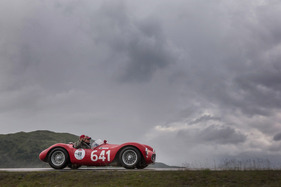
A second Maserati A6GCS from 1955 enters the competition with starting number 42, driven by Jutta Roschmann and Gabriele Bürger.

Another top-class racing car with the Maserati logo from Roschmann starts with number 41 in place of the unfortunately "ill" Ferrari 500 Mondial, driven by Dieter Roschmann himself. The Maserati 300 S Fantuzzi short nose, built in 1955 and first delivered to Bill Lloyd in the USA, was a "long nose" from 1957 to 1999; the conversion was carried out by "Rallye Motors" as early as 1957, shortly before that, in December 1956, the same vehicle had won the 30 Lap Nassau Trophy under the expert hand of none other than Sir Stirling Moss. It was not restored to its original condition until 1999 as part of a complete restoration by Mario Linke.
Aston Martin DB3 S
But Great Britain also feels well represented at the Ennstal-Classic 2025, with the racing spirit finely embodied by an Aston Martin DB3 S, driven by David and Christopher Martyr on starting number 40.

This car also has a lot of history to offer. Delivered in 1955, it celebrated numerous racing successes, such as the 12-hour classic in Hyeres or victories in Lisbon and Oulton Park. The racing career was brought to an abrupt halt by the Le Mans disaster, the car with chassis number 104 was sold to the USA and conquered the tracks of Pebble Beach, Laguna Seca and Watkins Glen. From 1959, No. 104 spent 15 years "hibernating" in a chicken coop. In 1989, the now fully restored racer returned to the UK, once again with the original number plate "OXE474".
Numerous appearances at classic events, such as the Mille Miglia Storico or Goodwood, brought the DB3 S back into the limelight, and in 2016 Sir Stirling also found himself behind the wheel of this automotive jewel. The current owners have been driving No. 104 since 2023, it is the first trip to the Ennstal-Classic.
Further information about the Ennstal-Classic can be found on the event website.