It is exactly 50 years since the Ferrari brand launched its own subsidiary called "Dino". This means that 2016 marks a milestone birthday for the brand: Dino, as admirers of the brand and its predominantly six-cylinder models know, was derived from the first name of Ferrari's son Alfredino, who played a major role in the construction of the successful Formula 1 engine of the 1950s.
The engine as a trigger
Almost every Dino today still carries the genes of his creative power: a short-stroke 65-degree V-six cylinder is set in constant turmoil by three largely free-breathing Weber twin carburetors, garnished by a usable rev range of over 8000 rpm and a background noise that can discreetly bring back memories of the paddocks of the fifties.
Every Dino that has survived the last 50 years with attentive care still breathes freely today and likes to rev up, as the trumpeting intake melody acoustically indicates.
In a test report in the 1960s, author Etienne Cornil wrote in the Schweizer Automobil Revue: "For a machine with no less than 80 hp per liter, the Dino engine is surprisingly smooth; it certainly can't be described as quiet. And what you hear from it immediately evokes memories of the twelve-cylinder engines from Maranello and excites the listener".
To this day, there is nothing to add.
From the engine to a total of four different vehicles
After Ferrari wanted to use the Dino V6 engine in Formula 2, which required a homologated annual quantity of at least 500 units, a fruitful collaboration with the Fiat Group quickly got underway as a quantity multiplier.

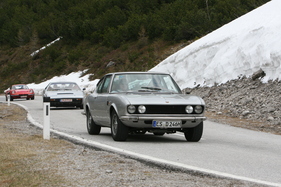
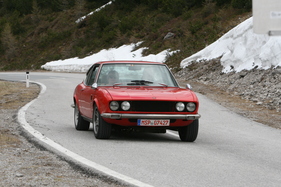
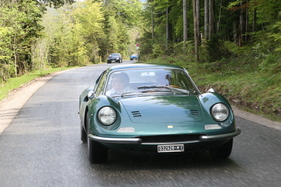
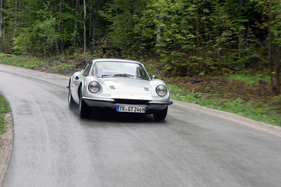
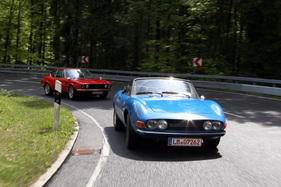
In addition to the Dino mid-engined coupé Dino 206/246 from Ferrari production, the two alternative models from Fiat came on wheels as a convertible - Design by Pininfarina - and coupé - Design by Bertone.
All three models had several versions of the elaborate twin-cam engine, which, with all displacement variants from 2.0 to 2.4 liters, always had a very short stroke and a decidedly fiery character.

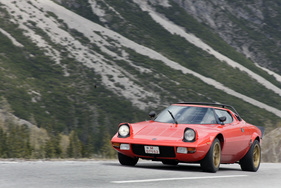
The Lancia Stratos, which also carried the 2.4-liter six-cylinder engine transversely in front of the rear axle and caused a sensation in rallying in particular, had to make do without the Dino lettering.
The Dino history ended with the 308 GT4 model (built between 1974 and 1980). This coupé was again coachbuilt by Bertone and built in Maranello. It had the first Ferrari V8 engine for road vehicles, which has accompanied the history of the Ferrari brand to this day. It was not until the 308 model that the Ferrari logo with the prancing horse was added after a few years. After the last Dino 308 GT4 was built, Dino ceased to exist as a brand in 1980.

Exit for the anniversary
For the Dino Register's anniversary outing, the engine was occasionally revved above 7000 rpm in deep respect for its half-century history. It still sounds pleasantly exciting today, and the area around the anniversary base in Garmisch shared the "joy of listening" described above in an emotional way. Around 50 coupés and convertibles of exotic brands were gathered in the mountains around the Zugspitze. They set off on their anniversary tour across the high valleys from the Karwendel to the village of Namlos and threaded the numerous toll roads in between, inviting the drivers to discreetly test the heating and defroster by smoothly adapting to the calendar position of the "ice saints".
The secret star - but clearly dubbed "Primus inter Pares" (Latin for "first among equals") on request - was one of the rare Dino 206s with a two-liter mid-engine, which had traveled all the way from Italy. It played a duet with one of the rare Lancia Stratos in the rally trim of the early years, and all of the V6 engines that traveled along sounded the symphonic crescendo of their aluminum or cast-iron engine blocks according to the classical score of Alfredino Ferrari.

We drove what the mountain roads had to offer. The Hahntennjoch invited us to ride it exactly two hours after the seasonal spring opening. We blew along the walls of late winter snow in the Spider with the roof down, which was only just beginning to turn into spring. And there was a little tinkering here and there, as soon as the fuel pump or ground loop in the trunk invited you to take a break. Those who wanted to immerse themselves in the participants' petrol conversations were given a gentle introduction to the art of using identical parts: front axle and gearbox similar to the Fiat 125, rear axle closely related to that of the Fiat 2300 Coupé, the spare parts supply situation is comparatively relaxed as far as these chunks are concerned. The later 2.4-liter Dino also drew on the Fiat modular system and used the more modern chassis, limited slip differential and ZF gearbox of the Fiat 130.
Incidentally, all three models were assembled in Maranello from 1969; the ZF transmission was a slightly better match for the now higher torques of the fine engines. This created the basis for the price development of all collector's items, which today result in awe-inspiring used prices. Virtually all models are currently in the six-figure range and all of them were taken on an anniversary tour as if a new mudguard was available on every corner.

The 50th anniversary remained a flawless birthday tour for four great car models (Dino 206/246, Fiat Dino Spider and Coupé, Lancia Stratos, Dino 308 GT4) - interrupted by a few lively screwing interludes - where guest models were also welcome: Fiat 124 Spider and modern Cinquecento rolled along as valued guests in the entourage. The parent brand Fiat unites them all today, as does their Ferrari ancestry and the fact that most of them had to make do without the Ferrari type mark of the Cavallino Rampante.
This also guaranteed a crowd of pedestrians at every break in the journey. The greeting from non-initiates was always "My God, they're so pretty", followed by the question of why the Ferrari horse was hidden here? The owners can recite the reason in their sleep, as can the brand's nascent fans after a short time. The crowning intermezzo was the statement of a youngster after a quick bleach on the history of the Dino: "It's only almost a Ferrari, but it almost sounds like two...".
Mission accomplished, as they would say in Maranello, or rather: "Missione assolvato."