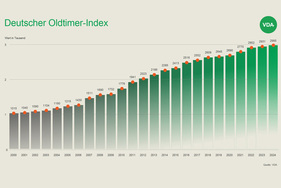


Classic car prices in Germany rose slightly in 2024. The German Classic Car Index (DOX), which is published annually by the German Association of the Automotive Industry (VDA), reached a score of 2,985 as of January 1, 2025. This corresponds to an increase of 1.85 percent compared to the previous year. It was therefore once again below the inflation rate.
The DOX is used to provide a trend statement on the value development of classic cars in Germany.
The vehicle values are determined by the valuation specialist classic-analytics. The vehicle selection comprises 88 vehicles and is a representative selection. New vehicles over 30 years old are included on a regular basis. Vehicles that are particularly expensive due to their rarity or history are not included.

The DOX has been calculated since 1999. Starting from a base value of 1000 points, an increase in value of 198 percent has been recorded in Germany since then.
To mark the 25th anniversary of the DOX, the VDA has examined and evaluated the index in three observation periods.
2024: Vintage car prices have risen slightly
As of January 1, 2025, the DOX is stable and unaffected: In 2024, prices have risen by an average of 1.85 percent compared to the previous year. The top 10 vehicles have developed significantly with an average increase of 18.5%, while the ten vehicles with the worst development have fallen in price by an average of 4.4%.
When looking at the top 10, the disproportionate share of vehicles from foreign production is striking. One reason for this is the stable development of vehicles from Germany at a high level. In contrast, vehicles from abroad are rarely traded at such high prices and are therefore possibly becoming more attractive and accessible.
There are six vehicles from abroad in the top 10.
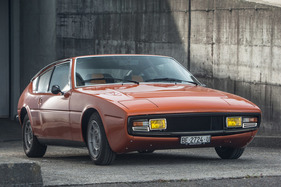
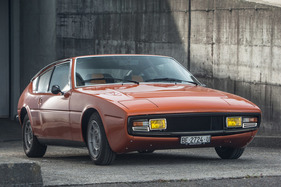
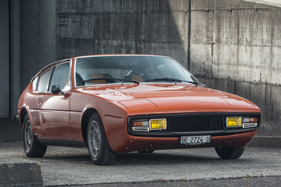
The Matra Bagheera from France stands out with 98.6 percent growth, followed by the Ford Taunus 20 M (23.8 percent), the Renault R4 5TL (12 percent), the Opel Rekord C 1700 with 11.4 percent and the Ford Capri I 2000 GT (11.1 percent). At 9.2 percent, the Toyota MR-2 is in sixth place, followed by the VW W181 Kübel (6.9 percent), the Buick Riviera (4.9 percent), the Ferrari 328 GTS (3.7 percent) and the Triumph Spitfire 1500 (3.6 percent).
The ten vehicles with the lowest performance were led by the BMW 2002 (-9.1 percent), followed by the VW Beetle 1303 (-6.5 percent), the new class from BMW (-6.1 percent), the VW-Porsche 914 2.0 (-5.4 percent) and the Porsche 356 1600 SC (-4.8 percent).
With the exception of the Opel Admiral 2800 (-1.7 percent), classic cars from foreign production suffered less wear and tear: the MGB MK III (UK, -4.6 percent), the Austin Healey MK III (UK, -3.1 percent), Ford Thunderbird Convertible (USA, -2 percent) and Chevrolet Corvette (USA, -0.7 percent).
2019-2024: Increase in DOX by 21.7 percent
In the last five years, which were characterized by corona and inflation, the value of all vehicles has increased by 21.7%, which is roughly in line with inflation. The top 10 vehicles have increased in value by an average of 84.2 percent, while the ten vehicles with the worst performance have fallen in price by an average of 5.7 percent.

The top 10 includes well-known candidates such as the Ford Capri 2000 GT (+122.2 percent), the Matra Bagheera (+98.6 percent), the Volkswagen K70 L (+92.7 percent) and Passat I LS (+92.7 percent) as well as the Ford 20 M (+85.7 percent). They are followed by the VW 412 L (+76.5 percent), the Trabant P 601 (+75 percent), the Mercedes W123 300 D (+73.5 percent), the Opel Rekord C 1700 (+62.5 percent) and the Toyota MR-2 (+62.5 percent) from Japanese production.
The 10 vehicles with the lowest performance in the five-year period are the Porsche 356 1600 C Coupé (-11.1 percent), the BMW 3.0 CSI (also -11.1 percent), the Austin Healey 3000 MK III (-7 percent), the Jaguar XJ 6 4.2 (-5.6 percent) and the Fiat 500 F (-5.6 percent). They were followed by the VW-Porsche 914 2.0 (-5.4 percent), the Jaguar E-Type V12 S3 convertible (-4.3 percent), the Buick Riviera (-3.5 percent), the Ford Thunderbird convertible (-2 percent) and the Alfa Romeo 2000 GTV (-1.3 percent).
Special evaluation for the 25th anniversary: DOX development between 1999 and 2024
The market has developed very significantly since the DOX was compiled. Starting from a low level of attention and evaluation, strong relative increases can be measured, with the index growing by an average of around 5.6 percent annually. The top 10 vehicles over this 25-year period are understandably different from those in other observation periods. At 8.2 percent, they have increased more significantly than the worst vehicles, which have achieved an annual increase of 2.1 percent over this period.

The top 10 is led by the BMW 3 Series (E21, 320/6) with an increase of 691 percent. It is followed by the Mercedes-Benz 300 SL (W198) as a gullwing (+689.5 percent) and the Volkswagen models VW Bus T2 (+687.5 percent) and Beetle 1300 (681 percent). Behind them: the Mercedes W123 300 D (672.7 percent), the Ford Escort 1100 S (580 percent), the Citroen 2 CV (575 percent), the VW 412 L (552.2 percent), the Ford Capri 2000 GT (545.2 percent) and the BMW 735 i (E23), which rose by 527.6 percent.
The Rolls Royce Silver Shadow I leads the ten vehicles with the lowest performance in the period under review with 51.7 percent. It is followed by the open-top Austin Healey 3000 MK III (52.7 percent), Ford Thunderbird (56.3 percent), MGB MK III (57.1 percent) and Triumph TR6 (US version, 65.5 percent). They are followed by the Volvo P544 (71.7 percent), the Buick Riviera (72.8 percent) and three other open-top models: the Fiat 124 Sport Spider (75.8 percent), the Mazda MX5 (91.5 percent) and the Cadillac Eldorado (100 percent).
The DOX is characterized by vehicles that do not achieve record sums at auction. Nevertheless, their increase in value is often impressive, at least in percentage terms. However, when measured against the costs of insurance, storage, maintenance or restoration, for example, the increase is very much put into perspective.
According to classic-analytics, the current market situation is stable. It should be borne in mind that valuation changes can only serve as a guide. The influence of the number of vehicles traded for a model and the relationship to long-term price trends are key factors. A slight price erosion following disproportionate development is understandable and does not automatically represent a trend.
The decisive factor is a differentiated view and assessment of the vehicle's condition by an expert on the one hand and the buyer on the other, for whom the model represents the corresponding value.