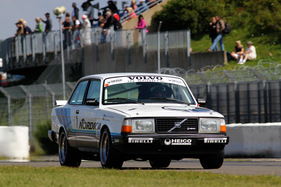
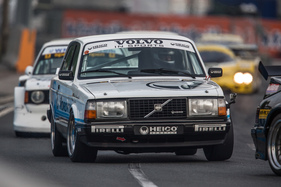
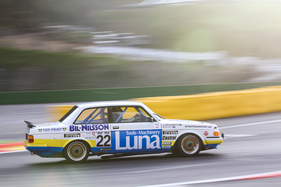
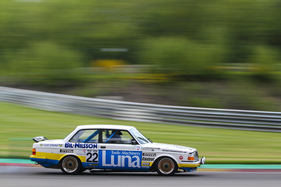
The touring car racing world was upside down: one car took victory after victory, even though at first glance it was better suited for family outings than for the racetrack, not to mention the obviously terrible aerodynamics.
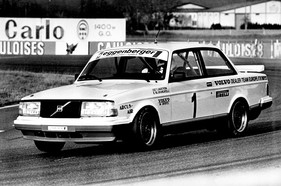
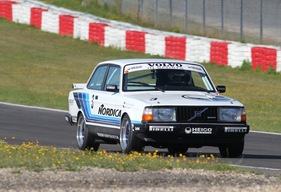
Nevertheless, the "flying brick", as the Volvo 240 Turbo was known, went on to win the European Touring Car Championship (ETC) and the German Touring Car Championship (DTM) in 1985. And to this day, 1985 remains the most successful year in Volvo's motorsport history.
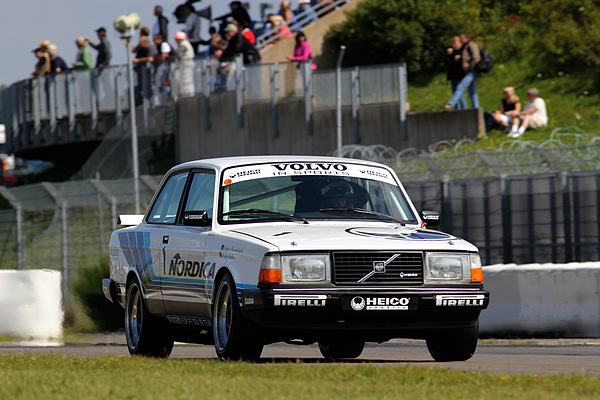
This extraordinary success story had already begun four years earlier, when in 1981 a turbo engine was installed for the first time in Sweden in a well-behaved family car, the Volvo 240 estate, thus opening up a whole new market for the company.
It soon became clear that this new model was a car that was very safe and durable, but also very fast and fun to drive. The robust B21ET 2.1-liter engine produced 155 hp, which meant that the 240 Turbo went from 0 to 100 km/h in just 9 seconds and thus reached a top speed of up to 195 km/h. So if you had a Volvo 240 Turbo, you probably owned the world's fastest estate car.
From family coach to racing car
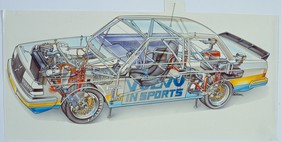
A year later, in 1983, new international rules were introduced for Group A touring cars. The vehicles that were registered had to come straight off the assembly line and the number of models built had to meet mass production standards. At least 5,000 of each type had to be built each year, they also had to have at least four seats and the minimum weight was measured in terms of engine capacity. These were all requirements that the Volvo Turbo 240 fulfilled perfectly.
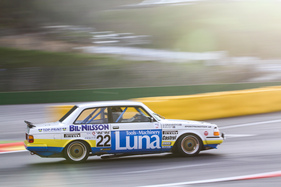
However, the new regulation also meant that at least 500 so-called "Evolution Cars" had to be built, which is why Volvo soon developed the Volvo 240 Turbo Evolution. In July 1983, the 500 cars were ready for inspection to make sure they were all the same. The 500 vehicles were then distributed in two markets and sold exclusively in the USA. The Evolution version not only had a larger turbocharged engine, it also had a modified engine control system and water injection, an invention that Volvo developed and later patented.
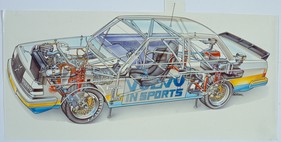
In 1984, the first 240 Turbo drove its first races in Group A and became a real competitor for other teams. While Volvo was responsible for the construction, it was independent teams that drove the 240 Turbo in races. They were also able to achieve two victories in the very first year. Swedes Ulf Granberg and Robert L. Kvist won the ETC race at Zolder in Belgium, while their compatriot Per Stureson won the German Touring Car Championship.
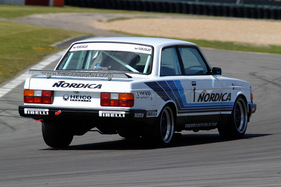
Volvo 240 Turbo at the 1985 European Touring Car Championship
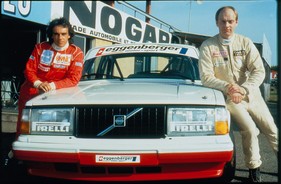
A year later, Volvo then fielded two separate works teams, which no longer only faced competitors such as Rover and BMW, but also had to compete against each other. The Swiss Eggenberger Motorsport Team competed in the European Touring Car Championship under the name "Volvo Dealer Team Europe". Their drivers were the Swede Thomas Lindström, Sigi Müller from West Germany, the Italian Gianfranco Brancatelli and the Belgian Pierre Dieudonné. The second team in the European Touring Car Championship was "Sweden's Magnum Racing Team" and featured three Swedish drivers: Ulf Granberg, Anders Olofsson and Ingvar Carlsson.
However, the Volvo teams also had to contend increasingly with attempts to poach Volvo drivers. Per Stureson was soon offered a new, more competitive car. Both the competition and the public initially found it difficult to take the Volvo 240 Turbo seriously. But it didn't take long for the "flying bricks" to prove their competitiveness. A hard blow for vehicles such as the Rover V8 3500 or the BMW 635, both of which had significantly larger engines.
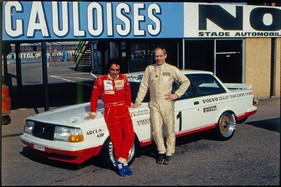
The tears of victory continue...
With a top speed of 260 km/h, the racing version of the Volvo 240 Turbo made the competition look old. And so the winning streak continued that year until October 13, 1985, when Volvo won six of fourteen races and Lidström/Brancatelli proved far superior to the competition in the entire ETC series. In addition, Per Stureson won the DTM after one victory and five podium finishes.
And as if the ETC and DTM weren't enough, Volvo was also victorious in the touring car championships in Finland, Portugal and New Zealand in the same year. In addition, a 240 Turbo won the Scottish Rally Championship in the same year.
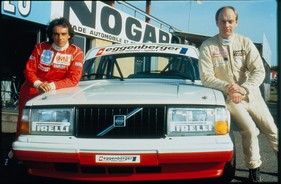
Thirty years have passed since the glorious times when the "flying brick" left all the competition in its wake. Back then, nobody would have expected such success, today it is history.