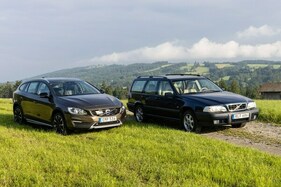
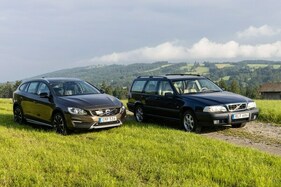
With a sporty, robust design, increased ground clearance and a high level of everyday practicality, Volvo nourishes the dream of limitless driving pleasure: The Cross Country models have stood for adventure on and off paved roads for around a quarter of a century. The development of this completely new all-road vehicle segment, unique in the automotive world at the time, began 25 years ago. The first Volvo V70 XC, introduced in September 1997 for model year 1998, is the ancestor of today's all-roaders such as the Volvo V60 Cross Country and Volvo V90 Cross Country.
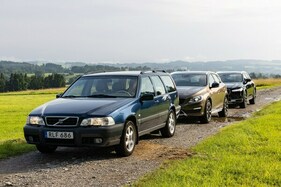
The year 1996 was marked by a spirit of adventure at Volvo: first the premium car manufacturer presented the Volvo 850 AWD, the first Swedish passenger car with permanent all-wheel drive, and then a new vehicle class began to take shape. People with an active lifestyle, who also sometimes travel on unpaved terrain, should no longer have to choose between a family car or an off-road vehicle.
Based on the Volvo 850 AWD, the Volvo V70 XC was created as a model with a robust design, generous space and high functionality.
Growing model family
The 4.72 meter long Volvo V70 XC combined the high level of safety typical of the brand with space for the whole family and a 575 liter trunk. More striking than its (optional) "Duo Tone" two-tone paint finish was its robust character: a visually distinctive radiator grille, more massive bumpers and rustic-looking body cladding met a higher body. To enable the estate to keep its cross-country promise, which was expressed in the "Cross Country" suffix (abbreviated to "XC"), the necessary off-road technology was on board: a high-torque turbo engine, permanent all-wheel drive and viscous coupling guaranteed the best traction even off-road.

Even though the first model generation was not even built for three years, almost 54,000 customers opted for the Allroad model. This success was the starting signal for a steadily growing model family: the second generation followed in 2000 and was simply called the Volvo XC70.

The new estate version, which was in no way inferior to a real SUV, looked even more determined with its plastic planks, while the independent interior emphasized its special role. With the compact Volvo V40 Cross Country, a dynamic hatchback also later rolled onto the road as a "CC" model, and with the Volvo S60 even a genuine four-door model.
The 60s of the first generation
The saloon and its estate counterpart, which is now in its second model generation, doubled the number of Cross Country models. Packaged in a sporty design, the 60 models of the first generation combined the typical underride guard with robust wheel arch extensions and 201 millimetres of ground clearance. The honeycomb-look front grille emphasized the independent character.
As a direct descendant of the Volvo V70 XC, the 4.64-metre-long Volvo V60 Cross Country offered at least as much comfortable space - despite its more dynamic appearance. The occupants also benefited from an extensive range of comfort and safety features: the Performance Sound audio system, dual-zone automatic air conditioning with air quality system and the City Safety emergency braking system came as standard. For propulsion, there was a choice of three diesel engines and a powerful T5 turbocharged petrol engine, which developed between 110 kW (150 hp) and 180 kW (245 hp) with front-wheel or all-wheel drive, manual transmission or Geartronic automatic transmission.
Today's representatives
It is impossible to imagine the current model portfolio without the Cross Country. In addition to the second-generation Volvo V60 Cross Country, there is also the larger Volvo V90 Cross Country, which is even more reminiscent of the original. The all-wheel-drive estate with off-road virtues, which is based on the scalable product architecture (SPA), is even more spacious than its predecessor at just under 4.96 meters.