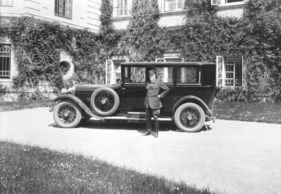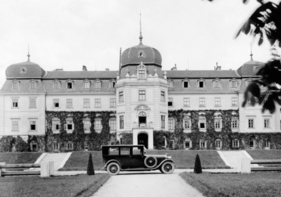
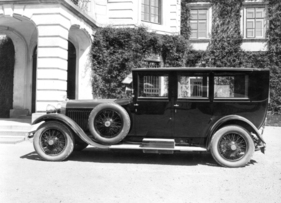
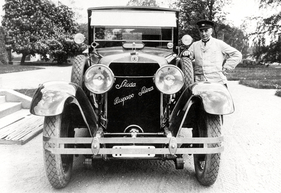
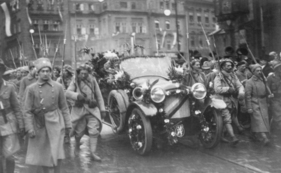
Automobiles from Mladá Boleslav have always been closely linked to the politics and history of their home country. Even Tomáš Garrigue Masaryk, co-founder and first president of Czechoslovakia, returned from exile in a Laurin & Klement from the M 2018 model series. 95 years ago, on May 10, 1926, the delivery bill for his new official car was issued: the prestigious Škoda Hispano-Suiza limousine. The president kept the impressive model with a six-cylinder engine and 6.6-liter displacement in his fleet for almost ten years - longer than any of his other vehicles.
Tomáš Garrigue Masaryk (1850 - 1937) was co-founder and first President of the Czechoslovak Republic from 1918 to 1935. Coming from a poor background, he completed his habilitation in Vienna and became a professor of philosophy in Prague at the age of 32. As a member of parliament in Vienna, he campaigned for the democratization of the monarchy. He gained international recognition for his fight against anti-Semitism, among other things. A deeply devout Protestant, he was committed to the separation of church and state and resolutely opposed totalitarian regimes. During his exile in the First World War, he won the support of his allies for the founding of independent Czechoslovakia before becoming its head of state from 1918 to 1935.
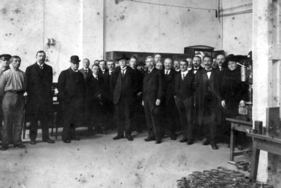
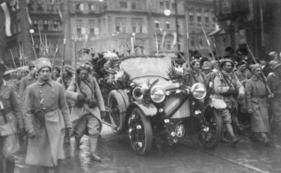
For his triumphal ride through Prague on December 21, 1918, the then 68-year-old Masaryk used an open Laurin & Klement M series model decorated with flowers immediately after his return from exile. On May 3, 1919, Václav Laurin and Václav Klement personally welcomed the President to their automobile factory in Mladá Boleslav. During this tour of the factory, Masaryk, impressed by his stay in America, spoke out in favor of developing affordable vehicles for the general public.
Škoda Hispano-Suiza: almost ten years in the service of Tomáš Garrigue Masaryk
During his political career, Tomáš Garrigue Masaryk relied in particular on official cars from Czech manufacturers, and he used the Škoda Hispano-Suiza for the longest time. The corresponding delivery bill to the Chancellery of the President of the Republic was issued on Monday, May 10, 1926.
President Masaryk used the prestigious limousine until the end of his term of office in December 1935.
The vehicle was the first of a total of 100 examples built at the Škoda Group's Pilsen plant between 1926 and 1929. It was based on the Hispano-Suiza from the Spanish-French company of the same name. The term 'Suiza' refers to the home country of Swiss designer Marc Birkigt, who designed one of the most high-quality and technically innovative automobiles of the time.
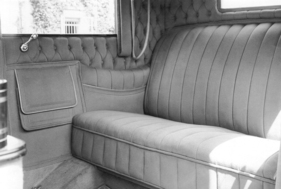
The Chancellery of the President of the Republic ordered the Škoda Hispano-Suiza with chassis number 388 and engine number 683 on June 25, 1925. The vehicle was built to order, presumably by the Brožík company under license from the Parisian coachbuilder Carosserie Kellner Frères. It was a limousine with a glass partition wall between the driver's cabin and the passenger compartment in the rear. As was customary for vehicles in this category at the time, each body was manufactured according to an individual design, many of them in Mladá Boleslav. Some customers also commissioned other manufacturers, for example J. O. Jech, Aero, Pokorný & Beywel, Petera or the well-known Berlin company Erdmann & Rossi.
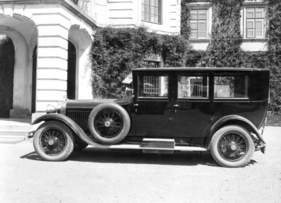
The original license plate number of Tomáš Garrigue Masaryk's official vehicle was 'N-1' before it was replaced by 'P-118' in the 1930s. 'P' stood for Prague. Occasionally, the president also used the license plate "N-XIV-842" to travel incognito. When Tomáš Garrigue Masaryk resigned from office in December 1935 at the age of 85 for health reasons, Škoda took over his official car on March 17, 1936 and brought the vehicle to Mladá Boleslav. Some examples of the Hispano-Suiza have survived to this day, but the whereabouts of the first and best-known of the 100 or so models are unclear.
Cutting-edge technology and outstanding quality
In addition to the prominent names of its buyers, the Škoda Hispano-Suiza's technical features also made it a unique model. Škoda was uncompromising on quality when it came to materials and workmanship: the smooth-running light cast inline petrol engine had six cylinders and a crankshaft with seven bearings. This was made from a 350-kilogram cast part and still weighed 45 kilograms after extensive machining. The 2.7-tonne saloon also had a brake booster: it used the vehicle's kinetic energy and progressively supported the drum brakes to improve the braking power: the more pressure on the pedal, the stronger the effect.
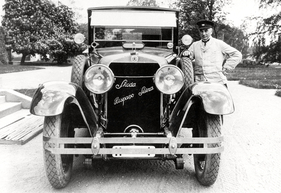
In contrast to the brake boosters commonly used at the time, whose effect depended on the oil pressure or the vacuum in the engine intake line, the braking effect of the Škoda Hispano-Suiza was maintained even when the engine was switched off - an important safety aspect. The in-line six-cylinder engine with technically sophisticated OHC valve control and a displacement of 6,654 cc produced 100 hp and was capable of up to 135 hp (74/99 kW) at 1600 and 3000 rpm respectively. The five-and-a-half meter long saloon reached a top speed of up to 130 km/h with a fuel consumption of 20 to 25 liters per 100 kilometers, which was reasonable for the time.